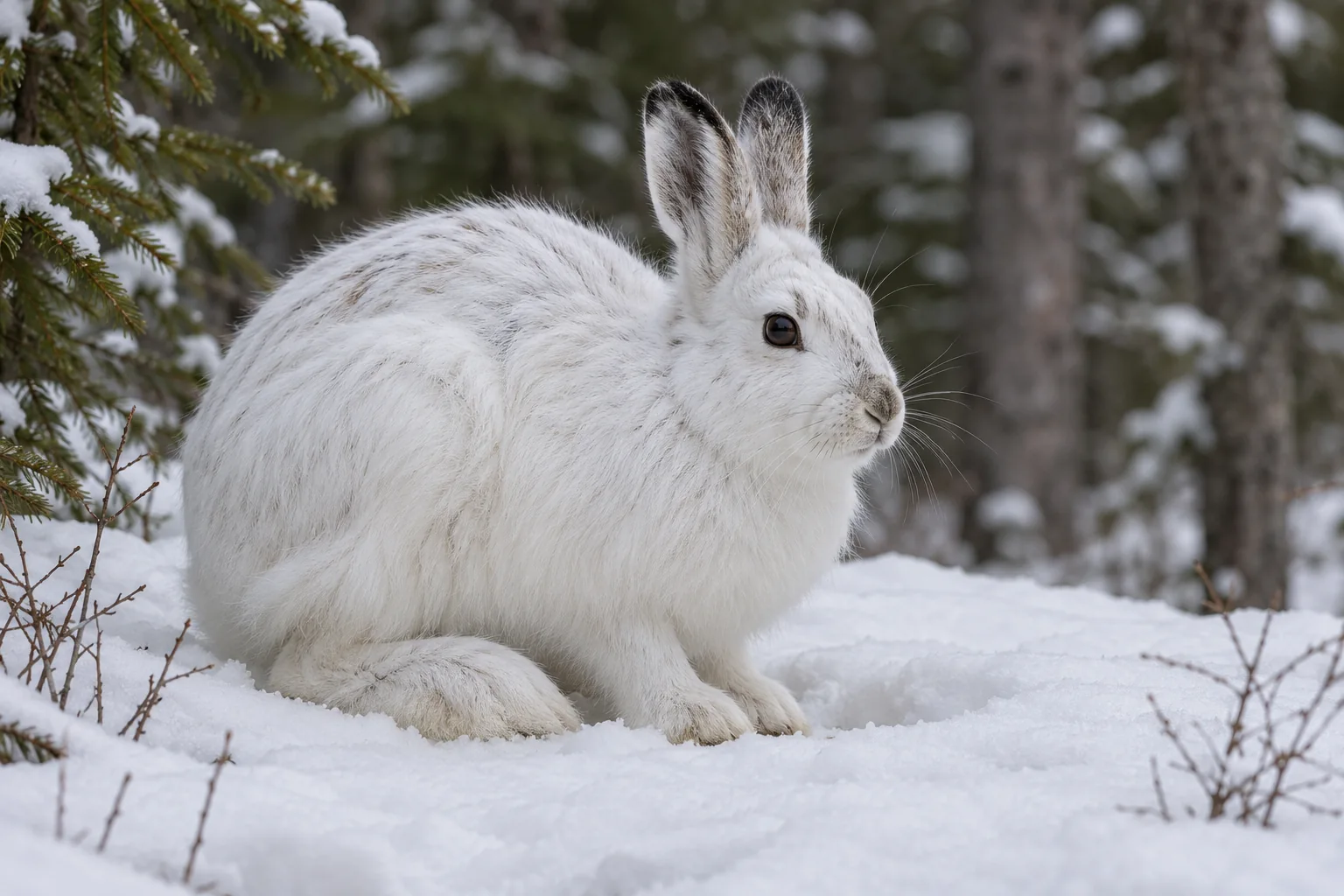
Many snowshoe hares turn white in winter because they shed their summer hairs and grow a different seasonal coat. White fur helps conceal them against snow, while a brown summer coat suits the darker forest floor. The timing is strongly linked to changing day length. Snow touching the animal does not bleach its existing hairs. [1]
This is a gradual molt, so a hare can look patchy while the replacement is underway. It is also a pattern with exceptions: some populations in mild, less snowy regions remain brown through winter. Asking how the coat changes and asking whether every snowshoe hare becomes white are therefore different questions. [1]
New hair replaces the old coat
The visible transformation comes from the coat being renewed. During autumn, dark hairs fall out and white hairs grow in; spring brings another replacement in the opposite direction. The Pennsylvania Game Commission describes a change that progresses across different parts of the animal rather than happening everywhere at once. This explains why intermediate coats can appear mottled or uneven. [3]
Pigmentation is controlled while the new hair is produced. Seasonal light signals influence the animal’s hormonal system and the production of pigment in growing fur. A white winter hair and a brown summer hair are products of different growth conditions. The familiar phrase “changes colour” is useful shorthand, but it can hide the important physical step: shedding one set of hairs and growing another. [3]
Day length provides a seasonal calendar
SUNY ESF’s Adirondack account identifies day length as the main control on the seasonal molt and describes a transition lasting about 70 days. That duration belongs to the species account, rather than a stopwatch rule for every individual throughout North America. Local populations, seasons and individuals can differ. [2]
Day length offers a reliable annual signal even when a particular week is unusually warm or snowy. It helps explain how a coat change can begin before the ground has acquired its lasting winter cover. It also explains the potential problem: the light calendar and the snow calendar need not move together. An animal following a seasonal cue can become white before its surroundings do. [2, 4]
Can a hare adjust when the snow is late?
Researchers studying nearly 200 snowshoe hares at two Montana sites found limited flexibility in matching coat colour to snow conditions. Molt timing differed between sites, but within sites the start of the change was comparatively fixed. The spring transition showed some flexibility in its rate. This supports a strong seasonal schedule without requiring the absolute claim that weather never influences the process. [4]
The researchers also found no evidence that hares systematically changed the studied behaviours to compensate for being the wrong colour. Vegetation cover, season and site mattered to resting and escape behaviour. These are findings from particular populations and observations, not proof that every hare reacts identically. They nevertheless show why an apparently simple solution—just delay the white coat or choose matching ground—cannot be assumed. [4]
Why white helps in a snowy forest
Against a snow-covered background, a mostly white body is less visually conspicuous than a brown one. Rocky Mountain National Park identifies the winter coat and the brown summer coat as seasonal camouflage. That concealment works alongside the animal’s behaviour, rather than replacing it. Hares also spend time still and sheltered, and become more active around dusk, dawn or at night. [7]
Their name refers to another winter adaptation: the large hind feet. Fur on the soles contributes insulation and traction, while the broad feet help support movement across snow. Coat colour, warm fur and effective movement address different parts of winter life. A hare does not survive cold conditions through whiteness alone, and a white coat is not the only feature worth noticing in a winter encounter. [7]
Why some winter coats stay brown
Hinterland Who’s Who describes snowshoe hares that remain brown all year in humid coastal parts of southwestern British Columbia, Washington and Oregon, where snow is less frequent. This regional variation is a useful correction to the idea of an automatic species-wide white winter uniform. A winter-brown hare is not necessarily failing to complete an ordinary white molt. [1]
A 2025 Pennsylvania study adds a more detailed local example. Using photographs of 59 individuals across eight years, the researchers recorded brown bodies, brown-ringed eyes and brown ears in winter. Four hares remained brown-bodied. These observations show how much variation a simple brown-versus-white description can conceal, but they do not establish the prevalence of those traits across the species’ entire range. [5]
The study’s authors discussed possible benefits under inconsistent snow cover and identified questions for further research, including the basis of the variation. Observing a useful-looking trait is not the same as proving its inheritance, its cause or its effect on survival. Keeping those distinctions makes the winter-brown animals more informative, rather than less remarkable. [5]
Does a mismatched coat always reduce survival?
Conspicuousness is only one part of the problem. A study of Yukon hares, published in 2022, found that white animals mismatched with snow-free ground had lower autumn mortality risk in the conditions studied. The authors proposed that winter insulation and reduced energy demands could offset lost camouflage by allowing less foraging time. Their abstract reported no corresponding spring mortality effect. [6]
This result does not make camouflage irrelevant. It shows that the consequences depend on season, temperature, energetic needs and local circumstances. A coat is both part of the animal’s visual appearance and part of its winter physiology. Counting white hares on brown ground therefore cannot, by itself, reveal their fate. [6]
For an observer, the useful clues are the location, the season, the amount of snow and the distribution of white and brown fur. A patchy hare may be midway through a molt; a brown winter hare may reflect regional variation. The seasonal transformation is a coordinated biological process, with enough local complexity to reward a closer look. [2, 5]
Keep exploring
Compare the hare’s changing coat with two other seasonal responses: animal hibernation and autumn leaf colour.
Sources and further reading
Checked November 17, 2026. Species accounts explain the molt; Montana and Pennsylvania studies retain their population scope. The Yukon survival result is summarized from its published abstract and is not treated as a universal prediction for camouflage mismatch.
- Hinterland Who’s Who — Snowshoe Hare
- SUNY College of Environmental Science and Forestry — Snowshoe Hare
- Pennsylvania Game Commission — Snowshoe Hare: molt and pigmentation
- Zimova and colleagues — Snowshoe hares display limited phenotypic plasticity to mismatch in seasonal camouflage (2014)
- Gigliotti and colleagues — Atypical winter coat coloration of snowshoe hares near the southern extent of their range (2025)
- Kennah and colleagues — Coat color mismatch improves survival of a keystone boreal herbivore: Energetic advantages exceed lost camouflage (2022 online; 2023 issue; abstract)
- National Park Service — Snowshoe Hare, Rocky Mountain National Park
Keep exploring.
One remarkable idea at a time—nature, science, history and beyond.
Last updated November 20, 2026.

Barnakle Editorial Team
Barnakle Editorial Team is the collective byline used for Barnakle’s editorial articles. The contributor profile explains the team identity and links to the publication’s editorial policies.
More from the editorial team →