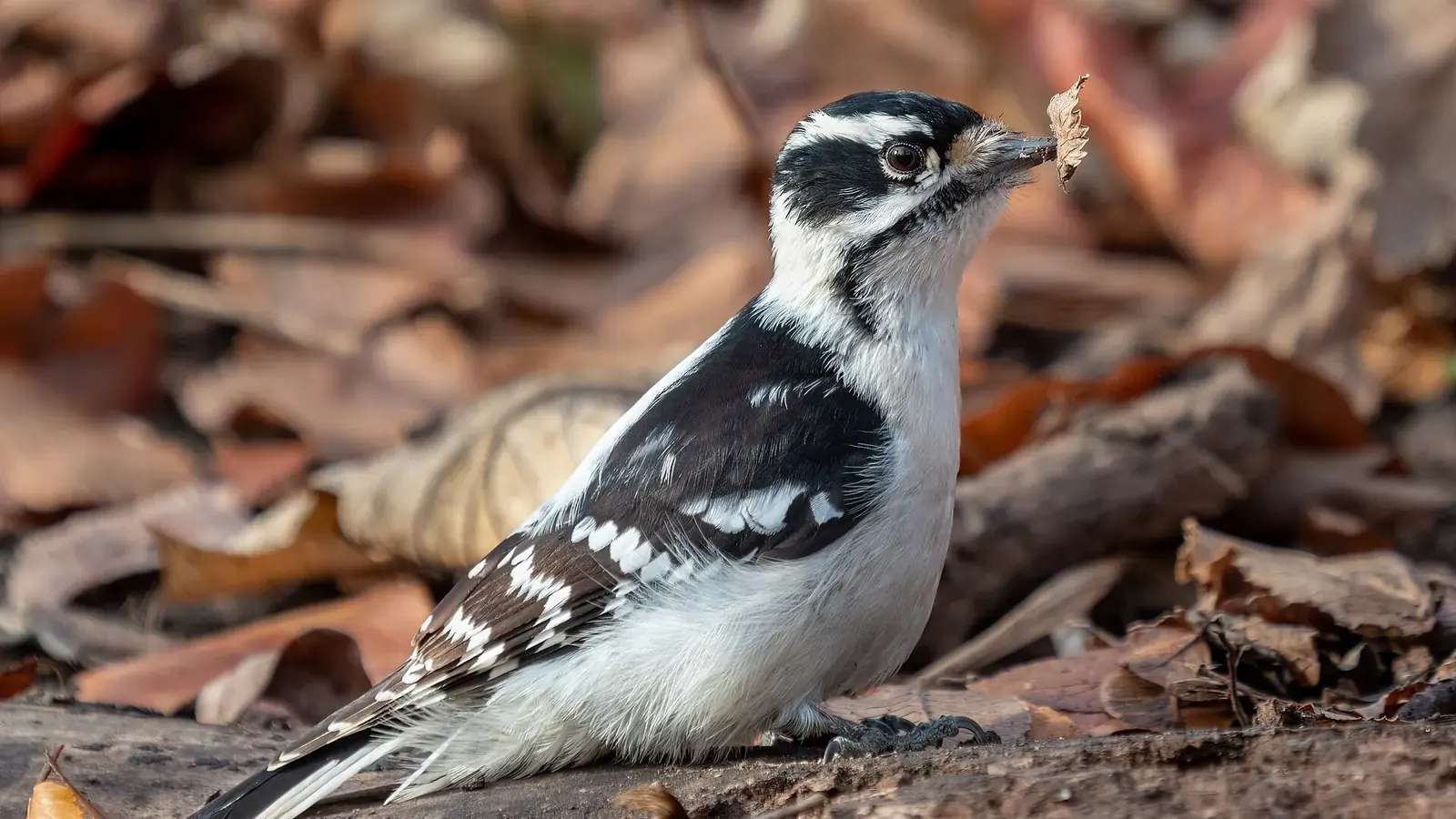
A woodpecker accelerates its head and strikes wood repeatedly while excavating or feeding. The behaviour looks hazardous through a human lens, which has encouraged a familiar explanation: a built-in shock absorber supposedly protects its brain.
A 2022 biomechanical study challenged that account. Measurements and models indicated that the cranial skeleton functions as a stiff hammer, minimising cranial shock absorption rather than relying on it as the main protective mechanism.
Hammering needs efficient energy transfer
To penetrate wood, a bird benefits from transferring the head's motion into the target. A structure that absorbs much of that energy before it reaches the bill would reduce hammering performance.
That creates a testable conflict for the cushioning story. Anatomical features that look potentially compressible are not enough; researchers need to measure whether the skull actually reduces the braincase's deceleration during a strike.
High-speed observations tested the motion
Van Wassenbergh and colleagues quantified impacts in three woodpecker species. Their analysis compared the movement of parts of the head and combined those observations with biomechanical models.
The results supported a stiff cranial system during pecking. The conclusion concerned the mechanism observed and modelled in those birds. It did not mean every tissue is perfectly rigid or that no energy is dissipated anywhere in the animal.
Size changes the physical problem
A bird's head is not a scaled human head subjected to the same motion. Brain dimensions affect how acceleration translates into pressure differences and mechanical stresses. Small size is important to interpreting the study's assessment of injury risk.
The accompanying physiological commentary emphasised that the birds benefit from their size and skull features. Simply applying a human concussion threshold to a bird's measured acceleration would ignore those differences.
Popular explanations need evidence of function
Woodpecker anatomy includes several striking features, but assigning one feature a protective function requires more than pointing it out. The relevant question is whether it changes the mechanics in a way supported by measurements.
This distinction also applies to proposed engineering inspiration. A claim that a helmet copies a woodpecker's shock absorber should be evaluated against evidence that the bird is using such an absorber in the first place.
The finding has boundaries
The study addressed impact mechanics and evaluated risk through models; it was not a lifetime clinical assessment of every woodpecker. It should not be expanded into a claim that birds can never experience brain damage under any circumstances.
The useful correction is narrower and better supported: woodpecker heads can be effective hammers without the skull acting as a protective cushion that absorbs each blow. The example shows why a plausible story about animal adaptation must be checked against what the structure actually does.
Explore a related question
Why Birds See Colors Humans Cannot
Sources and further reading
Keep exploring.
One remarkable idea at a time—nature, science, history and beyond.
Last updated October 27, 2026.

Barnakle Editorial Team
Barnakle Editorial Team is the collective byline used for Barnakle’s editorial articles. The contributor profile explains the team identity and links to the publication’s editorial policies.
More from the editorial team →