
Electric storms and expanding air
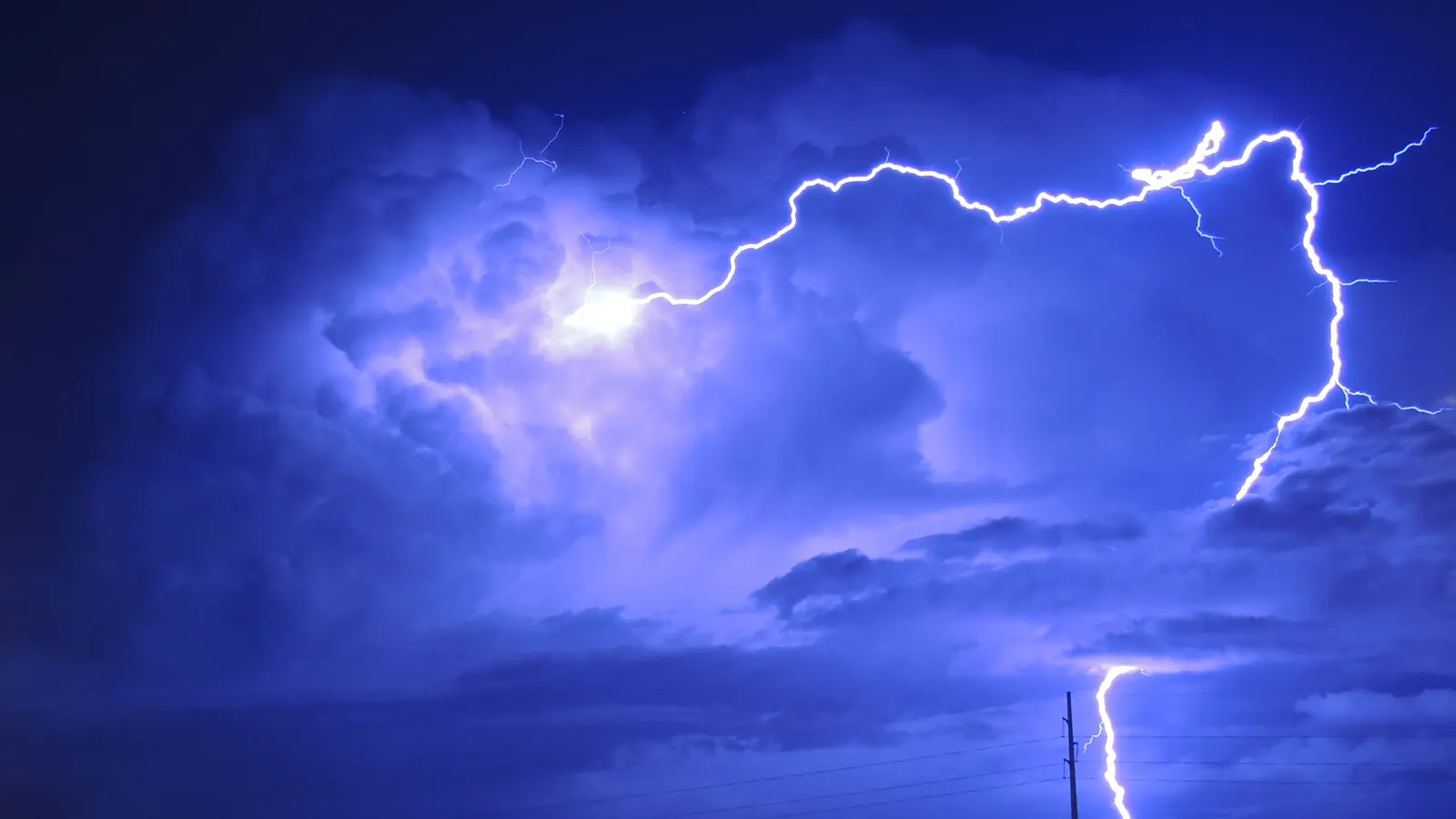
Lightning is a rapid electrical discharge produced when separated charges create an electric field strong enough to break down the insulating air. Thunder is the sound generated when the lightning channel heats surrounding air extremely quickly, producing a pressure wave.
What Causes Lightning and Thunder? is a simple question with a layered answer. The sections below move from the central mechanism to the colours, timing, viewing conditions and misconceptions that generate the most common follow-up questions. Where a simplified classroom explanation leaves out an important qualification, the qualification is included rather than hidden.
The short answer
Collisions among ice particles inside a thunderstorm help separate electrical charge. The resulting electric field can become strong enough to ionize air and open a conducting path. This distinction matters because the familiar appearance is the final result of several linked physical steps, not a single isolated event.
A powerful current then flows through part of that path as lightning. Rapid heating and expansion of air around the channel produce thunder. The mechanism also predicts what should change when one part of the system changes, which makes the account scientifically useful rather than merely descriptive.
For readers asking about the short answer, the practical point is that observations depend on position, timing and conditions. A photograph or brief glance captures only one configuration, whereas the scientific explanation must account for the full range of repeatable appearances. That is why authoritative explanations combine direct observation with models, calibrated instruments and predictions that can be checked independently.
A thunderstorm is a moving electrical system
Strong updrafts carry water droplets and ice upward while heavier particles fall. The cloud contains liquid water, ice crystals, graupel and turbulent air at different temperatures. Researchers test the explanation by comparing measurements made under different geometries, conditions and observing methods.
Collisions exchange charge between particles, though details remain an active research area. Air motion then sorts charged particles into broad regions within the cloud. Scale is important here: processes that happen at the level of atoms or charged particles can create patterns visible across an entire sky.
For readers asking about a thunderstorm is a moving electrical system, the practical point is that observations depend on position, timing and conditions. A photograph or brief glance captures only one configuration, whereas the scientific explanation must account for the full range of repeatable appearances. That is why authoritative explanations combine direct observation with models, calibrated instruments and predictions that can be checked independently.
How charge separates
In a common storm structure, positive charge accumulates high in the cloud and negative charge dominates a lower region. A smaller positive region may form near the cloud base. The mechanism also predicts what should change when one part of the system changes, which makes the account scientifically useful rather than merely descriptive.
The pattern varies from storm to storm and can change rapidly. Charge separation stores electrical energy in the cloud-ground environment. Careful wording prevents a common mistake—confusing what an observer sees with the underlying object or process that produced the view.
For readers asking about how charge separates, the practical point is that observations depend on position, timing and conditions. A photograph or brief glance captures only one configuration, whereas the scientific explanation must account for the full range of repeatable appearances. That is why authoritative explanations combine direct observation with models, calibrated instruments and predictions that can be checked independently.
Electric fields and air breakdown
Ordinary air is a good electrical insulator. A sufficiently intense electric field accelerates free electrons and triggers collisions that create more charged particles. Scale is important here: processes that happen at the level of atoms or charged particles can create patterns visible across an entire sky.
The air becomes partly ionized and therefore more conductive. Lightning develops through branching channels rather than as a single simple spark across the entire distance. This distinction matters because the familiar appearance is the final result of several linked physical steps, not a single isolated event.
For readers asking about electric fields and air breakdown, the practical point is that observations depend on position, timing and conditions. A photograph or brief glance captures only one configuration, whereas the scientific explanation must account for the full range of repeatable appearances. That is why authoritative explanations combine direct observation with models, calibrated instruments and predictions that can be checked independently.
Stepped leaders and streamers
For many cloud-to-ground flashes, a faint negatively charged leader advances downward in short branching steps. Positive streamers may rise from objects and the ground as the leader approaches. Careful wording prevents a common mistake—confusing what an observer sees with the underlying object or process that produced the view.
When a connection forms, the conducting path links cloud charge with the ground. The attachment point cannot be reliably predicted by watching an approaching storm. Researchers test the explanation by comparing measurements made under different geometries, conditions and observing methods.
For readers asking about stepped leaders and streamers, the practical point is that observations depend on position, timing and conditions. A photograph or brief glance captures only one configuration, whereas the scientific explanation must account for the full range of repeatable appearances. That is why authoritative explanations combine direct observation with models, calibrated instruments and predictions that can be checked independently.
The bright return stroke
A large current travels through the established channel and creates the brilliant return stroke. The luminous motion appears extremely fast because the channel is energized in a fraction of a second. This distinction matters because the familiar appearance is the final result of several linked physical steps, not a single isolated event.
Several strokes can reuse a path, making a flash flicker. A flash can also contain complex branches and continuing current. The mechanism also predicts what should change when one part of the system changes, which makes the account scientifically useful rather than merely descriptive.
For readers asking about the bright return stroke, the practical point is that observations depend on position, timing and conditions. A photograph or brief glance captures only one configuration, whereas the scientific explanation must account for the full range of repeatable appearances. That is why authoritative explanations combine direct observation with models, calibrated instruments and predictions that can be checked independently.
Lightning does not always hit the ground
Most lightning occurs within a cloud or between cloud regions. Cloud-to-ground flashes are especially important for public safety and infrastructure. Researchers test the explanation by comparing measurements made under different geometries, conditions and observing methods.
Positive cloud-to-ground lightning can originate from upper positive charge and travel away from the rain core. Lightning can also occur between clouds or from cloud to surrounding air. Scale is important here: processes that happen at the level of atoms or charged particles can create patterns visible across an entire sky.
For readers asking about lightning does not always hit the ground, the practical point is that observations depend on position, timing and conditions. A photograph or brief glance captures only one configuration, whereas the scientific explanation must account for the full range of repeatable appearances. That is why authoritative explanations combine direct observation with models, calibrated instruments and predictions that can be checked independently.
Why lightning produces thunder
Current heats the narrow lightning channel to an extremely high temperature very rapidly. The surrounding air expands explosively and compresses nearby air. The mechanism also predicts what should change when one part of the system changes, which makes the account scientifically useful rather than merely descriptive.
That disturbance begins as a shock wave and weakens into an acoustic wave as it spreads. Thunder is therefore the sound of the channel’s rapid heating, not clouds colliding. Careful wording prevents a common mistake—confusing what an observer sees with the underlying object or process that produced the view.
For readers asking about why lightning produces thunder, the practical point is that observations depend on position, timing and conditions. A photograph or brief glance captures only one configuration, whereas the scientific explanation must account for the full range of repeatable appearances. That is why authoritative explanations combine direct observation with models, calibrated instruments and predictions that can be checked independently.
Why thunder cracks and rumbles
A nearby channel segment can produce a sharp crack because sound paths arrive close together. A long branching channel produces sound from many locations at different distances. Scale is important here: processes that happen at the level of atoms or charged particles can create patterns visible across an entire sky.
Reflections, refraction and terrain spread the arrivals into a rumble. Distant high-frequency sound is absorbed more strongly, leaving lower rolling tones. This distinction matters because the familiar appearance is the final result of several linked physical steps, not a single isolated event.
For readers asking about why thunder cracks and rumbles, the practical point is that observations depend on position, timing and conditions. A photograph or brief glance captures only one configuration, whereas the scientific explanation must account for the full range of repeatable appearances. That is why authoritative explanations combine direct observation with models, calibrated instruments and predictions that can be checked independently.
Why the flash arrives before the sound
Light travels vastly faster than sound through air. The visual signal therefore reaches an observer almost immediately on storm scales. Careful wording prevents a common mistake—confusing what an observer sees with the underlying object or process that produced the view.
Sound takes roughly three seconds to travel one kilometre, with variation from atmospheric conditions. Counting delay can suggest distance, but it is not a reason to remain outdoors. Researchers test the explanation by comparing measurements made under different geometries, conditions and observing methods.
For readers asking about why the flash arrives before the sound, the practical point is that observations depend on position, timing and conditions. A photograph or brief glance captures only one configuration, whereas the scientific explanation must account for the full range of repeatable appearances. That is why authoritative explanations combine direct observation with models, calibrated instruments and predictions that can be checked independently.
Different kinds of lightning
Sheet lightning is usually ordinary lightning whose channel is hidden by cloud. Heat lightning is distant lightning whose thunder is too far away to be heard. This distinction matters because the familiar appearance is the final result of several linked physical steps, not a single isolated event.
Sprites and other transient luminous events occur high above some thunderstorms and involve different atmospheric regions. Volcanic plumes and intense snowstorms can also separate charge and produce lightning. The mechanism also predicts what should change when one part of the system changes, which makes the account scientifically useful rather than merely descriptive.
For readers asking about different kinds of lightning, the practical point is that observations depend on position, timing and conditions. A photograph or brief glance captures only one configuration, whereas the scientific explanation must account for the full range of repeatable appearances. That is why authoritative explanations combine direct observation with models, calibrated instruments and predictions that can be checked independently.
Can lightning strike the same place twice?
Tall structures are struck repeatedly when storm conditions support electrical breakdown. Protection systems provide a preferred conductive route and grounding; they do not repel storms. Researchers test the explanation by comparing measurements made under different geometries, conditions and observing methods.
Local height, shape and field enhancement affect attachment. The familiar saying that lightning never strikes twice is false. Scale is important here: processes that happen at the level of atoms or charged particles can create patterns visible across an entire sky.
For readers asking about can lightning strike the same place twice?, the practical point is that observations depend on position, timing and conditions. A photograph or brief glance captures only one configuration, whereas the scientific explanation must account for the full range of repeatable appearances. That is why authoritative explanations combine direct observation with models, calibrated instruments and predictions that can be checked independently.
How lightning is detected
Ground networks compare radio signals from a flash at multiple stations to estimate location and time. Satellites can map optical flashes across large areas, including regions with sparse ground instruments. The mechanism also predicts what should change when one part of the system changes, which makes the account scientifically useful rather than merely descriptive.
Weather radar observes precipitation and storm structure rather than directly measuring every lightning channel. Combining systems helps forecasters follow storm development. Careful wording prevents a common mistake—confusing what an observer sees with the underlying object or process that produced the view.
For readers asking about how lightning is detected, the practical point is that observations depend on position, timing and conditions. A photograph or brief glance captures only one configuration, whereas the scientific explanation must account for the full range of repeatable appearances. That is why authoritative explanations combine direct observation with models, calibrated instruments and predictions that can be checked independently.
Lightning safety
If thunder is audible, lightning is close enough to pose danger. A substantial enclosed building or hard-topped vehicle provides safer shelter than an open structure. Scale is important here: processes that happen at the level of atoms or charged particles can create patterns visible across an entire sky.
People should wait at least 30 minutes after the last thunder before resuming outdoor activity, following official guidance. Trees, open fields, water and small shelters do not provide reliable protection. This distinction matters because the familiar appearance is the final result of several linked physical steps, not a single isolated event.
For readers asking about lightning safety, the practical point is that observations depend on position, timing and conditions. A photograph or brief glance captures only one configuration, whereas the scientific explanation must account for the full range of repeatable appearances. That is why authoritative explanations combine direct observation with models, calibrated instruments and predictions that can be checked independently.
What scientists still study
Researchers investigate the precise microphysics of charge transfer in mixed-phase clouds. High-speed cameras and radio arrays reveal channel development in increasing detail. Careful wording prevents a common mistake—confusing what an observer sees with the underlying object or process that produced the view.
Aircraft, balloons and satellites measure fields, particles and flashes at different scales. A mature explanation of lightning includes both established electrical principles and uncertainties in storm-scale initiation. Researchers test the explanation by comparing measurements made under different geometries, conditions and observing methods.
For readers asking about what scientists still study, the practical point is that observations depend on position, timing and conditions. A photograph or brief glance captures only one configuration, whereas the scientific explanation must account for the full range of repeatable appearances. That is why authoritative explanations combine direct observation with models, calibrated instruments and predictions that can be checked independently.
Frequently asked questions
What is the simplest correct explanation?
Lightning is a rapid electrical discharge produced when separated charges create an electric field strong enough to break down the insulating air. Thunder is the sound generated when the lightning channel heats surrounding air extremely quickly, producing a pressure wave.
Can the appearance change without the underlying physics changing?
Yes. Viewing angle, distance, atmospheric conditions, brightness, local surroundings and the sensitivity of human vision or cameras can change what is perceived even when the governing physical process remains the same.
Why do photographs sometimes look different from direct observation?
Cameras collect and process light differently from the human visual system. Exposure time, sensor response, white balance, contrast and computational processing can reveal faint structure or amplify colour, so an image should be interpreted with its capture method in mind.
How do scientists know the explanation is reliable?
The explanation connects independently measured quantities and makes predictions across changing conditions. Spectroscopy, imaging, timing, field measurements, laboratory physics and observations from different locations provide checks with different strengths and limitations.
What should a reader remember?
Keep the geometry and the energy pathway in view. Ask where the light or sound began, what it interacted with, how it travelled and why the observer received that particular signal at that particular time.
Key takeaways
- Lightning is a rapid electrical discharge produced when separated charges create an electric field strong enough to break down the insulating air. Thunder is the sound generated when the lightning channel heats surrounding air extremely quickly, producing a pressure wave.
- The observed appearance is evidence of a physical process, but it is also shaped by viewing geometry and detection.
- Authoritative measurements support the central mechanism while leaving room to refine details.
- Related phenomena may share part of the physics without being the same event.
Continue exploring
What researchers will test next
Progress now depends on measurements that connect controlled experiments with the complexity of the wider world. Researchers need observations collected across different locations, instruments and timescales, with methods described clearly enough for independent teams to repeat them. Larger samples can reveal whether an apparent pattern is widespread or driven by a few unusual cases. Longer records can separate temporary variation from a durable change.
New instruments may improve precision, but precision alone does not guarantee a better explanation. Scientists must still test alternative causes, disclose uncertainty and check whether an analysis gives the same answer when reasonable assumptions change. Open data and carefully documented methods allow other researchers to find errors, reproduce results and combine evidence that was gathered for different purposes.
The most useful future studies will make competing explanations face distinct predictions. When several independent tests agree, confidence can grow. When they disagree, the mismatch becomes evidence about what the original account was missing. Barnakle treats this process as a strength of science: conclusions can be reliable without being final, and responsible reporting should explain both what is known and what observation could change the picture.
Sources and further reading
Keep exploring.
One remarkable idea at a time—nature, science, history and beyond.
Sources and further reading
Barnakle uses credible primary and authoritative sources wherever possible.
- NOAA — What Causes Lightning and Thunder?
- https://www.nesdis.noaa.gov/about/k-12-education/severe-weather/what-causes-lightning-and-thunder
- NOAA NSSL — Lightning Basics
- https://www.nssl.noaa.gov/education/svrwx101/lightning/
- NOAA JetStream — How Lightning Is Created
- https://www.noaa.gov/jetstream/lightning/how-lightning-is-created
- NOAA — Lightning Safety
- https://www.noaa.gov/jetstream/lightning/lightning-safety
Last reviewed September 24, 2026.

Barnakle Editorial Team
A member of the Barnakle editorial team, exploring remarkable ideas with clarity, curiosity and care.
More from this author →