
Pigments and tunable nanocrystals reshape the light reflected by living skin
The short answer
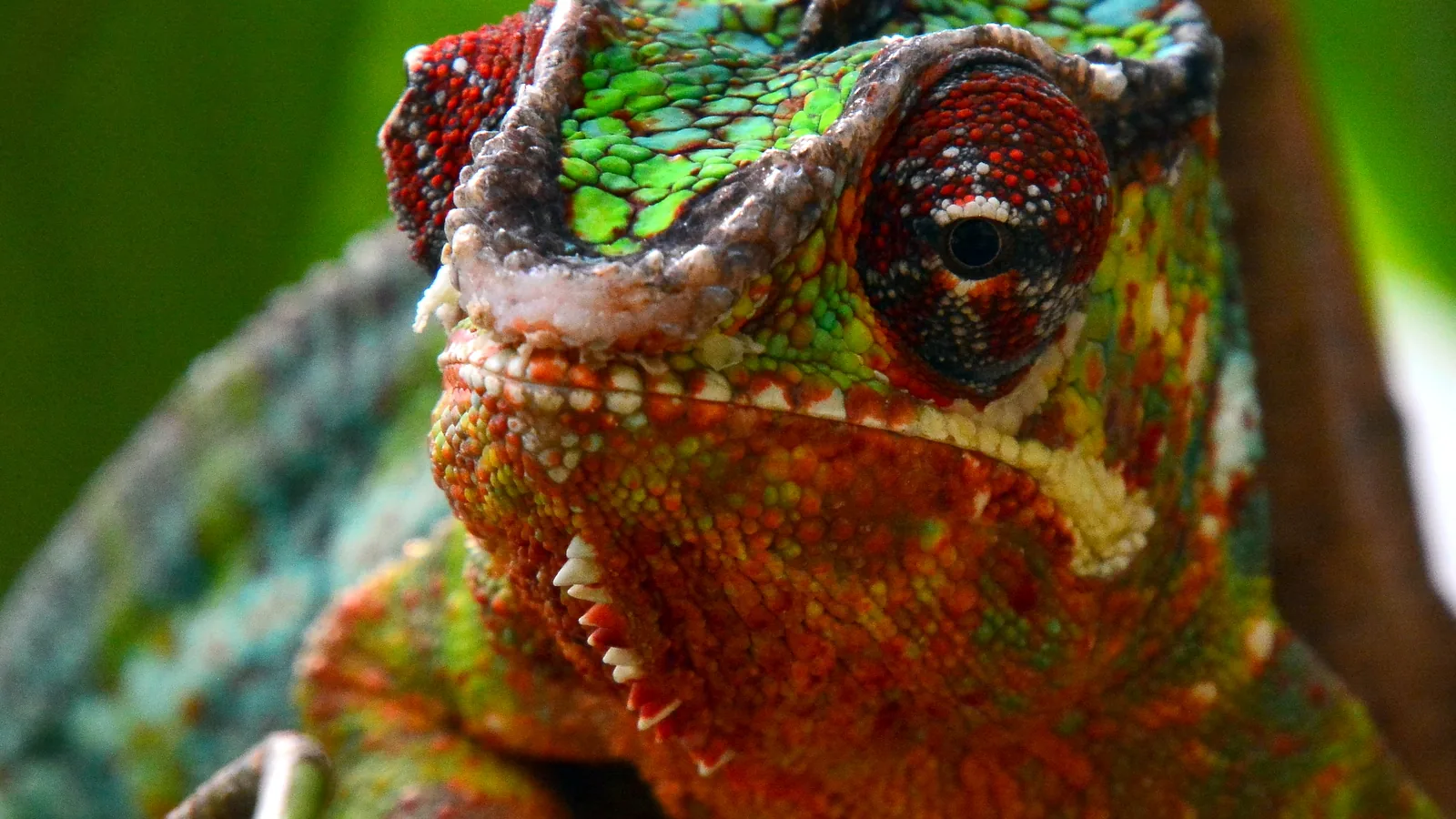
Chameleons change colour by controlling specialized skin cells. Pigment-bearing chromatophores alter darkness and pattern, while iridophores reflect light from ordered guanine nanocrystals. In panther chameleons, changing the spacing between those crystals shifts reflected wavelengths. Colour communicates social state, supports temperature control and can aid camouflage, but it is not instant perfect background matching.
A chameleon’s display is a layered optical system rather than paint moving across the skin. Light passes through yellow and red pigment cells, interacts with reflective structures and is modified by darker melanin below. Hormones, nerves and cell mechanics coordinate a visible response to rivals, mates, temperature and stress.
Skin contains several cell layers
Chromatophores occupy different depths and contain pigments or reflective structures. Their combined optical effects create colours that no single layer could produce alone.
Understanding Skin contains several cell layers requires separating the immediate physical mechanism from the conditions that make it stronger, weaker or easier to observe. Researchers measure those variables independently, compare natural examples and test whether the same explanation predicts a new result. This approach turns a plausible story into an evidence-based account.
The evidence for Skin contains several cell layers comes from methods that fail in different ways. Direct observation establishes what occurs, instruments quantify timing or structure, experiments isolate candidate causes and models test whether known rules reproduce the pattern. Agreement across those methods is more persuasive than repetition of one dramatic example.
Context also matters for Skin contains several cell layers. Scale, species, location, temperature, geometry and measurement limits can change the result without overturning the underlying mechanism. Careful reporting preserves that variation, states uncertainty and prevents a useful explanation from becoming an exaggerated universal rule.
Xanthophores add yellow and red
Upper cells contain carotenoids and pteridines that absorb and reflect selected wavelengths. Their pigments combine with structural blue reflection to produce many greens and mixed hues.
Understanding Xanthophores add yellow and red requires separating the immediate physical mechanism from the conditions that make it stronger, weaker or easier to observe. Researchers measure those variables independently, compare natural examples and test whether the same explanation predicts a new result. This approach turns a plausible story into an evidence-based account.
The evidence for Xanthophores add yellow and red comes from methods that fail in different ways. Direct observation establishes what occurs, instruments quantify timing or structure, experiments isolate candidate causes and models test whether known rules reproduce the pattern. Agreement across those methods is more persuasive than repetition of one dramatic example.
Context also matters for Xanthophores add yellow and red. Scale, species, location, temperature, geometry and measurement limits can change the result without overturning the underlying mechanism. Careful reporting preserves that variation, states uncertainty and prevents a useful explanation from becoming an exaggerated universal rule.
Iridophores create structural colour
Iridophores contain guanine crystals with a refractive index different from surrounding cytoplasm. Regular spacing makes certain wavelengths reinforce through optical interference.
Understanding Iridophores create structural colour requires separating the immediate physical mechanism from the conditions that make it stronger, weaker or easier to observe. Researchers measure those variables independently, compare natural examples and test whether the same explanation predicts a new result. This approach turns a plausible story into an evidence-based account.
The evidence for Iridophores create structural colour comes from methods that fail in different ways. Direct observation establishes what occurs, instruments quantify timing or structure, experiments isolate candidate causes and models test whether known rules reproduce the pattern. Agreement across those methods is more persuasive than repetition of one dramatic example.
Context also matters for Iridophores create structural colour. Scale, species, location, temperature, geometry and measurement limits can change the result without overturning the underlying mechanism. Careful reporting preserves that variation, states uncertainty and prevents a useful explanation from becoming an exaggerated universal rule.
Crystal spacing can change
In panther chameleons, relaxed males have more closely spaced crystals and reflect shorter wavelengths. Excitement expands the lattice, shifting reflection toward yellow, orange and red.
Understanding Crystal spacing can change requires separating the immediate physical mechanism from the conditions that make it stronger, weaker or easier to observe. Researchers measure those variables independently, compare natural examples and test whether the same explanation predicts a new result. This approach turns a plausible story into an evidence-based account.
The evidence for Crystal spacing can change comes from methods that fail in different ways. Direct observation establishes what occurs, instruments quantify timing or structure, experiments isolate candidate causes and models test whether known rules reproduce the pattern. Agreement across those methods is more persuasive than repetition of one dramatic example.
Context also matters for Crystal spacing can change. Scale, species, location, temperature, geometry and measurement limits can change the result without overturning the underlying mechanism. Careful reporting preserves that variation, states uncertainty and prevents a useful explanation from becoming an exaggerated universal rule.
Melanophores control brightness
Deeper cells distribute or concentrate melanin-containing organelles. Moving dark pigment changes how much light is absorbed and can strengthen patterns or darken the animal.
Understanding Melanophores control brightness requires separating the immediate physical mechanism from the conditions that make it stronger, weaker or easier to observe. Researchers measure those variables independently, compare natural examples and test whether the same explanation predicts a new result. This approach turns a plausible story into an evidence-based account.
The evidence for Melanophores control brightness comes from methods that fail in different ways. Direct observation establishes what occurs, instruments quantify timing or structure, experiments isolate candidate causes and models test whether known rules reproduce the pattern. Agreement across those methods is more persuasive than repetition of one dramatic example.
Context also matters for Melanophores control brightness. Scale, species, location, temperature, geometry and measurement limits can change the result without overturning the underlying mechanism. Careful reporting preserves that variation, states uncertainty and prevents a useful explanation from becoming an exaggerated universal rule.
Communication is a major function
Males display vivid colours toward rivals and receptive females. Pattern, speed and intensity convey identity, motivation and condition before physical combat becomes necessary.
Understanding Communication is a major function requires separating the immediate physical mechanism from the conditions that make it stronger, weaker or easier to observe. Researchers measure those variables independently, compare natural examples and test whether the same explanation predicts a new result. This approach turns a plausible story into an evidence-based account.
The evidence for Communication is a major function comes from methods that fail in different ways. Direct observation establishes what occurs, instruments quantify timing or structure, experiments isolate candidate causes and models test whether known rules reproduce the pattern. Agreement across those methods is more persuasive than repetition of one dramatic example.
Context also matters for Communication is a major function. Scale, species, location, temperature, geometry and measurement limits can change the result without overturning the underlying mechanism. Careful reporting preserves that variation, states uncertainty and prevents a useful explanation from becoming an exaggerated universal rule.
Temperature influences colour
A darker surface can absorb more solar radiation, while a lighter state may reduce heating. Chameleons combine colour with posture, orientation, shade seeking and movement.
Understanding Temperature influences colour requires separating the immediate physical mechanism from the conditions that make it stronger, weaker or easier to observe. Researchers measure those variables independently, compare natural examples and test whether the same explanation predicts a new result. This approach turns a plausible story into an evidence-based account.
The evidence for Temperature influences colour comes from methods that fail in different ways. Direct observation establishes what occurs, instruments quantify timing or structure, experiments isolate candidate causes and models test whether known rules reproduce the pattern. Agreement across those methods is more persuasive than repetition of one dramatic example.
Context also matters for Temperature influences colour. Scale, species, location, temperature, geometry and measurement limits can change the result without overturning the underlying mechanism. Careful reporting preserves that variation, states uncertainty and prevents a useful explanation from becoming an exaggerated universal rule.
Camouflage is real but limited
Species often resemble the colours and texture range of their habitats, and changes can reduce contrast. They do not sample any background and reproduce it with unlimited precision.
Understanding Camouflage is real but limited requires separating the immediate physical mechanism from the conditions that make it stronger, weaker or easier to observe. Researchers measure those variables independently, compare natural examples and test whether the same explanation predicts a new result. This approach turns a plausible story into an evidence-based account.
The evidence for Camouflage is real but limited comes from methods that fail in different ways. Direct observation establishes what occurs, instruments quantify timing or structure, experiments isolate candidate causes and models test whether known rules reproduce the pattern. Agreement across those methods is more persuasive than repetition of one dramatic example.
Context also matters for Camouflage is real but limited. Scale, species, location, temperature, geometry and measurement limits can change the result without overturning the underlying mechanism. Careful reporting preserves that variation, states uncertainty and prevents a useful explanation from becoming an exaggerated universal rule.
Stress can alter appearance
Handling, predators, illness and social defeat can produce darker or high-contrast states. A colour cannot be interpreted reliably without species, body region and behavioural context.
Understanding Stress can alter appearance requires separating the immediate physical mechanism from the conditions that make it stronger, weaker or easier to observe. Researchers measure those variables independently, compare natural examples and test whether the same explanation predicts a new result. This approach turns a plausible story into an evidence-based account.
The evidence for Stress can alter appearance comes from methods that fail in different ways. Direct observation establishes what occurs, instruments quantify timing or structure, experiments isolate candidate causes and models test whether known rules reproduce the pattern. Agreement across those methods is more persuasive than repetition of one dramatic example.
Context also matters for Stress can alter appearance. Scale, species, location, temperature, geometry and measurement limits can change the result without overturning the underlying mechanism. Careful reporting preserves that variation, states uncertainty and prevents a useful explanation from becoming an exaggerated universal rule.
Vision guides the display
Chameleons have independently moving eyes and strong colour vision. A display evolves for the visual system and lighting conditions of the receiver as well as the physiology of the sender.
Understanding Vision guides the display requires separating the immediate physical mechanism from the conditions that make it stronger, weaker or easier to observe. Researchers measure those variables independently, compare natural examples and test whether the same explanation predicts a new result. This approach turns a plausible story into an evidence-based account.
The evidence for Vision guides the display comes from methods that fail in different ways. Direct observation establishes what occurs, instruments quantify timing or structure, experiments isolate candidate causes and models test whether known rules reproduce the pattern. Agreement across those methods is more persuasive than repetition of one dramatic example.
Context also matters for Vision guides the display. Scale, species, location, temperature, geometry and measurement limits can change the result without overturning the underlying mechanism. Careful reporting preserves that variation, states uncertainty and prevents a useful explanation from becoming an exaggerated universal rule.
Deeper iridophores may manage heat
A second iridophore layer in panther chameleons reflects a broad range of light, especially near-infrared wavelengths. Researchers propose that it helps protect against solar heating.
Understanding Deeper iridophores may manage heat requires separating the immediate physical mechanism from the conditions that make it stronger, weaker or easier to observe. Researchers measure those variables independently, compare natural examples and test whether the same explanation predicts a new result. This approach turns a plausible story into an evidence-based account.
The evidence for Deeper iridophores may manage heat comes from methods that fail in different ways. Direct observation establishes what occurs, instruments quantify timing or structure, experiments isolate candidate causes and models test whether known rules reproduce the pattern. Agreement across those methods is more persuasive than repetition of one dramatic example.
Context also matters for Deeper iridophores may manage heat. Scale, species, location, temperature, geometry and measurement limits can change the result without overturning the underlying mechanism. Careful reporting preserves that variation, states uncertainty and prevents a useful explanation from becoming an exaggerated universal rule.
Species use different mechanisms
The crystal-spacing discovery is powerful but should not be pasted onto every chameleon. Pigments, structures and control pathways vary across a diverse family.
Understanding Species use different mechanisms requires separating the immediate physical mechanism from the conditions that make it stronger, weaker or easier to observe. Researchers measure those variables independently, compare natural examples and test whether the same explanation predicts a new result. This approach turns a plausible story into an evidence-based account.
The evidence for Species use different mechanisms comes from methods that fail in different ways. Direct observation establishes what occurs, instruments quantify timing or structure, experiments isolate candidate causes and models test whether known rules reproduce the pattern. Agreement across those methods is more persuasive than repetition of one dramatic example.
Context also matters for Species use different mechanisms. Scale, species, location, temperature, geometry and measurement limits can change the result without overturning the underlying mechanism. Careful reporting preserves that variation, states uncertainty and prevents a useful explanation from becoming an exaggerated universal rule.
Common misconceptions
Chameleons do not change colour simply to copy whatever they touch, and emotion is not the only control. Their available palette is constrained by anatomy. Social signalling, temperature, light and stress often explain dramatic changes better than the background alone.
A concise explanation is valuable only when it preserves the causal chain. It becomes misleading when it substitutes a memorable label for a mechanism, confuses association with cause or extends evidence beyond the conditions actually studied.
How scientists know
Researchers combine high-speed photography, spectrometry, skin histology, electron microscopy and optical modelling. They compare relaxed and excited animals, measure crystal spacing and calculate which wavelengths the observed lattice should reflect. Behavioural experiments connect the physical colour to its social function.
No single measurement carries the conclusion. Observations, experiments, physical theory and repeated records provide independent checks, while disagreement points to an uncontrolled variable or a question that still needs a better test.
Frequently asked questions
Can a chameleon become any colour?
No. Each species and individual is limited by its pigments, reflective structures and patterns.
How fast can colour change occur?
Visible shifts can occur within seconds to minutes, depending on species, state and body region.
Are females colourful too?
Yes, although patterns and signalling roles differ widely among species and reproductive states.
Does changing colour hurt?
Normal physiological colour change is reversible cell regulation, not skin injury or repeated shedding.
Why are guanine crystals reflective?
Their refractive index and orderly spacing create interference that strengthens selected wavelengths.
Key takeaways
- Chameleon colour comes from layered pigment and structural cells.
- Iridophore nanocrystal spacing can tune reflected wavelengths.
- Social signalling is often more important than perfect camouflage.
- Mechanisms and meanings differ among species.
Continue exploring
Sources and further reading
Keep exploring.
One remarkable idea at a time—nature, science, history and beyond.
Sources and further reading
Barnakle uses credible primary and authoritative sources wherever possible.
- Nature Communications — Photonic crystals cause active colour change
- https://www.nature.com/articles/ncomms7368
- PubMed — Photonic crystals in chameleons
- https://pubmed.ncbi.nlm.nih.gov/25757068/
- PMC full text — Active colour change
- https://pmc.ncbi.nlm.nih.gov/articles/PMC4366488/
- Nature Communications — Bio-inspired colour systems
- https://www.nature.com/articles/s41467-021-24916-w
Last reviewed October 3, 2026.

Barnakle Editorial Team
A member of the Barnakle editorial team, exploring remarkable ideas with clarity, curiosity and care.
More from this author →