

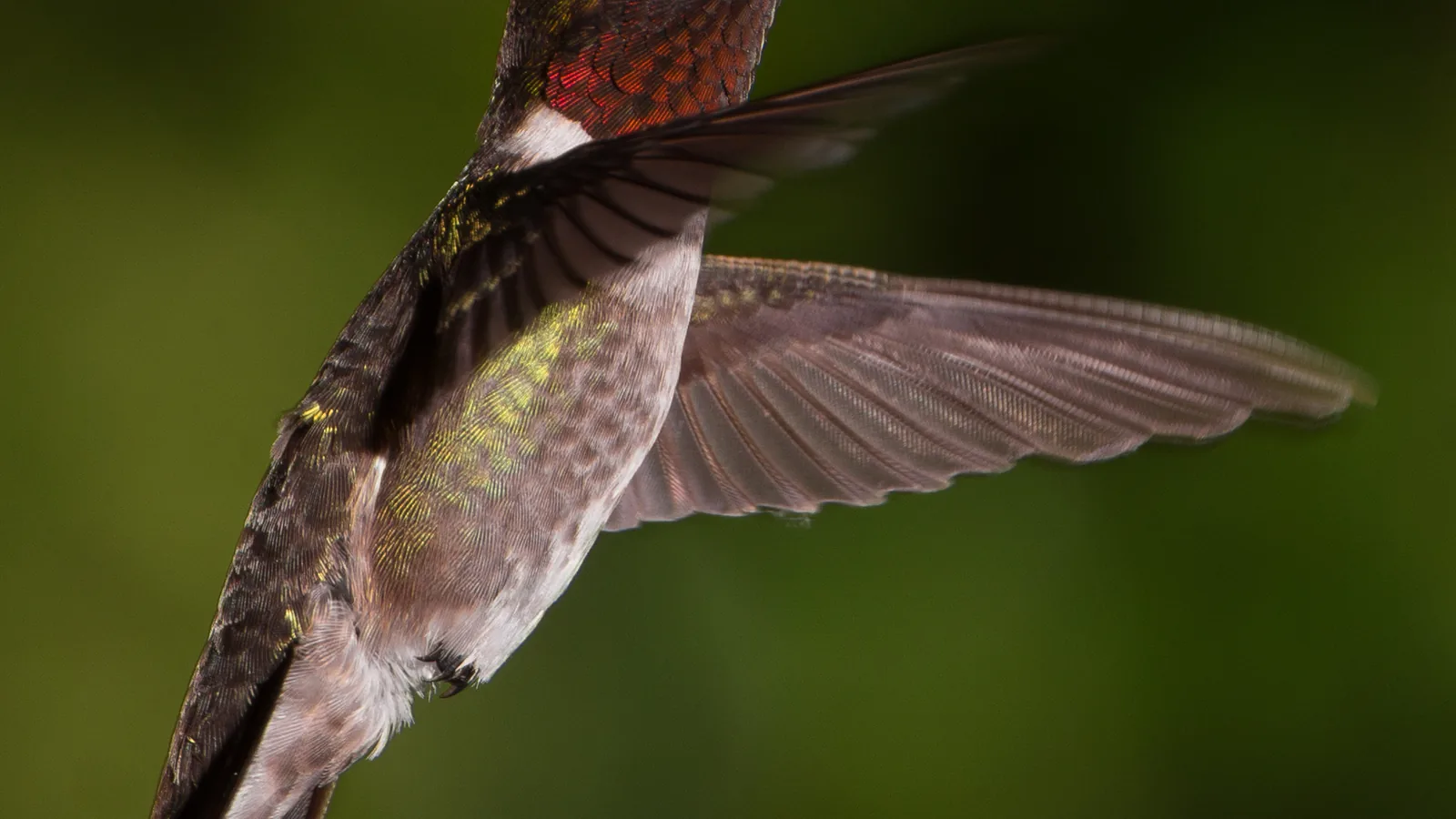
A rotating shoulder and continuously reversing wings generate lift through almost the entire stroke
The short answer
Hummingbirds hover by sweeping their wings back and forth in a flattened figure-eight pattern while rotating them at the shoulder. Unlike most birds, they generate substantial lift during both the downstroke and upstroke. Rapid wingbeats, powerful flight muscles, flexible joints, precise visual control and extremely high metabolism keep the body nearly fixed beside a flower.
Hovering demands continuous support because forward speed cannot push air over a fixed wing. A hummingbird instead accelerates air downward with every wingbeat. Its flight combines bird anatomy with aerodynamic features often associated with insects, yet it remains a distinct vertebrate solution built around feathers, a rotating humerus and enlarged chest muscles.
The shoulder permits extreme rotation
A ball-and-socket shoulder and mobile wing skeleton let the wing reverse orientation between half-strokes. This rotation keeps the aerodynamic force pointed mostly upward.
Understanding The shoulder permits extreme rotation requires separating the immediate mechanism from the conditions that make it stronger, weaker or easier to observe. Researchers measure those variables independently, compare natural examples and test whether the same explanation predicts new results. This turns a plausible story into an evidence-based account.
The evidence for The shoulder permits extreme rotation comes from methods that fail in different ways. Direct observation establishes what occurs, instruments quantify timing or structure, experiments isolate candidate causes and models test whether known rules reproduce the pattern. Agreement across methods is more persuasive than repetition of one memorable example.
Context also matters for The shoulder permits extreme rotation. Scale, species, location, temperature, geometry and measurement limits can change the result without overturning the underlying process. Careful reporting preserves that variation, states uncertainty and prevents a useful explanation from becoming an exaggerated universal rule.
Both half-strokes support weight
The downstroke generally provides more lift, but the inverted wing also generates substantial force on the upstroke. That balance separates hummingbirds from birds that hover only briefly.
Understanding Both half-strokes support weight requires separating the immediate mechanism from the conditions that make it stronger, weaker or easier to observe. Researchers measure those variables independently, compare natural examples and test whether the same explanation predicts new results. This turns a plausible story into an evidence-based account.
The evidence for Both half-strokes support weight comes from methods that fail in different ways. Direct observation establishes what occurs, instruments quantify timing or structure, experiments isolate candidate causes and models test whether known rules reproduce the pattern. Agreement across methods is more persuasive than repetition of one memorable example.
Context also matters for Both half-strokes support weight. Scale, species, location, temperature, geometry and measurement limits can change the result without overturning the underlying process. Careful reporting preserves that variation, states uncertainty and prevents a useful explanation from becoming an exaggerated universal rule.
The wingtip traces a shallow figure eight
Viewed relative to the body, the wing sweeps forward and backward with twisting at reversal. The exact path changes with species, speed, wind and load.
Understanding The wingtip traces a shallow figure eight requires separating the immediate mechanism from the conditions that make it stronger, weaker or easier to observe. Researchers measure those variables independently, compare natural examples and test whether the same explanation predicts new results. This turns a plausible story into an evidence-based account.
The evidence for The wingtip traces a shallow figure eight comes from methods that fail in different ways. Direct observation establishes what occurs, instruments quantify timing or structure, experiments isolate candidate causes and models test whether known rules reproduce the pattern. Agreement across methods is more persuasive than repetition of one memorable example.
Context also matters for The wingtip traces a shallow figure eight. Scale, species, location, temperature, geometry and measurement limits can change the result without overturning the underlying process. Careful reporting preserves that variation, states uncertainty and prevents a useful explanation from becoming an exaggerated universal rule.
Leading-edge vortices strengthen lift
At high angles of attack, a rotating vortex can remain attached near the wing’s leading edge. This low-pressure structure helps a small flapping wing generate force without behaving like a conventional airplane wing.
Understanding Leading-edge vortices strengthen lift requires separating the immediate mechanism from the conditions that make it stronger, weaker or easier to observe. Researchers measure those variables independently, compare natural examples and test whether the same explanation predicts new results. This turns a plausible story into an evidence-based account.
The evidence for Leading-edge vortices strengthen lift comes from methods that fail in different ways. Direct observation establishes what occurs, instruments quantify timing or structure, experiments isolate candidate causes and models test whether known rules reproduce the pattern. Agreement across methods is more persuasive than repetition of one memorable example.
Context also matters for Leading-edge vortices strengthen lift. Scale, species, location, temperature, geometry and measurement limits can change the result without overturning the underlying process. Careful reporting preserves that variation, states uncertainty and prevents a useful explanation from becoming an exaggerated universal rule.
Wingbeat frequency is high but variable
Many hummingbirds beat tens of times per second. Smaller species often cycle faster, while larger birds use greater wing area and force per stroke.
Understanding Wingbeat frequency is high but variable requires separating the immediate mechanism from the conditions that make it stronger, weaker or easier to observe. Researchers measure those variables independently, compare natural examples and test whether the same explanation predicts new results. This turns a plausible story into an evidence-based account.
The evidence for Wingbeat frequency is high but variable comes from methods that fail in different ways. Direct observation establishes what occurs, instruments quantify timing or structure, experiments isolate candidate causes and models test whether known rules reproduce the pattern. Agreement across methods is more persuasive than repetition of one memorable example.
Context also matters for Wingbeat frequency is high but variable. Scale, species, location, temperature, geometry and measurement limits can change the result without overturning the underlying process. Careful reporting preserves that variation, states uncertainty and prevents a useful explanation from becoming an exaggerated universal rule.
Large chest muscles power the motion
The pectoralis drives the downstroke and a proportionally enlarged supracoracoideus helps power the upstroke. The arrangement supports active force production in both directions.
Understanding Large chest muscles power the motion requires separating the immediate mechanism from the conditions that make it stronger, weaker or easier to observe. Researchers measure those variables independently, compare natural examples and test whether the same explanation predicts new results. This turns a plausible story into an evidence-based account.
The evidence for Large chest muscles power the motion comes from methods that fail in different ways. Direct observation establishes what occurs, instruments quantify timing or structure, experiments isolate candidate causes and models test whether known rules reproduce the pattern. Agreement across methods is more persuasive than repetition of one memorable example.
Context also matters for Large chest muscles power the motion. Scale, species, location, temperature, geometry and measurement limits can change the result without overturning the underlying process. Careful reporting preserves that variation, states uncertainty and prevents a useful explanation from becoming an exaggerated universal rule.
Feathers shape and control the wing
Primary feathers form the outer lifting surface and can twist, separate and bend under load. Passive flexibility reduces the control effort needed for each rapid reversal.
Understanding Feathers shape and control the wing requires separating the immediate mechanism from the conditions that make it stronger, weaker or easier to observe. Researchers measure those variables independently, compare natural examples and test whether the same explanation predicts new results. This turns a plausible story into an evidence-based account.
The evidence for Feathers shape and control the wing comes from methods that fail in different ways. Direct observation establishes what occurs, instruments quantify timing or structure, experiments isolate candidate causes and models test whether known rules reproduce the pattern. Agreement across methods is more persuasive than repetition of one memorable example.
Context also matters for Feathers shape and control the wing. Scale, species, location, temperature, geometry and measurement limits can change the result without overturning the underlying process. Careful reporting preserves that variation, states uncertainty and prevents a useful explanation from becoming an exaggerated universal rule.
Hovering consumes extraordinary energy
Flight muscles demand oxygen and fuel at very high rates. Hummingbirds feed frequently, use sugars rapidly and rely on efficient lungs, circulation and mitochondria.
Understanding Hovering consumes extraordinary energy requires separating the immediate mechanism from the conditions that make it stronger, weaker or easier to observe. Researchers measure those variables independently, compare natural examples and test whether the same explanation predicts new results. This turns a plausible story into an evidence-based account.
The evidence for Hovering consumes extraordinary energy comes from methods that fail in different ways. Direct observation establishes what occurs, instruments quantify timing or structure, experiments isolate candidate causes and models test whether known rules reproduce the pattern. Agreement across methods is more persuasive than repetition of one memorable example.
Context also matters for Hovering consumes extraordinary energy. Scale, species, location, temperature, geometry and measurement limits can change the result without overturning the underlying process. Careful reporting preserves that variation, states uncertainty and prevents a useful explanation from becoming an exaggerated universal rule.
Vision stabilizes position
The bird tracks flower edges, background motion and its own drift. Specialized neural processing converts visual slip into rapid corrections of wing angle and body position.
Understanding Vision stabilizes position requires separating the immediate mechanism from the conditions that make it stronger, weaker or easier to observe. Researchers measure those variables independently, compare natural examples and test whether the same explanation predicts new results. This turns a plausible story into an evidence-based account.
The evidence for Vision stabilizes position comes from methods that fail in different ways. Direct observation establishes what occurs, instruments quantify timing or structure, experiments isolate candidate causes and models test whether known rules reproduce the pattern. Agreement across methods is more persuasive than repetition of one memorable example.
Context also matters for Vision stabilizes position. Scale, species, location, temperature, geometry and measurement limits can change the result without overturning the underlying process. Careful reporting preserves that variation, states uncertainty and prevents a useful explanation from becoming an exaggerated universal rule.
Tail and body make fine adjustments
Small tail movements and changes in body pitch help balance torque and respond to gusts. The wings provide most force, but the entire body participates in control.
Understanding Tail and body make fine adjustments requires separating the immediate mechanism from the conditions that make it stronger, weaker or easier to observe. Researchers measure those variables independently, compare natural examples and test whether the same explanation predicts new results. This turns a plausible story into an evidence-based account.
The evidence for Tail and body make fine adjustments comes from methods that fail in different ways. Direct observation establishes what occurs, instruments quantify timing or structure, experiments isolate candidate causes and models test whether known rules reproduce the pattern. Agreement across methods is more persuasive than repetition of one memorable example.
Context also matters for Tail and body make fine adjustments. Scale, species, location, temperature, geometry and measurement limits can change the result without overturning the underlying process. Careful reporting preserves that variation, states uncertainty and prevents a useful explanation from becoming an exaggerated universal rule.
Thin air reduces performance
At elevation, each wingbeat encounters fewer air molecules. Birds compensate with larger stroke amplitude or altered kinematics, while maximum load lifting eventually declines.
Understanding Thin air reduces performance requires separating the immediate mechanism from the conditions that make it stronger, weaker or easier to observe. Researchers measure those variables independently, compare natural examples and test whether the same explanation predicts new results. This turns a plausible story into an evidence-based account.
The evidence for Thin air reduces performance comes from methods that fail in different ways. Direct observation establishes what occurs, instruments quantify timing or structure, experiments isolate candidate causes and models test whether known rules reproduce the pattern. Agreement across methods is more persuasive than repetition of one memorable example.
Context also matters for Thin air reduces performance. Scale, species, location, temperature, geometry and measurement limits can change the result without overturning the underlying process. Careful reporting preserves that variation, states uncertainty and prevents a useful explanation from becoming an exaggerated universal rule.
Hovering is only one flight mode
Hummingbirds also fly forward, backward, sideways and through courtship dives. The same flexible system changes force direction quickly, producing exceptional manoeuvrability.
Understanding Hovering is only one flight mode requires separating the immediate mechanism from the conditions that make it stronger, weaker or easier to observe. Researchers measure those variables independently, compare natural examples and test whether the same explanation predicts new results. This turns a plausible story into an evidence-based account.
The evidence for Hovering is only one flight mode comes from methods that fail in different ways. Direct observation establishes what occurs, instruments quantify timing or structure, experiments isolate candidate causes and models test whether known rules reproduce the pattern. Agreement across methods is more persuasive than repetition of one memorable example.
Context also matters for Hovering is only one flight mode. Scale, species, location, temperature, geometry and measurement limits can change the result without overturning the underlying process. Careful reporting preserves that variation, states uncertainty and prevents a useful explanation from becoming an exaggerated universal rule.
Common misconceptions
Hummingbirds do not hover because their wings simply beat faster than every other bird. Shoulder rotation, upstroke lift, wing shape, muscles and sensory control matter together. Their wings do not literally spin through a complete circle, and hovering is not effortless despite its visual stillness.
A concise explanation is useful only when it preserves the causal chain. It becomes misleading when it substitutes a familiar label for a mechanism, confuses association with cause or extends evidence beyond the conditions actually studied.
How scientists know
Researchers film hovering with high-speed cameras, reconstruct three-dimensional wing motion, measure forces on aerodynamic platforms and visualize air with particle imaging. Respirometry quantifies energy use, while experiments in low-density gases or at elevation reveal how birds compensate for thin air.
No single measurement carries the conclusion. Observations, experiments, physical theory and repeated records provide independent checks, while disagreement points to an uncontrolled variable or a question that still needs a better test.
Frequently asked questions
Can hummingbirds fly backward?
Yes. By changing wing orientation and body angle, they redirect aerodynamic force and can move backward from a flower.
How fast do their wings beat?
The rate varies by species and behaviour, commonly from a few dozen to many dozens of beats per second.
Why do they hum?
Fluctuating aerodynamic forces and wing motion produce pressure waves at the wingbeat frequency and its harmonics.
Do they hover all day?
No. Hovering is costly, so birds also perch, glide briefly and use efficient forward flight.
How do they survive overnight?
Many enter torpor, lowering body temperature and metabolism to conserve energy when they cannot feed.
Key takeaways
- Hummingbirds rotate their wings to generate lift on both half-strokes.
- Vortices and rapid reversals help support stationary flight.
- Powerful muscles and high metabolism pay the energetic cost.
- Vision and body control stabilize the bird beside a flower.
Continue exploring
Sources and further reading
Keep exploring.
One remarkable idea at a time—nature, science, history and beyond.
Sources and further reading
Barnakle uses credible primary and authoritative sources wherever possible.
- PubMed — Aerodynamics of the hovering hummingbird
- https://pubmed.ncbi.nlm.nih.gov/15973407/
- Smithsonian — Hummingbird flight physiology
- https://repository.si.edu/server/api/core/bitstreams/69d9a05a-1707-4aff-bab7-32a8f09e9766/content
- Smithsonian — Hovering at elevation
- https://repository.si.edu/items/8b042747-05df-480d-a1fe-b1e9b5f05346
- Smithsonian National Zoo — Hummingbirds
- https://nationalzoo.si.edu/migratory-birds/hummingbirds
Last reviewed October 2, 2026.

Barnakle Editorial Team
A member of the Barnakle editorial team, exploring remarkable ideas with clarity, curiosity and care.
More from this author →