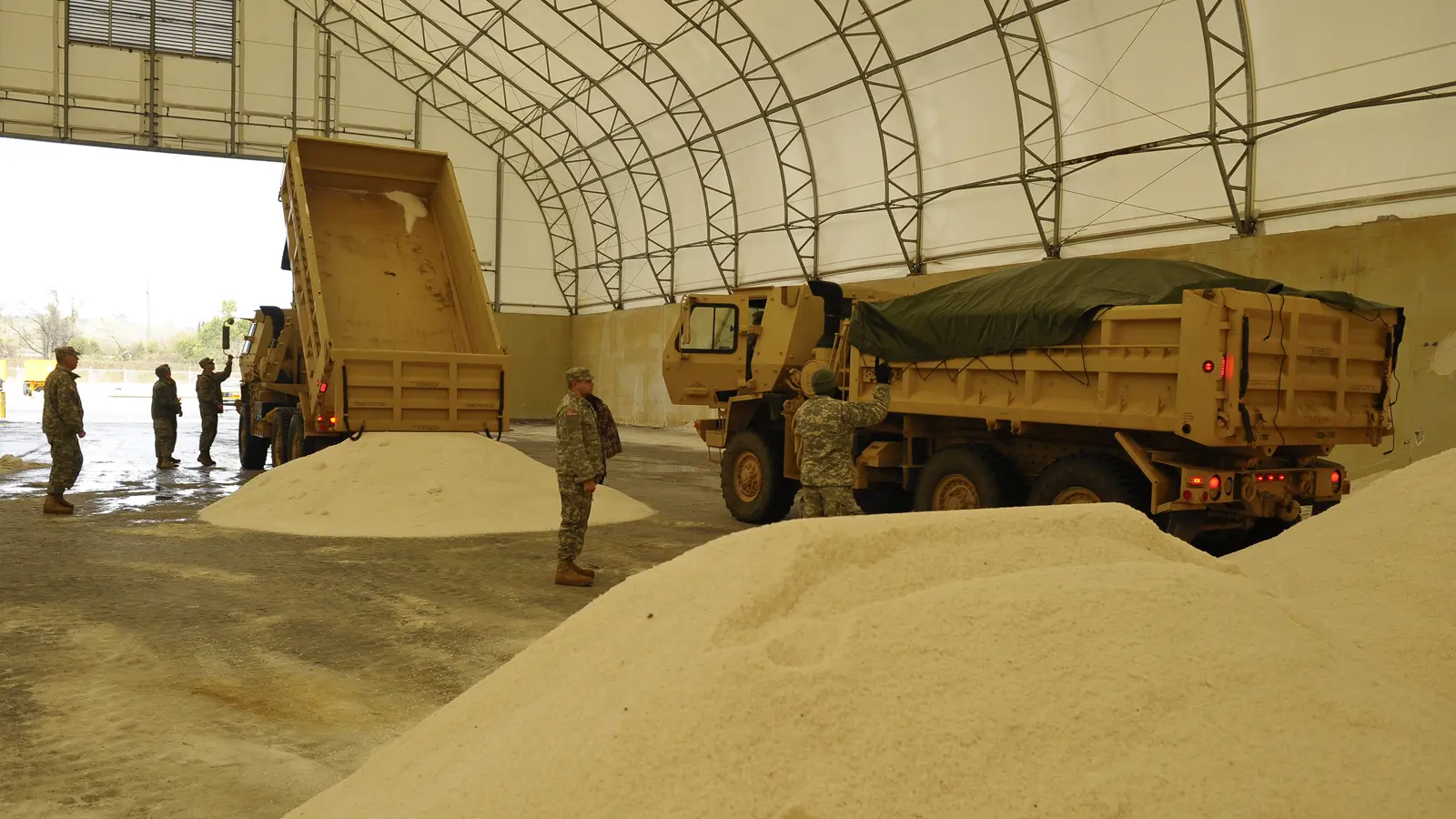
Dissolved ions lower water’s freezing point and shift the balance between solid ice and liquid brine
The short answer
Ice and liquid water constantly exchange molecules at their boundary. At 0°C under ordinary pressure, freezing and melting can balance. Adding dissolved particles changes the chemical potential of the liquid phase, so the balance now occurs at a lower temperature. Road crews exploit that shift, but salt does not create heat and it cannot melt unlimited ice under every condition.
Ice always has a molecular surface layer
Even below the normal melting point, the outermost molecules of ice are less tightly constrained than those inside the crystal. Moisture, pressure and impurities provide enough liquid water for salt to begin dissolving.
Dissolved ions disrupt crystal formation
Sodium chloride separates into sodium and chloride ions in water. Those particles are surrounded by water molecules and reduce the tendency of liquid water to join the ordered ice lattice.
Freezing-point depression is a colligative effect
For dilute solutions, the size of the temperature change depends mainly on how many dissolved particles are present rather than their chemical identity. Salts are effective because each formula unit produces multiple ions.
Melting continues toward equilibrium
Once brine has a lower freezing point than the actual pavement temperature, ice molecules can enter the liquid faster than water molecules refreeze. Dilution from melting gradually weakens the brine.
Temperature sets a practical limit
Sodium chloride has a eutectic limit near −21°C under ideal composition, but road performance deteriorates well before that because dissolution and melting slow. Other chloride salts work at lower temperatures but have different costs and impacts.
Brine can prevent bonding before a storm
Anti-icing applies a liquid salt solution before precipitation. A thin brine layer can stop snow and ice from bonding strongly to pavement, making later mechanical removal easier.
Dry salt needs liquid water to work
Solid crystals must dissolve before they depress the freezing point. Pre-wetting road salt speeds that process, improves adhesion to pavement and reduces particles bouncing into ditches.
Melting absorbs energy
Changing solid ice into liquid water requires latent heat. The necessary energy comes from the surroundings, including pavement and air, which is why the local temperature can fall during melting.
Salt creates environmental trade-offs
Chloride can accumulate in soil, groundwater and streams, corrode vehicles and infrastructure and stress plants and freshwater organisms. Accurate application and alternative practices reduce unnecessary use.
Common misconceptions
Salt does not melt ice by heating it, grinding it or chemically destroying water molecules. It shifts phase equilibrium after dissolving. Adding more salt is not always better: excess material can be wasted, and sodium chloride cannot overcome sufficiently cold conditions. Sand improves traction but usually does not meaningfully lower the freezing point.
How scientists know
Chemists measure phase diagrams, solution concentration, temperature and heat flow. Highway researchers test brines on pavement under controlled weather, monitor residual chemical concentration and compare anti-icing with deicing operations. Environmental studies track chloride through soils, lakes and streams.
Does table salt work on ice?
Yes, because it is mostly sodium chloride, though road products differ in grain size, additives and cost.
Why does salt stop working when it is very cold?
Dissolution and melting slow, and below the brine’s freezing limit solid ice and salt can coexist.
Is calcium chloride better?
It can work at lower temperatures and releases heat while dissolving, but it costs more and has its own handling impacts.
Why spread salt before snow?
Preventing a strong ice–pavement bond often needs less material than melting a bonded layer afterward.
Can sugar melt ice?
Any soluble substance can depress freezing somewhat, but effectiveness, cost and environmental behaviour differ.
Key takeaways
- Salt must dissolve to form brine.
- Ions lower the freezing point of water.
- Temperature and concentration limit performance.
- Responsible application reduces corrosion and environmental harm.
Continue exploring
- Why snowflakes form different shapes
- Why static electricity builds up
Sources and further reading
Keep exploring.
One remarkable idea at a time—nature, science, history and beyond.
Last updated October 29, 2026.

Barnakle Editorial Team
Barnakle Editorial Team is the collective byline used for Barnakle’s editorial articles. The contributor profile explains the team identity and links to the publication’s editorial policies.
More from the editorial team →