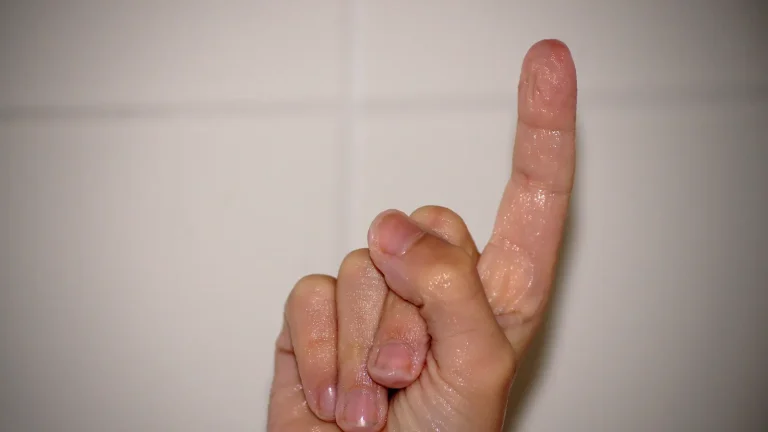
A narrow paper edge can injure sensitive skin; movement and inflammation can prolong discomfort
A sheet of paper bends easily in your hand, yet its edge can leave a cut that keeps announcing itself every time you type. That mismatch makes paper cuts memorable. Their pain comes from an injury in sensitive, frequently moving skin, followed by the nervous system's response. The familiar explanation that paper simply finds the greatest concentration of pain nerves is much less secure than it sounds.
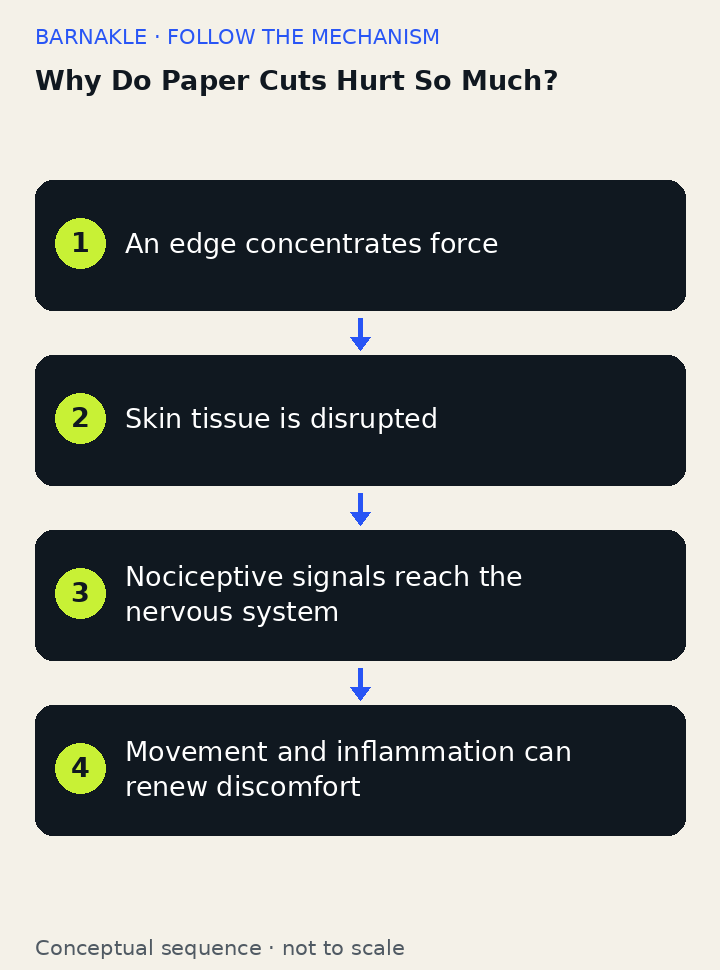
How a flexible sheet can break skin
A broad sheet feels soft, yet its edge presents a tiny contact area. Hand force concentrated onto that line can create enough stress to separate superficial skin.
Paper is a network of cellulose fibres, fillers and coatings. Its ability to cut depends on the edge, the stiffness of the sheet and the angle of contact, rather than flexibility alone.
The broad face of a sheet distributes a push. Its narrow edge concentrates the same action into a much smaller contact region, while the sheet's stiffness helps the edge transmit force. Edge condition, movement and skin geometry all affect whether a cut happens. None of that means that every paper edge produces the same injury.
A 2024 physics study tested paper cutting in a soft material and modelled a competition between slicing and buckling. Very thin paper can bend before it cuts, while a thicker edge spreads the force more broadly. The study helps explain why cutting depends on geometry and stiffness; it does not establish how much pain a person will feel.
Sources: [4]
Pain is a signal, not a wound-depth meter
Fingertips have excellent tactile sensitivity and fine spatial resolution for pain. A human study using small laser stimuli found that pain could be localized more precisely there than on the back of the hand, despite lower measured intraepidermal nerve-fibre density. That result concerns localization; it is not a direct experiment comparing the intensity of paper cuts.
Specialized sensory neurons respond to damaging force and chemicals released by injured cells, sending electrical signals toward the spinal cord and brain.
Touch sensitivity, pain detection and the ability to locate pain are separate properties. A study that measures where volunteers feel a tiny painful stimulus cannot establish that every cut there will feel stronger. That distinction matters when describing the fingertip study: it challenges a simple nerve-density explanation rather than supplying a complete explanation for paper-cut pain.
Why the sting returns
A small cut on a working finger can be disturbed repeatedly by movement and contact. The amount of visible bleeding does not measure how strongly the nervous system responds.
Inflammatory chemicals released around injured tissue can sensitize pain-sensing neurons. This is a general mechanism of injury-related pain, rather than a measurement of every individual paper cut.
Typing, gripping and bending can stretch skin around a finger cut and mechanically disturb the injured area.
The evidence for general pain mechanisms is stronger than the evidence assigning a particular share of paper-cut pain to each possible irritation. Everyday observations should not be presented as a controlled comparison of wound types.
The first sensation and the later sting need not have identical causes. The original cut mechanically disrupts tissue. Subsequent movement and inflammatory changes alter the conditions around the wound. A small injury on a finger may be disturbed repeatedly during an ordinary day, whereas a similar injury elsewhere may receive much less attention or friction.
What the evidence can and cannot establish
The intensity of a sting does not establish how deep a cut is or whether an injury needs treatment. This article explains mechanisms; it does not assess an individual wound.
There is no single measurement that ranks every paper cut against every other wound. Location, depth, inflammation, individual experience and the stimulus used to test pain all matter. The most defensible explanation brings these factors together without pretending that a memorable everyday sensation has one universally demonstrated cause.
Why a cut beside a finger joint keeps stinging
Imagine two equally small cuts, one beside a finger joint and one in skin that moves less during your normal activities. Flexing the finger can repeatedly stretch one wound's edges. That provides a plausible reason for repeated discomfort without requiring the first cut to be deeper, or its skin to contain more pain fibres. It is an explanation of how circumstances affect pain, not a way to judge injury severity.
Pain detection, experience and localization
| Term or component | What it means here |
|---|---|
| Nociception | Detection and transmission of potentially damaging stimuli. |
| Pain | A personal experience shaped by the nervous system and context. |
| Pain localization | How precisely a stimulus can be located; not identical to intensity. |
What a paper cut cannot tell you about injury severity
Paper does not need a special pain toxin to cause a painful cut. Mechanical tissue injury, sensory signalling and inflammation provide an explanation without treating pain intensity as a reliable measure of wound depth.
How researchers study pain and paper cutting
Neuroscientists record sensory-fibre activity and study pain channels; materials researchers examine paper edges, stiffness and fracture with microscopy and mechanical tests.
Paper-cut questions
Why are paper cuts on fingers so noticeable?
Fingertips are good at locating small painful stimuli, and ordinary hand movement can repeatedly disturb injured skin. Localization and intensity are different measurements, so this does not mean every fingertip cut must hurt more.
Does paper-cut pain require fibres to remain in the wound?
No. Tissue injury and the nervous system’s response can produce pain without retained fibres. Pain alone does not establish whether material remains in a wound.
Why can bending a finger make a paper cut sting again?
Bending stretches the skin around the cut and can disturb the healing edges. That repeated movement helps explain why a small finger injury can keep drawing attention during everyday tasks.
A small cut can have several sources of discomfort
The surprising part of a paper cut is not that paper contains a special irritant. It is that a small mechanical injury meets a sensitive nervous system and a hand that rarely stays still. For wound-care information and guidance on when to seek medical help, see MedlinePlus: cuts and puncture wounds. This explanation does not assess an individual injury.
Continue exploring
Sources and further reading
Keep exploring.
One remarkable idea at a time—nature, science, history and beyond.
Last updated November 6, 2026.

Barnakle Editorial Team
Barnakle Editorial Team is the collective byline used for Barnakle’s editorial articles. The contributor profile explains the team identity and links to the publication’s editorial policies.
More from the editorial team →