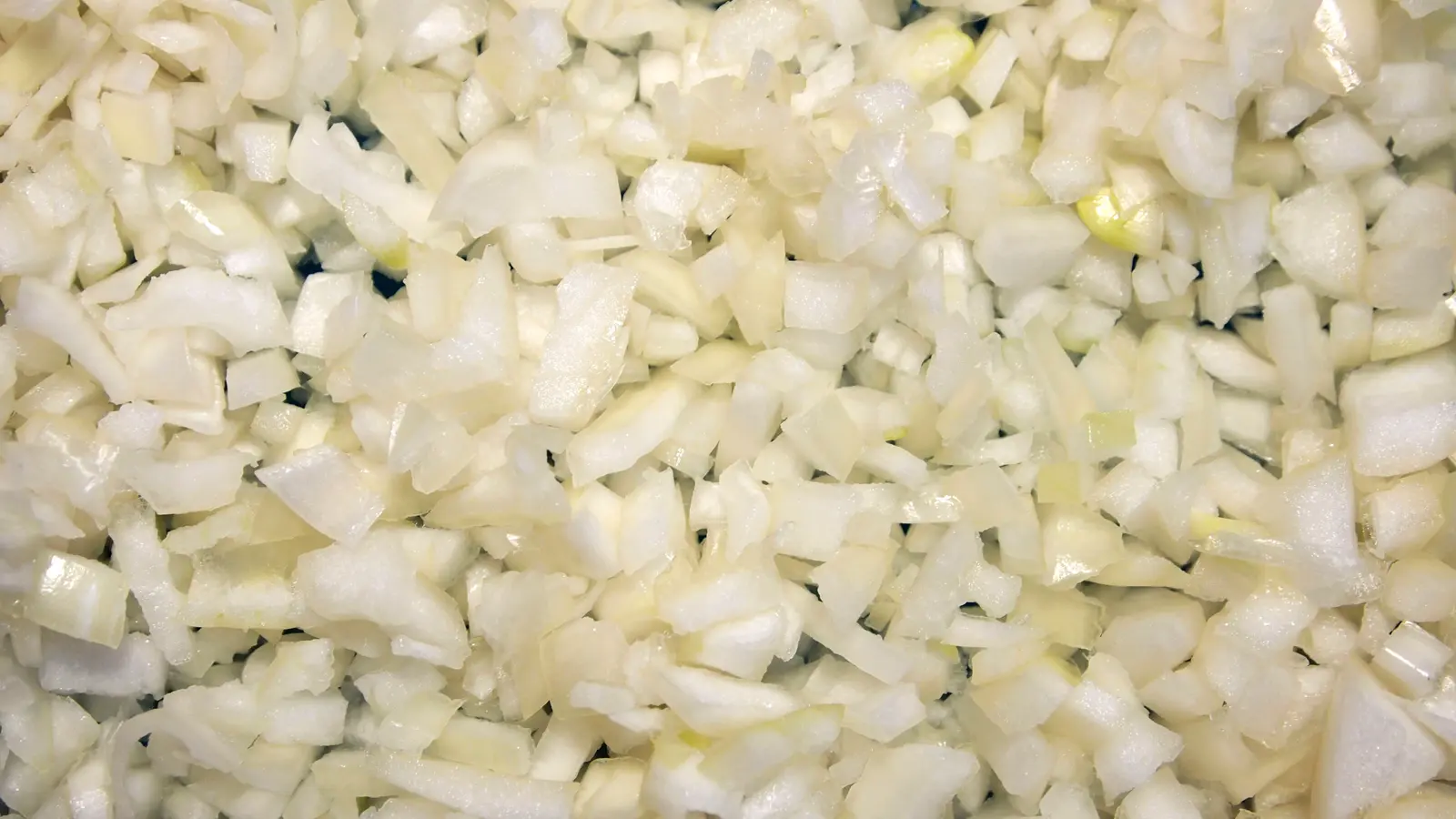
Chopping an onion damages its cells and starts a chemical reaction. Enzymes meet sulfur-containing precursors, and the resulting pathway produces a volatile tear-inducing compound called the lachrymatory factor. Once that irritant reaches the eyes, protective tearing follows.
The important word is produces. The onion is not merely releasing a ready-made cloud of tear gas stored inside the bulb. Damaging the tissue brings the ingredients of a rapid reaction together.
What cutting changes inside the onion
In intact tissue, the organisation of the cells keeps reaction components apart. Cutting breaks that organisation. The enzyme alliinase acts on sulfur-containing flavour precursors and produces reactive intermediates, including 1-propenesulfenic acid.
A second enzyme, lachrymatory-factor synthase, helps direct that intermediate toward the tear-inducing product, commonly called syn-propanethial-S-oxide. The enzyme and the irritant are different substances: one promotes the reaction, while the other can travel from the chopped tissue to your eyes.
Why the second enzyme matters
Researchers once treated formation of the lachrymatory factor as a spontaneous consequence of the flavour-producing reactions. The identification of a dedicated synthase showed that this branch of the chemistry was specifically enzyme-driven.
A 2017 ACS Chemical Biology study examined the enzyme’s crystal structure and active site. Structural information helped the researchers propose how the enzyme rearranges its substrate. The work addressed the molecular steps behind an everyday kitchen observation.
Why the eyes water
The lachrymatory factor is volatile, meaning it can pass into the surrounding air. You do not have to splash onion juice into an eye for the vapour to reach the ocular surface. Irritation triggers tearing, which helps wash and dilute material at that surface.
The American Chemical Society’s explanation of onion tears connects the tissue damage, chemical production and exposure. Onion odour and tear production are related experiences, but smelling the bulb is not itself the whole causal chain.
It is also unnecessary to describe the familiar effect as concentrated sulfuric acid being poured into the eye. The named volatile compound and the irritation response provide a more precise explanation than that popular shortcut.
Are tearless onions scientifically possible?
Yes. In a 2008 Plant Physiology study, researchers reduced expression of lachrymatory-factor synthase. Damaged tissue then produced much less lachrymatory factor. That intervention tests the enzyme’s role more directly than observing that one onion seems milder than another.
The experiment also changed the wider sulfur-metabolite profile. Reducing one route can divert reactive material into other products. A low-tear onion is therefore not necessarily an onion with all of its characteristic chemistry switched off.
That research does not establish that every onion sold as mild has the same breeding history or biochemical changes. A product label and a particular laboratory intervention should not be treated as interchangeable evidence.
What kitchen precautions are trying to change
Cooling an onion before cutting is intended to reduce the rate at which irritating material is produced or released. Ventilation aims to reduce how much reaches the face. These are different points in the chain: one acts near the source, the other along the exposure route.
A sharp knife can make cleaner cuts with less unnecessary crushing, although it still damages cells. None of these measures guarantees zero irritation. Keep the cutting surface stable, handle the knife safely and avoid touching your eyes with onion-contaminated hands.
Why a kitchen trick is not automatically proof
If one chopping session causes fewer tears, several things may have changed: the onion, the amount cut, the room’s airflow or how close your face was to the board. A fair comparison needs those conditions considered before crediting one trick.
The supported explanation remains straightforward: damaged tissue starts an enzyme pathway, a volatile product reaches the eyes, and the body responds with tears. Reducing production and reducing exposure are more useful aims than treating every folk remedy as an equally plausible cure.
Keep exploring
Another familiar chemical transformation happens on wet iron. Read why metal rusts to follow a different reaction from starting material to visible result.
Sources and further reading
Keep exploring.
One remarkable idea at a time—nature, science, history and beyond.
Last updated October 22, 2026.

Barnakle Editorial Team
Barnakle Editorial Team is the collective byline used for Barnakle’s editorial articles. The contributor profile explains the team identity and links to the publication’s editorial policies.
More from the editorial team →