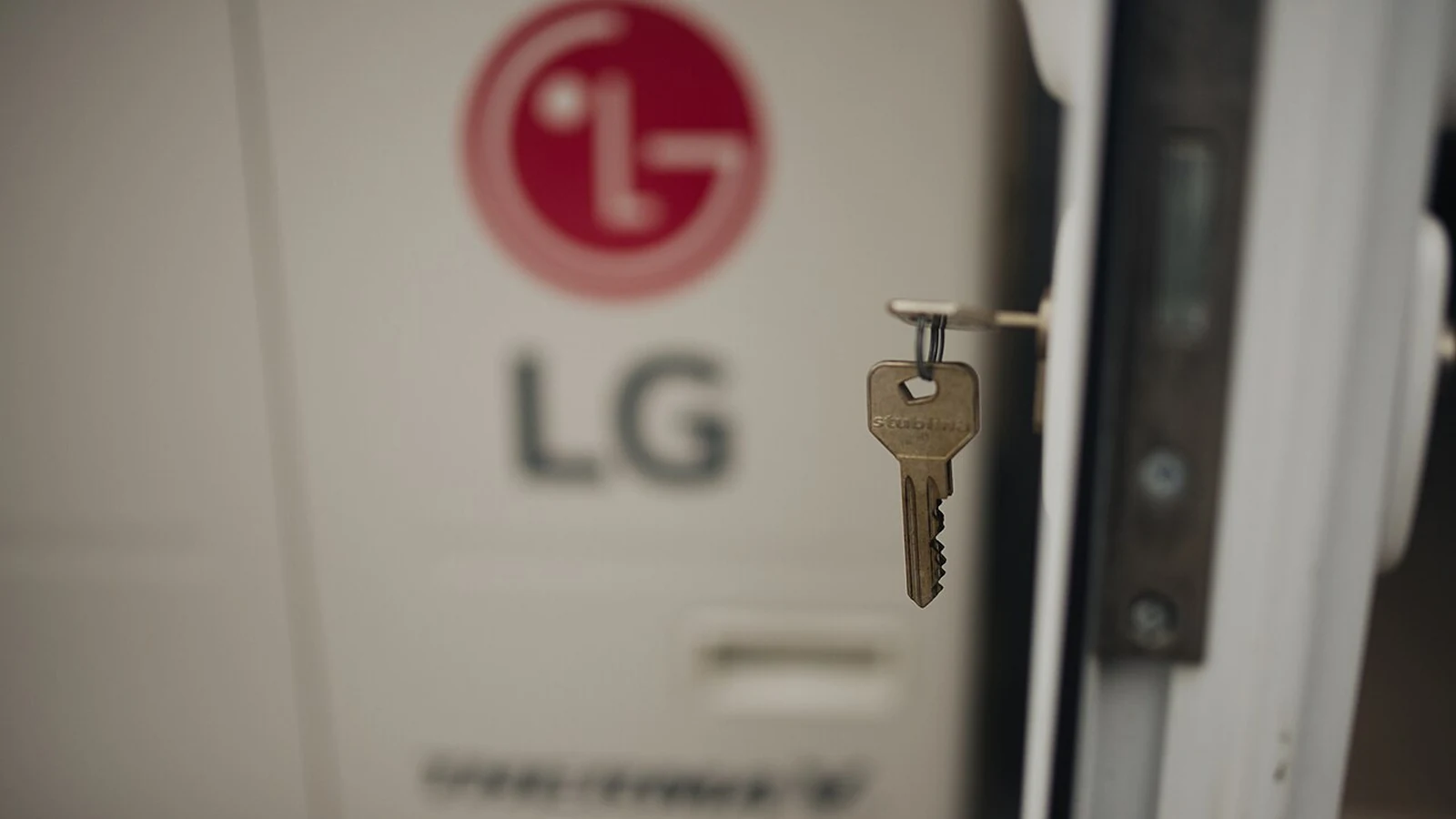
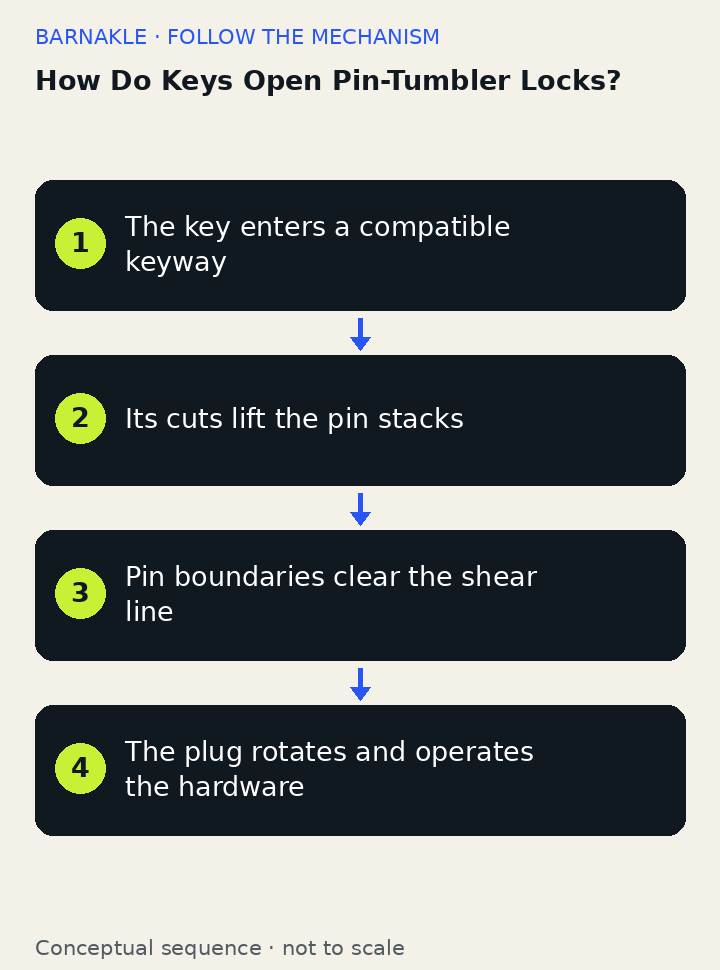
The correct key raises paired pins until every boundary lines up with the cylinder’s shear line
A key turns smoothly only after several small obstructions have been moved into the right positions. In a pin-tumbler cylinder, the key's cuts lift stacks of pins until their boundaries align with the surface where the plug must rotate. The key is therefore a shaped positioning tool, not a handle that simply pushes one hidden release.
The cylinder contains a blocked rotating boundary
The keyway runs through a cylindrical plug fitted inside the lock housing. Turning the plug transmits motion through a cam, tailpiece or spindle to retract a latch or move a bolt.
Bores drilled through the shell and plug hold pairs of pins. The circular interface where the plug meets the shell is the shear line, and a solid pin crossing it acts like a small mechanical bolt.
A spring above each driver pin keeps the stack following the key surface and returns the pins when the key leaves. Spring force must be reliable without creating excessive insertion friction.
The plug must rotate relative to its housing. A pin that crosses their interface obstructs that movement. Springs help return the stacks toward the keyway and keep them following the inserted key. Thinking about the boundary first makes the purpose of the different pin lengths easier to understand.
Sources: [1]
A key positions several independent pin stacks
The lower pins rest against the key. Their lengths correspond to the depth code of the key cuts, allowing one specific combination of valleys to place all pin boundaries at one height.
Longitudinal grooves in the key must fit warding inside the keyway before its cuts can even reach the pin stacks. This restricts incompatible blanks but is separate from the pin combination.
The side profile of a key and its cut depths solve different problems. The profile must fit the keyway; the depth pattern then positions the pin stacks. A key can therefore enter a cylinder without being the right key to turn it. Physical compatibility is one requirement, while correct positioning is another.
Sources: [1]
Correct alignment permits rotation
When fully inserted, each valley lifts its key pin and driver pin so their meeting point lies at the shear line. If even one boundary sits above or below it, the plug remains blocked.
Once the shear line is clear, torque turns the plug. The rear component converts that rotation into movement of a latch, deadbolt mechanism or electrical switch.
In the simplest arrangement, the split between each key pin and driver pin must align at the shear line. Some authorized systems use additional pin divisions to admit more than one key. That does not remove the central principle: a configuration has to clear the rotational boundary before the plug can move as intended.
Sources: [1]
The basic mechanism is only one part of security
Loose tolerances can make a lock easier to manipulate, while very tight tolerances can increase sensitivity to dirt and wear. Designers balance reliable operation, cost, durability and resistance to attack.
Security pins, sidebars, restricted keyways, hardened components and drill resistance can supplement the basic mechanism. A pin-tumbler explanation describes the core, not every modern cylinder.
A cylinder cannot establish the strength of a complete door by itself. The surrounding latch or bolt, frame, installation and other security features matter. Modern cylinders may also add sidebars and other mechanisms. This article explains normal operation of one mechanism, not a universal assessment of security or a guide to defeating a lock.
Sources: [1]
Why a key can enter without turning
A worn key may still slide into its familiar keyway but no longer position a stack accurately enough for reliable rotation. That contrast illustrates why insertion and unlocking are different events. It does not establish that wear is the cause of every sticky lock; contamination, alignment and other mechanical faults also require appropriate assessment.
Keyway profile, key cuts and shear line
| Term or component | What it means here |
|---|---|
| Keyway profile | Determines which shapes can physically enter. |
| Key cuts | Position the pin stacks for the intended key combination. |
| Shear line | The rotational boundary that the pin configuration must clear. |
Not every keyed lock uses pin tumblers
A key’s teeth do not match visible pins one-for-one like a saw cutting through material, and every lock with a key is not necessarily a pin-tumbler design. Wafer, lever, disc-detainer and electronic locks use different internal mechanisms. This article explains normal operation, not methods for bypassing locks.
How cylinders and keys are tested
Lock engineers measure pin dimensions, plug torque, key wear, cycle life, contamination tolerance and forced-entry resistance. Cutaway models and imaging reveal pin positions, while certification standards apply repeatable operating and security tests.
Pin-tumbler lock questions
Why will a worn key sometimes stop working?
Rounded or damaged cuts may no longer lift one or more stacks precisely to the shear line.
Can two locks use the same key?
Yes, keyed-alike systems deliberately use matching combinations, and large code spaces can still contain repeats.
Should a sticky lock be lubricated?
Follow the lock manufacturer’s guidance on whether and how to lubricate that model. A product suitable for one cylinder may be unsuitable for another, and friction is not the only possible cause of difficult operation.
The key clears a shared rotational boundary
The pin-tumbler cylinder converts the geometry of an authorized key into permission for a plug to rotate. Several small alignments cooperate at a shared boundary. That is the heart of its operation, while the security of the whole opening remains a broader question involving the cylinder, hardware and installation together.
Continue exploring
Sources and further reading
Keep exploring.
One remarkable idea at a time—nature, science, history and beyond.
Last updated November 6, 2026.

Barnakle Editorial Team
Barnakle Editorial Team is the collective byline used for Barnakle’s editorial articles. The contributor profile explains the team identity and links to the publication’s editorial policies.
More from the editorial team →