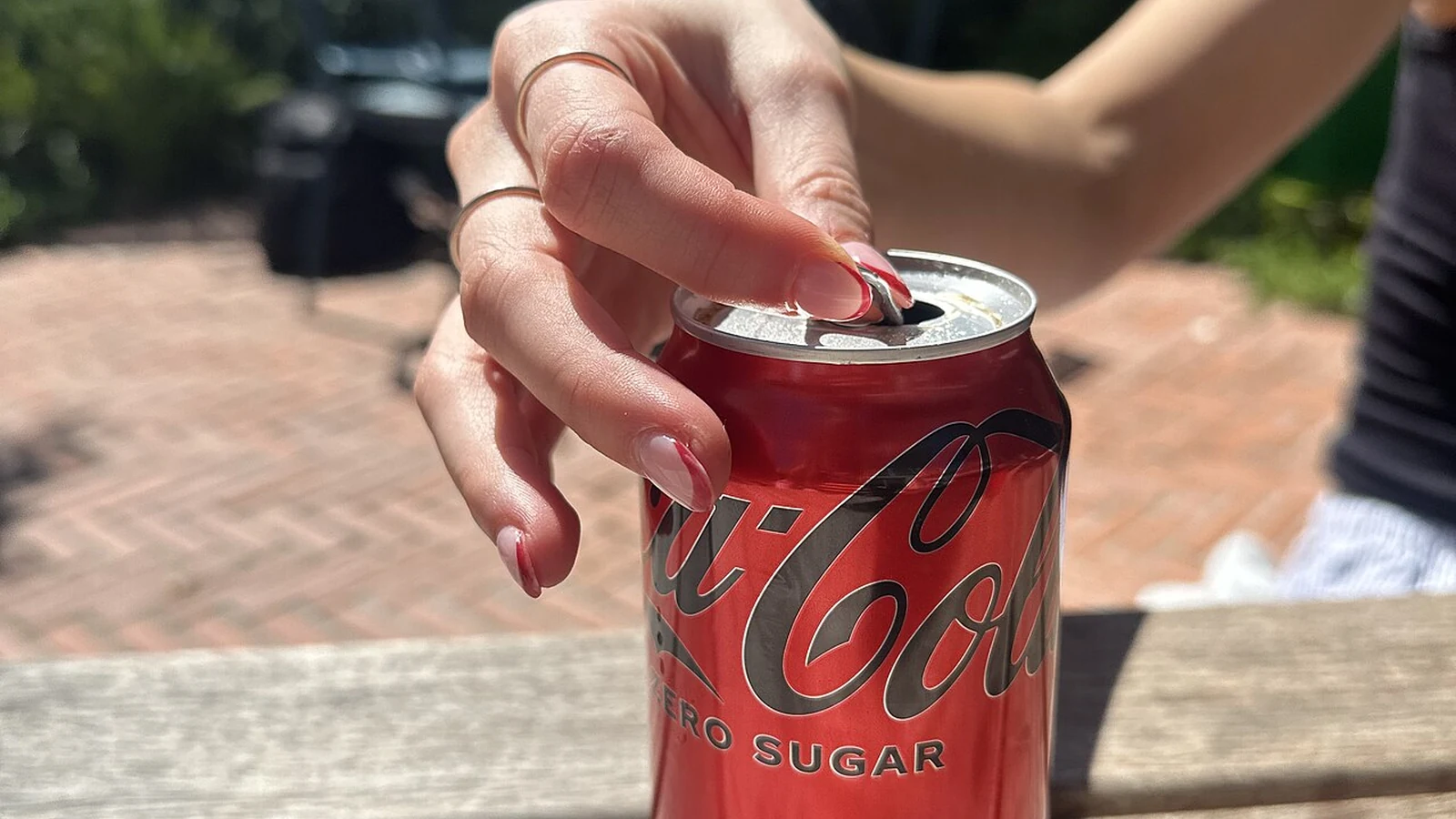
Pressurized carbon dioxide rushes through the new opening while dissolved gas begins escaping from the drink
The first hiss from a soda can and the fizz that follows are connected but different. The hiss begins when pressurized gas finds a narrow route to the room. The fizz continues as dissolved carbon dioxide leaves the drink through growing bubbles. Opening the can changes the pressure conditions for both the gas above the liquid and the liquid itself.
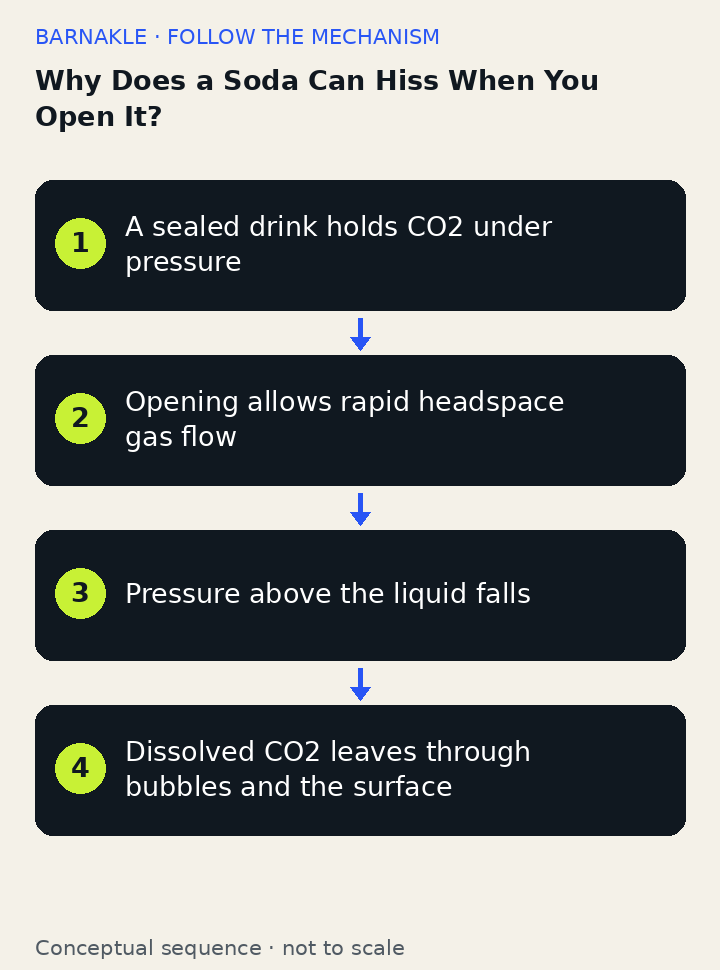
The unopened can preserves a pressurized equilibrium
During packaging, chilled beverage contacts CO2 at elevated pressure. Molecules enter the liquid and participate in equilibria involving dissolved gas and small amounts of carbonic acid.
At a fixed temperature and dilute conditions, the equilibrium concentration of dissolved gas rises with its partial pressure above the liquid. Sealing preserves a high CO2 pressure and therefore strong carbonation.
A small gas volume remains above the drink. Its pressure depends on product formulation and temperature and also helps the thin can resist deformation during normal handling.
Gas in the headspace and carbon dioxide dissolved in the drink exchange molecules. Their balance depends on temperature and the gas's partial pressure. For a given temperature, raising that pressure generally allows more gas to remain dissolved. Sealing the container preserves conditions very different from those above an open glass sitting in a room.
Opening creates a fast route for gas flow
The tab acts as a lever, concentrating force on a deliberately thinned outline in the lid. The opening forms predictably while the panel remains attached rather than becoming a loose sharp piece.
The initial pressure difference drives headspace gas outward. Fast flow, vortices and mixing at the edge create fluctuating pressure waves across many frequencies that the ear perceives as a hiss.
The tab opens a scored part of the lid. Once a passage exists, the pressure difference drives gas outward. Rapid, unsteady flow produces pressure fluctuations we hear as a hiss. The tab supplies the opening; it does not inject the carbonation or produce all the gas responsible for the sound.
Sources: [1]
Lower pressure lets dissolved gas leave solution
As gas leaves, the CO2 partial pressure in the headspace falls. The beverage is now supersaturated relative to the new condition, so dissolved molecules tend to enter bubbles and the gas phase.
Microscopic scratches, fibres, particles and trapped gas pockets reduce the energetic barrier to bubble formation. A smooth clean surface offers fewer sites than a rough or contaminated one.
After opening, the liquid contains more dissolved carbon dioxide than is stable under its new surroundings. Gas does not all depart instantly. Bubbles need places to begin and time to grow, while transfer also occurs at the exposed liquid surface. Continued fizz is evidence that the approach to a new balance takes time.
Temperature and agitation change what happens next
CO2 is generally less soluble at higher temperature, and warm liquid releases gas more readily. Temperature also changes pressure in the sealed headspace, making warm containers more prone to forceful fizzing.
Agitation can distribute tiny gas pockets and increase gas-liquid contact. When the can opens and pressure falls, those nuclei expand rapidly and can carry liquid foam through the opening.
Warming changes gas solubility and the pressure conditions inside a sealed container. Agitation can redistribute gas pockets that become growing bubbles after pressure falls. The outcome also depends on the drink and container. Avoid presenting can-tapping or any other small ritual as a guaranteed way to reverse that complete physical history.
Why the hiss ends before the drink goes flat
Leave an opened drink undisturbed and it gradually loses its fizz even though the loud opening hiss has ended. Gas is still transferring out of solution. That separation in time is useful: the brief sound marks rapid pressure release, while the slower loss of carbonation shows a liquid continuing to respond to the new pressure above it.
Opening hiss, continuing fizz and going flat
| Term or component | What it means here |
|---|---|
| Opening hiss | Sound associated with rapid gas release and unsteady flow. |
| Continuing fizz | Dissolved carbon dioxide leaves through growing bubbles. |
| Going flat | The drink approaches a lower-carbonation state over time. |
Opening does not release all carbonation at once
The hiss does not prove that all carbonation escaped instantly, and the tab does not pump gas into the drink. It merely opens a path. Tapping a shaken can may sometimes alter bubbles near the wall, but it is not a guaranteed reset; allowing time for bubbles to dissolve or rise is more dependable.
How carbonation and pressure release are studied
Food scientists measure headspace pressure, dissolved CO2, temperature, bubble size and foam height. High-speed cameras track nucleation and growth, microphones analyse the pressure-release sound, and packaging tests measure lid fracture and can strength.
Soda-can questions
Why is a warm can louder?
Warming changes gas solubility and pressure in a sealed drink, which can change the release on opening. The loudness also depends on the opening and container, so temperature alone does not predict every sound.
Why does shaking cause overflow?
It produces or redistributes bubble nuclei that expand rapidly after depressurization.
Is the hiss only carbon dioxide?
It is primarily escaping headspace gas and turbulent flow; water vapour and air may also be present.
Headspace pressure and dissolved gas respond differently
Opening a can is a small experiment in equilibrium, flow and nucleation. The gas headspace responds rapidly; dissolved carbon dioxide continues to leave over a longer period. Keeping those stages separate explains why a can can stop hissing yet retain plenty of carbonation, and why warmth or agitation can make opening more eventful.
Continue exploring
Sources and further reading
Keep exploring.
One remarkable idea at a time—nature, science, history and beyond.
Last updated November 6, 2026.

Barnakle Editorial Team
Barnakle Editorial Team is the collective byline used for Barnakle’s editorial articles. The contributor profile explains the team identity and links to the publication’s editorial policies.
More from the editorial team →