Microscopic nozzles place precisely timed droplets while paper and printhead move on perpendicular axes
The short answer
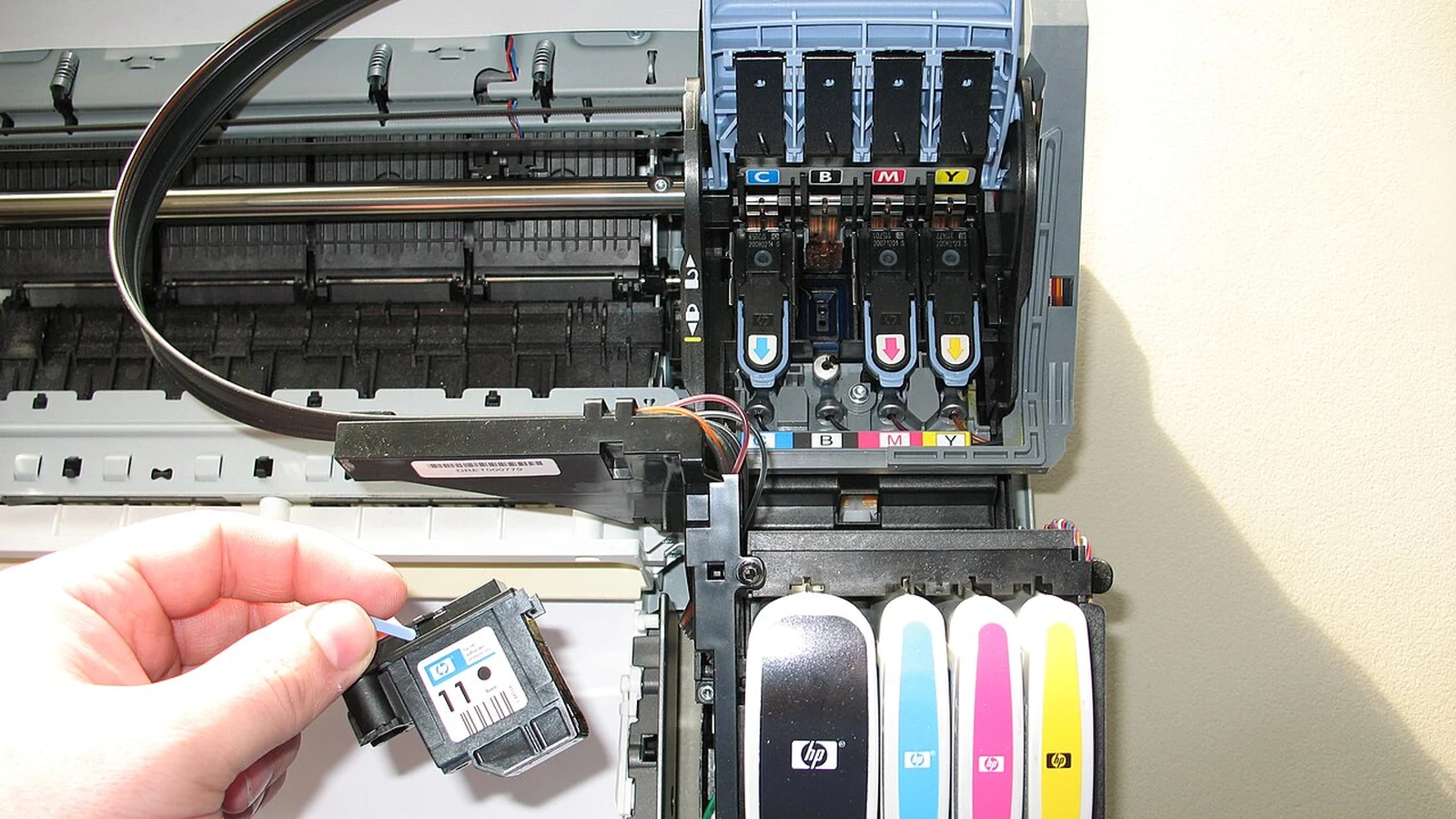
An inkjet printer builds an image from tiny droplets ejected through hundreds or thousands of nozzles. Electronics convert page data into a raster map, decide which colour droplets belong at each position and synchronize firing with printhead and paper motion. Thermal inkjet heaters create vapour bubbles that push droplets out; piezoelectric heads flex small chambers with voltage. Capillary pressure refills each chamber. Cyan, magenta, yellow and black inks overlap as dots, while paper coatings control spreading, absorption and drying.
A printed photograph looks continuous from normal distance, but magnification reveals a carefully arranged field of discrete droplets whose size, colour and position were controlled in milliseconds.
Software turns a page into a dot map
The print driver interprets text, vectors and pixels, applies colour management and rasterizes the page at the printer’s available resolution. Screening algorithms distribute limited ink colours so the eye perceives many tones.
The important distinction is between the visible result and the chain of physical events that produces it. Researchers follow forces, energy, matter or information through each stage and test those transitions instead of treating a familiar outcome as its own explanation.
Measurements separate the main mechanism from conditions that only change timing, scale or intensity. Investigators vary one factor at a time, compare controlled tests with everyday operation and ask whether the proposed explanation predicts a new observation.
Material, temperature, geometry, manufacturing tolerances, wear and environment all matter. They can change performance without overturning the underlying principle, so an accurate account states both the normal pattern and the limits around it.
Direct observation establishes what happens, instruments quantify changes too small or fast to see, and models test whether established scientific rules reproduce the pattern. Agreement among independent methods is stronger than one memorable demonstration.
Similar-looking cases may end differently when one link in the causal chain changes. Tracing that link explains both the ordinary result and the exceptions more effectively than memorising a label.
A strong explanation makes testable predictions, identifies failure modes and changes when better evidence reveals a missing variable. Those qualifications refine the mechanism rather than weakening it.
The carriage establishes horizontal position
In many home printers, a belt-driven carriage moves the printhead across an encoder strip. The controller tracks position finely enough to fire droplets while the head is moving rather than stopping over each dot.
The important distinction is between the visible result and the chain of physical events that produces it. Researchers follow forces, energy, matter or information through each stage and test those transitions instead of treating a familiar outcome as its own explanation.
Measurements separate the main mechanism from conditions that only change timing, scale or intensity. Investigators vary one factor at a time, compare controlled tests with everyday operation and ask whether the proposed explanation predicts a new observation.
Material, temperature, geometry, manufacturing tolerances, wear and environment all matter. They can change performance without overturning the underlying principle, so an accurate account states both the normal pattern and the limits around it.
Direct observation establishes what happens, instruments quantify changes too small or fast to see, and models test whether established scientific rules reproduce the pattern. Agreement among independent methods is stronger than one memorable demonstration.
Similar-looking cases may end differently when one link in the causal chain changes. Tracing that link explains both the ordinary result and the exceptions more effectively than memorising a label.
A strong explanation makes testable predictions, identifies failure modes and changes when better evidence reveals a missing variable. Those qualifications refine the mechanism rather than weakening it.
Paper advances in measured steps
Rollers move the sheet perpendicular to the carriage path. An encoder and feed mechanism coordinate each advance so successive swaths meet without white gaps, dark overlaps or skew.
The important distinction is between the visible result and the chain of physical events that produces it. Researchers follow forces, energy, matter or information through each stage and test those transitions instead of treating a familiar outcome as its own explanation.
Measurements separate the main mechanism from conditions that only change timing, scale or intensity. Investigators vary one factor at a time, compare controlled tests with everyday operation and ask whether the proposed explanation predicts a new observation.
Material, temperature, geometry, manufacturing tolerances, wear and environment all matter. They can change performance without overturning the underlying principle, so an accurate account states both the normal pattern and the limits around it.
Direct observation establishes what happens, instruments quantify changes too small or fast to see, and models test whether established scientific rules reproduce the pattern. Agreement among independent methods is stronger than one memorable demonstration.
Similar-looking cases may end differently when one link in the causal chain changes. Tracing that link explains both the ordinary result and the exceptions more effectively than memorising a label.
A strong explanation makes testable predictions, identifies failure modes and changes when better evidence reveals a missing variable. Those qualifications refine the mechanism rather than weakening it.
Thermal heads form vapour bubbles
A microscopic resistor rapidly heats a thin ink layer. A vapour bubble expands, displacing a droplet through the nozzle; collapse then draws fresh ink into the chamber through capillary action.
The important distinction is between the visible result and the chain of physical events that produces it. Researchers follow forces, energy, matter or information through each stage and test those transitions instead of treating a familiar outcome as its own explanation.
Measurements separate the main mechanism from conditions that only change timing, scale or intensity. Investigators vary one factor at a time, compare controlled tests with everyday operation and ask whether the proposed explanation predicts a new observation.
Material, temperature, geometry, manufacturing tolerances, wear and environment all matter. They can change performance without overturning the underlying principle, so an accurate account states both the normal pattern and the limits around it.
Direct observation establishes what happens, instruments quantify changes too small or fast to see, and models test whether established scientific rules reproduce the pattern. Agreement among independent methods is stronger than one memorable demonstration.
Similar-looking cases may end differently when one link in the causal chain changes. Tracing that link explains both the ordinary result and the exceptions more effectively than memorising a label.
A strong explanation makes testable predictions, identifies failure modes and changes when better evidence reveals a missing variable. Those qualifications refine the mechanism rather than weakening it.
Piezoelectric heads flex a chamber wall
An applied voltage changes the shape of a piezoelectric element. Its mechanical pulse reduces chamber volume and expels a droplet without boiling the ink, allowing different fluid formulations and waveform control.
The important distinction is between the visible result and the chain of physical events that produces it. Researchers follow forces, energy, matter or information through each stage and test those transitions instead of treating a familiar outcome as its own explanation.
Measurements separate the main mechanism from conditions that only change timing, scale or intensity. Investigators vary one factor at a time, compare controlled tests with everyday operation and ask whether the proposed explanation predicts a new observation.
Material, temperature, geometry, manufacturing tolerances, wear and environment all matter. They can change performance without overturning the underlying principle, so an accurate account states both the normal pattern and the limits around it.
Direct observation establishes what happens, instruments quantify changes too small or fast to see, and models test whether established scientific rules reproduce the pattern. Agreement among independent methods is stronger than one memorable demonstration.
Similar-looking cases may end differently when one link in the causal chain changes. Tracing that link explains both the ordinary result and the exceptions more effectively than memorising a label.
A strong explanation makes testable predictions, identifies failure modes and changes when better evidence reveals a missing variable. Those qualifications refine the mechanism rather than weakening it.
Surface tension shapes the droplet
Nozzle diameter, fluid viscosity, surface tension and drive pulse determine whether a clean primary droplet forms. Poor balance creates satellites, misting or a clogged meniscus.
The important distinction is between the visible result and the chain of physical events that produces it. Researchers follow forces, energy, matter or information through each stage and test those transitions instead of treating a familiar outcome as its own explanation.
Measurements separate the main mechanism from conditions that only change timing, scale or intensity. Investigators vary one factor at a time, compare controlled tests with everyday operation and ask whether the proposed explanation predicts a new observation.
Material, temperature, geometry, manufacturing tolerances, wear and environment all matter. They can change performance without overturning the underlying principle, so an accurate account states both the normal pattern and the limits around it.
Direct observation establishes what happens, instruments quantify changes too small or fast to see, and models test whether established scientific rules reproduce the pattern. Agreement among independent methods is stronger than one memorable demonstration.
Similar-looking cases may end differently when one link in the causal chain changes. Tracing that link explains both the ordinary result and the exceptions more effectively than memorising a label.
A strong explanation makes testable predictions, identifies failure modes and changes when better evidence reveals a missing variable. Those qualifications refine the mechanism rather than weakening it.
Colour comes from overlapping inks
Subtractive cyan, magenta and yellow inks remove different parts of white light reflected by paper. Black improves neutral density, text sharpness and ink economy; photo printers may add light or specialized colours.
The important distinction is between the visible result and the chain of physical events that produces it. Researchers follow forces, energy, matter or information through each stage and test those transitions instead of treating a familiar outcome as its own explanation.
Measurements separate the main mechanism from conditions that only change timing, scale or intensity. Investigators vary one factor at a time, compare controlled tests with everyday operation and ask whether the proposed explanation predicts a new observation.
Material, temperature, geometry, manufacturing tolerances, wear and environment all matter. They can change performance without overturning the underlying principle, so an accurate account states both the normal pattern and the limits around it.
Direct observation establishes what happens, instruments quantify changes too small or fast to see, and models test whether established scientific rules reproduce the pattern. Agreement among independent methods is stronger than one memorable demonstration.
Similar-looking cases may end differently when one link in the causal chain changes. Tracing that link explains both the ordinary result and the exceptions more effectively than memorising a label.
A strong explanation makes testable predictions, identifies failure modes and changes when better evidence reveals a missing variable. Those qualifications refine the mechanism rather than weakening it.
Paper controls the final dot
Ink can wick along fibres, penetrate pores or remain near a coated surface. Absorbency and coating chemistry affect dot gain, edge sharpness, colour density, gloss and drying time.
The important distinction is between the visible result and the chain of physical events that produces it. Researchers follow forces, energy, matter or information through each stage and test those transitions instead of treating a familiar outcome as its own explanation.
Measurements separate the main mechanism from conditions that only change timing, scale or intensity. Investigators vary one factor at a time, compare controlled tests with everyday operation and ask whether the proposed explanation predicts a new observation.
Material, temperature, geometry, manufacturing tolerances, wear and environment all matter. They can change performance without overturning the underlying principle, so an accurate account states both the normal pattern and the limits around it.
Direct observation establishes what happens, instruments quantify changes too small or fast to see, and models test whether established scientific rules reproduce the pattern. Agreement among independent methods is stronger than one memorable demonstration.
Similar-looking cases may end differently when one link in the causal chain changes. Tracing that link explains both the ordinary result and the exceptions more effectively than memorising a label.
A strong explanation makes testable predictions, identifies failure modes and changes when better evidence reveals a missing variable. Those qualifications refine the mechanism rather than weakening it.
Maintenance protects the nozzles
Capping stations slow evaporation, wipers remove residue and purge cycles pull ink through blocked jets. Cleaning consumes ink because reliable microfluidics require open, consistently wet nozzles.
The important distinction is between the visible result and the chain of physical events that produces it. Researchers follow forces, energy, matter or information through each stage and test those transitions instead of treating a familiar outcome as its own explanation.
Measurements separate the main mechanism from conditions that only change timing, scale or intensity. Investigators vary one factor at a time, compare controlled tests with everyday operation and ask whether the proposed explanation predicts a new observation.
Material, temperature, geometry, manufacturing tolerances, wear and environment all matter. They can change performance without overturning the underlying principle, so an accurate account states both the normal pattern and the limits around it.
Direct observation establishes what happens, instruments quantify changes too small or fast to see, and models test whether established scientific rules reproduce the pattern. Agreement among independent methods is stronger than one memorable demonstration.
Similar-looking cases may end differently when one link in the causal chain changes. Tracing that link explains both the ordinary result and the exceptions more effectively than memorising a label.
A strong explanation makes testable predictions, identifies failure modes and changes when better evidence reveals a missing variable. Those qualifications refine the mechanism rather than weakening it.
Common misconceptions
Printer resolution is not identical to photographic detail, and a larger dots-per-inch number does not guarantee a better image. Multiple addressable droplet positions may be used to render one tone. Ink cartridges also contain more than coloured water: solvents, humectants, surfactants, dyes or pigments and preservatives are balanced for the head and paper.
Everyday shorthand becomes misleading when it confuses a contributing condition with the main cause, treats a signal as an energy source or assumes that every design and material behaves identically.
How we know
Engineers use high-speed microscopy to watch droplets, stroboscopic imaging to measure velocity and direction, test charts to quantify colour and alignment, and accelerated cycles to assess nozzle reliability, drying and paper interaction.
Laboratory measurements reveal mechanism, standards make comparisons reproducible and field records show how wear, weather and human use affect performance over time.
Frequently asked questions
Why does a printer clean itself?
It wipes, caps and purges the nozzles to restore consistent droplet formation.
Why are there four basic colours?
CMYK subtractive mixing can reproduce a broad gamut while black improves density and efficiency.
What causes horizontal bands?
Clogged nozzles, misalignment or inaccurate paper advance can leave repeating gaps or overlaps.
Why does photo paper look sharper?
Its coating limits uncontrolled spreading and holds colourants near the surface.
Do all inkjets use heat?
No. Major designs include thermal and piezoelectric drop-on-demand heads.
Key takeaways
- Page data becomes a timed map of droplets.
- Thermal or piezoelectric chambers eject ink.
- Motion systems place dots in two dimensions.
- Ink chemistry and paper determine the visible result.
Continue exploring
Sources and further reading
Keep exploring.
One remarkable idea at a time—nature, science, history and beyond.
Sources and further reading
Barnakle uses credible primary and authoritative sources wherever possible.
- NIST — Additive manufacturing and inkjet measurement
- https://www.nist.gov/topics/additive-manufacturing
- Library of Congress — Inkjet print preservation
- https://www.loc.gov/preservation/care/photolea.html
- Smithsonian — Printing technology collections
- https://americanhistory.si.edu/collections/search?edan_q=inkjet%20printer
Last reviewed October 15, 2026.

Barnakle Editorial Team
A member of the Barnakle editorial team, exploring remarkable ideas with clarity, curiosity and care.
More from this author →