
Octopuses are unusual because sophisticated behavior evolved in a body and nervous system radically different from ours. They learn, remember, explore, solve some novel problems and control eight flexible arms through a partnership between a central brain and extensive neural circuits in the arms. Intelligence is the best explanation for a suite of abilities—not permission to turn every surprising movement into proof of humanlike thought.
A mind built on another evolutionary road
Octopuses are cephalopod mollusks. Their closest living relatives include squid and cuttlefish; their broader family includes snails and clams. The lineage leading to vertebrates and the lineage leading to modern cephalopods separated more than half a billion years ago. Complex nervous systems therefore developed independently. That evolutionary distance makes the octopus a natural experiment: how does flexible behavior emerge when evolution starts with a soft-bodied marine animal rather than a backbone, limbs and a skull?
An octopus has a large central brain encircling the esophagus, substantial optic lobes and a vast peripheral nervous system. A majority of its roughly half-billion neurons are outside the central brain, many in axial nerve cords and ganglia running through the arms. Calling this “nine brains” is memorable but inaccurate. Arms can coordinate many local movements and sensory responses, yet behavior still depends on communication with central circuits. Distributed control is not eight independent personalities.
Why arms change the control problem
A jointed arm has a manageable set of angles. A muscular octopus arm can bend, shorten, elongate, twist and stiffen almost anywhere. Directly calculating every muscle adjustment from the central brain would be costly. Local neural circuits organize movement into reusable patterns while the brain selects goals and integrates information. Researchers have shown that arm systems can produce stereotyped reaching and fetching movements and that suckers supply both touch and chemical information.
- Eyes and skin gather information about the scene.
- The central brain evaluates goals, memory and context.
- Descending pathways recruit an arm and broad action.
- Arm circuits manage many local details of shape and contact.
- Sensory feedback continually updates the whole system.
What experiments actually show
Across species and laboratory designs, octopuses can learn visual and tactile discriminations, remember rewarded choices, navigate spaces and manipulate containers. Wild observations document den use, camouflage, hunting strategies and object carrying. Some individuals explore unfamiliar objects persistently; others avoid them. The strongest conclusions come from controlled experiments that rule out scent trails, unintentional cues and simple trial-and-error explanations.
Tool use is a useful example of both wonder and caution. Veined octopuses have been observed transporting coconut shell halves and later assembling them as shelter. The behavior involves carrying an object at an immediate cost for possible future use. It fits functional definitions of tool use, but it does not prove the animal imagines the future in the same language-rich way a person does.
Camouflage is an information problem
Octopus skin contains chromatophores controlled by muscles, plus reflective iridophores and leucophores. Neural control can rapidly alter color, contrast, pattern and texture. The animal must sample a scene, choose a body pattern and coordinate thousands of skin elements while moving. Experiments suggest visual features such as edges, contrast and spatial scale help guide the choice. Yet most studied octopuses appear color-blind by conventional receptor tests, making their color matching an active research puzzle rather than magic.
Learning, sleep and individual difference
The vertical lobe system plays an important role in learning and memory. Its organization is different from the vertebrate hippocampus, another sign that evolution can build flexible learning through different anatomy. Researchers have also described quiet and active sleep-like states, with bursts of changing skin patterns during active periods. Comparisons with vertebrate dreaming are tempting, but skin changes do not reveal subjective content. The secure conclusion is that octopus sleep is behaviorally structured and scientifically testable.
“The octopus” is not one personality. More than 300 species occupy environments from reefs to the deep sea. Age, sex, hunger, rearing, prior experience and laboratory conditions affect behavior. Small samples are common because cephalopods are difficult to house and many species live relatively short lives. Responsible coverage identifies the species and avoids treating a viral individual as a universal ambassador.
- Octopus intelligence evolved independently from vertebrate intelligence.
- The animal has one central brain plus extensive, capable arm circuitry—not nine separate brains.
- Learning, exploration, problem solving and flexible hunting support the case for intelligence.
- Camouflage and soft-arm control are demanding computations.
- Human words such as planning or dreaming should be used only when experiments justify them.
Why the question matters
Studying octopuses broadens neuroscience beyond familiar mammalian designs. Their arms inspire soft robotics; their skin informs adaptive materials; their learning systems test which neural principles are universal. It also carries welfare implications. Several jurisdictions include cephalopods in research protections because evidence supports their capacity for pain and complex experience. Wonder should lead to better questions and better care, not sensational claims.
- Albertin et al., Current Biology (2023), evolution of cephalopod nervous systems.
- Zullo et al., Current Biology (2019), octopus motor-control pathways.
- Olson et al. (2023–2024), octopus arm motor control and neuronal segmentation.
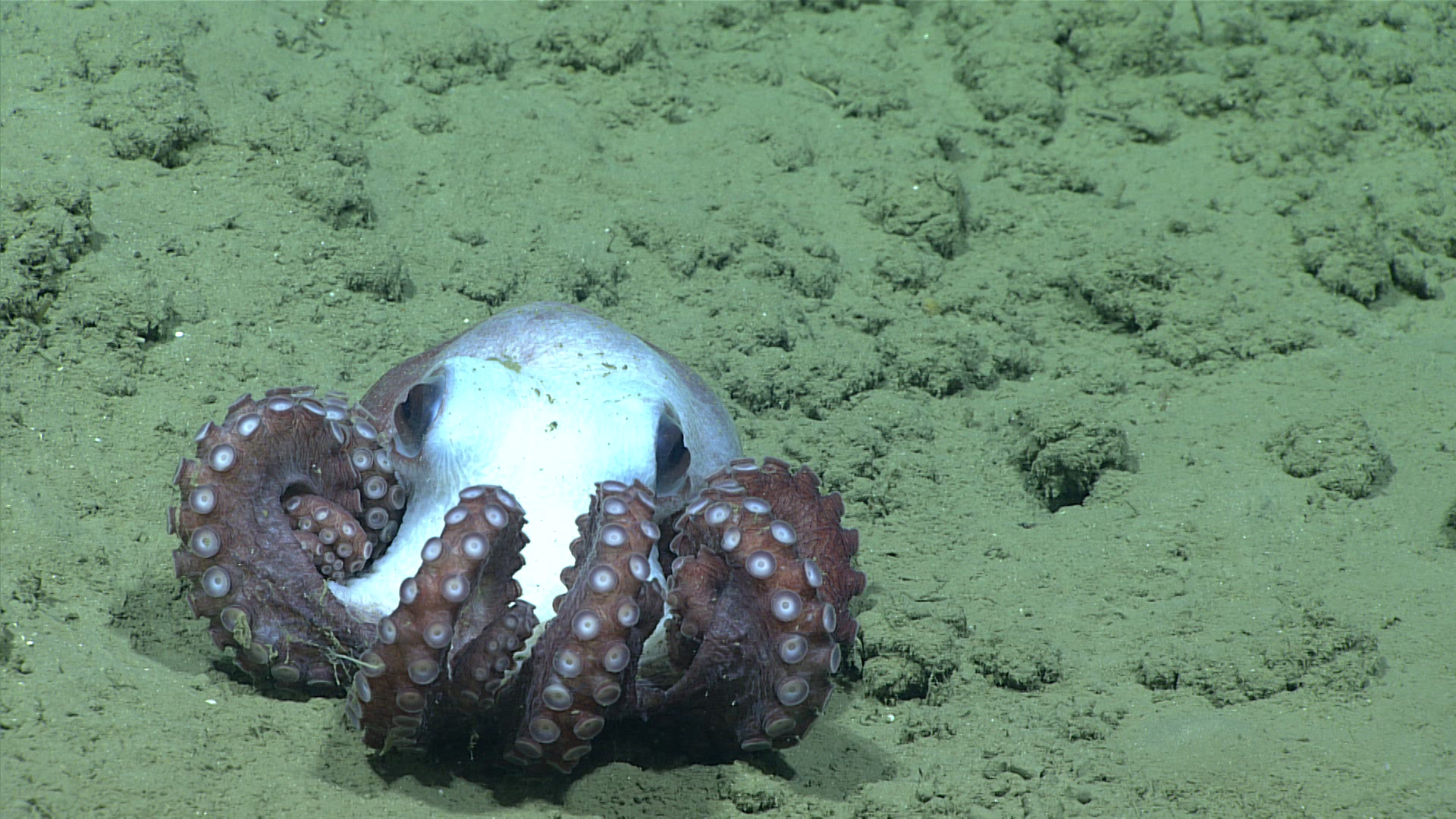
- NOAA Ocean Exploration species observations and imagery.
What intelligence means in an octopus
Intelligence is not one score that can be transferred cleanly across species. Researchers look for flexible learning, memory, problem solving, behavioral choice and the ability to use information in a new context. A task designed for a social primate may be meaningless to a solitary marine predator. Fair tests begin with the animal’s sensory world: vision, touch, chemical sensing through suckers, flexible arms and a strong motivation to explore shelter and food.
Evidence becomes more convincing when behavior changes with experience and cannot be explained by a fixed reflex. Octopuses can learn visual and tactile discriminations, reverse a previously rewarded choice, navigate mazes and manipulate unfamiliar objects. Performance varies among species and individuals. That variation is informative, but small sample sizes and differences in housing make sweeping rankings unreliable.
The phrase “seems intelligent” therefore signals appropriate caution. It acknowledges a broad behavioral case without claiming an octopus thinks exactly like a person. Convergent evolution can produce similar functional outcomes—learning a route or solving a barrier—through very different neural machinery.
One brain, eight arms and a neural ring
The central brain sits between the eyes and surrounds the esophagus. Large optic lobes process visual information, while the vertical lobe system contributes to learning and memory. Hundreds of millions of additional neurons occupy the peripheral nervous system, particularly the axial nerve cords of the arms. Interbrachial commissures connect arms through a nerve ring, creating routes for coordination that do not always require detailed central commands.
This organization corrects the “nine brains” myth. An arm can process local touch and chemical signals and generate coordinated movements, but it remains part of one animal. Experiments on arm preparations reveal substantial local capability; experiments in intact animals show descending pathways from the brain and information traveling among arms. Distributed control describes a partnership, not nine independent decision makers.1
The arrangement makes evolutionary sense. Each arm has almost unlimited degrees of freedom and hundreds of suckers. A central controller that specified every bend and sucker adjustment would face an enormous computational burden. Local circuits can handle recurring details while central systems select direction, prey, shelter or defense.
How an arm turns intention into movement
Octopus muscle is organized in longitudinal, transverse and oblique groups around a three-dimensional muscular hydrostat. Because the tissue is effectively incompressible, contracting one dimension produces expansion in another. The same physical principle lets an elephant trunk or human tongue move without bones. Neural circuits recruit patterns of muscle activation that propagate bends, stiffen segments or shorten an arm.
Reaching often involves creating a bend near the arm base and propagating it toward a target. Fetching can use a temporary set of joints, simplifying a flexible arm into a more manageable structure. These stereotyped building blocks do not make behavior mindless. They are efficient motor solutions selected and adjusted according to goals and sensory feedback.
Suckers add a second layer. They adhere, manipulate and sample chemicals on contact. Local processing helps an arm explore crevices while the central brain receives summarized information. Recent anatomical work maps segmentation and connections within arm cords, showing that “distributed” is a testable circuit architecture rather than a metaphor borrowed from computing.2
Learning, memory and the vertical lobe
Classic experiments taught octopuses to distinguish shapes, orientations, textures or rewarded locations. The vertical lobe contains networks with many small interneurons and synapses capable of long-term change. Researchers have found forms of synaptic plasticity analogous in function—not necessarily ancestry—to mechanisms supporting memory in vertebrates. Independent evolution arriving at plastic synapses suggests that changing connection strength is a broadly useful solution to learning.
Laboratory interpretation requires care. An octopus may refuse a task because it is stressed, bored or unmoved by the reward. Its skin pattern and posture provide behavioral context, but observers can overread them. Blinding, consistent protocols and reporting individual data improve reliability. A dramatic success by one animal should be presented as an observation until replicated across subjects and conditions.
Reversal learning is particularly revealing: after an animal learns that one cue predicts reward, researchers switch the rule. Success requires suppressing the old association and acquiring a new one. Some octopuses perform such tasks, supporting behavioral flexibility. Comparisons with mammals still need matched difficulty and sensory relevance.
Tool use and future value
Veined octopuses in Indonesia have been documented excavating coconut shell halves, carrying them beneath the body and later assembling them into shelter. Transport makes movement awkward and offers no immediate protection, while the shells become useful later. That delayed benefit is why the observation meets a functional definition of tool use more convincingly than simply placing stones around a den.3
Tool definitions are human categories, and borderline cases should not be forced into them. Shell carrying does not prove language-like planning or a human conception of tomorrow. It does show that an invertebrate can select, transport and deploy an external object flexibly. The discovery widens the range of bodies and ecologies in which tool behavior can evolve.
Object play has also been proposed when captive octopuses repeatedly manipulate floating items without an obvious food or defense function. Repetition, variation and absence of immediate reward make the interpretation plausible, but enrichment studies must distinguish play from investigation, irritation or attempts to alter water flow.
Camouflage: perception written across skin
Chromatophores are pigment sacs expanded by radial muscles under direct neural control. Beneath them, iridophores reflect light structurally and leucophores scatter surrounding wavelengths. Papillae change skin texture. Together they let an octopus alter pattern, contrast and three-dimensional appearance quickly. The display is not a single photograph copied onto skin; researchers classify recurring components and body patterns selected for different scenes and behaviors.
Experiments suggest edges, object size, spatial frequency and contrast help guide camouflage. Conventional evidence indicates many octopuses possess one main visual pigment and do not discriminate color in ordinary tests, yet they often match colorful environments effectively. Proposed explanations include brightness matching, chromatic aberration or skin-based light sensing, but the exact contribution of each remains debated. The puzzle should be reported as an open question.
Skin patterns also accompany signaling, hunting, stress and sleep-like states. A moving color display during rest is visually tempting to call a dream. Scientists can securely describe recurring active-sleep behavior and neural or bodily patterns; subjective dream content cannot be read from the skin.
Hunting demands flexible decisions
Octopuses hunt crustaceans, mollusks and fishes using strategies suited to prey and terrain. They probe holes with arms, pounce using the web between arms, drill some shells and deploy venom. Choice among strategies can reflect experience. Their boneless body allows entry through gaps limited mainly by the beak, turning exploration into both an advantage and a challenge for aquarium care.
Field observations complement laboratory tasks. Dens contain prey remains and selected objects; temporary partnerships with fishes have been documented in some reef systems; deep-sea species reveal different movement and reproductive strategies. Behavior should always be attached to a named species and setting. More than 300 octopus species do not share one ecology.
Individuality without human personality labels
Repeated behavioral tests find differences in approach, avoidance, activity and problem-solving style among individuals. Researchers sometimes call consistent differences personality, using the term technically rather than assigning human character types. An octopus that approaches a novel object quickly in one test may not be universally “brave.” Consistency across time and contexts must be measured.
Age, hunger, sex, reproductive condition and prior experience all influence responses. Many octopus species have short lifespans and females undergo profound changes while brooding eggs. Studies should not treat these biological stages as noise. They shape the mind being measured.
Welfare and the limits of inference
Evidence that cephalopods experience pain-like states has influenced research regulation. In one controlled study, octopuses avoided a chamber associated with noxious stimulation and preferred a chamber associated with pain relief, alongside physiological evidence of lasting sensitization.4 Such experiments support precaution in anesthesia, housing and humane endpoints without requiring claims that octopus experience is identical to ours.
Intelligence creates practical welfare needs: secure but enriched enclosures, species-appropriate dens, water quality, opportunities for exploration and trained care. It does not mean every individual desires social company; many species are largely solitary and forced proximity can be stressful. Good welfare follows biology rather than projecting human preferences.
What octopuses offer science and engineering
Soft robotics borrows principles from muscular hydrostats, distributed sensing and compliant control. A useful robot does not need to copy an octopus exactly. Engineers extract principles—local feedback, variable stiffness, embodied computation—and adapt them to grippers, medical devices or underwater machines. Biology provides design strategies, while engineering models can return testable questions about movement.
Neuroscience gains a broader comparison. If vertebrates and cephalopods use different anatomy but converge on flexible learning, researchers can ask which computational features are fundamental and which are historical accidents. The answer may refine definitions of cognition that currently assume a centralized vertebrate brain.
How to assess the next clever-octopus story
- Identify the species, number of animals and whether behavior occurred in the wild or captivity.
- Ask what simpler explanation the experiment ruled out.
- Separate local arm processing from complete independence.
- Look for repeated performance, controls and individual data.
- Treat words such as planning, play and dreaming as hypotheses unless the study defines measurable criteria.
Viral anecdotes can inspire research, but anecdotes are selected precisely because they are unusual. Controlled work can be less cinematic while revealing more. The strongest Barnakle story keeps both: the animal’s undeniable strangeness and the method that tells us what the behavior means.
Numbered references
- Carls-Diamante S. “Where is it like to be an octopus?” Frontiers in Systems Neuroscience (2022). doi:10.3389/fnsys.2022.840022.
- Zullo L. et al. “Motor control pathways in the nervous system of Octopus vulgaris arm.” Journal of Comparative Physiology A (2019). PMC.
- Finn J.K., Tregenza T. & Norman M.D. “Defensive tool use in a coconut-carrying octopus.” Current Biology (2009). doi:10.1016/j.cub.2009.10.052.
- Crook R.J. “Behavioral and neurophysiological evidence suggests affective pain experience in octopus.” iScience (2021). doi:10.1016/j.isci.2021.102229.
- NOAA Ocean Exploration. Octopus observation, Windows to the Deep 2019. NOAA.
Keep exploring.
One remarkable idea at a time—nature, science, history and beyond.
Sources and further reading
Barnakle uses credible primary and authoritative sources wherever possible.
- Albertin et al. 2023 Evolution of cephalopod nervous systemsnZullo et al. 2019 motor control pathwaysnOlson et al. 2023–2024 arm motor controlnNOAA Ocean Exploration
Last reviewed September 12, 2026.

Barnakle Editorial Team
A member of the Barnakle editorial team, exploring remarkable ideas with clarity, curiosity and care.
More from this author →