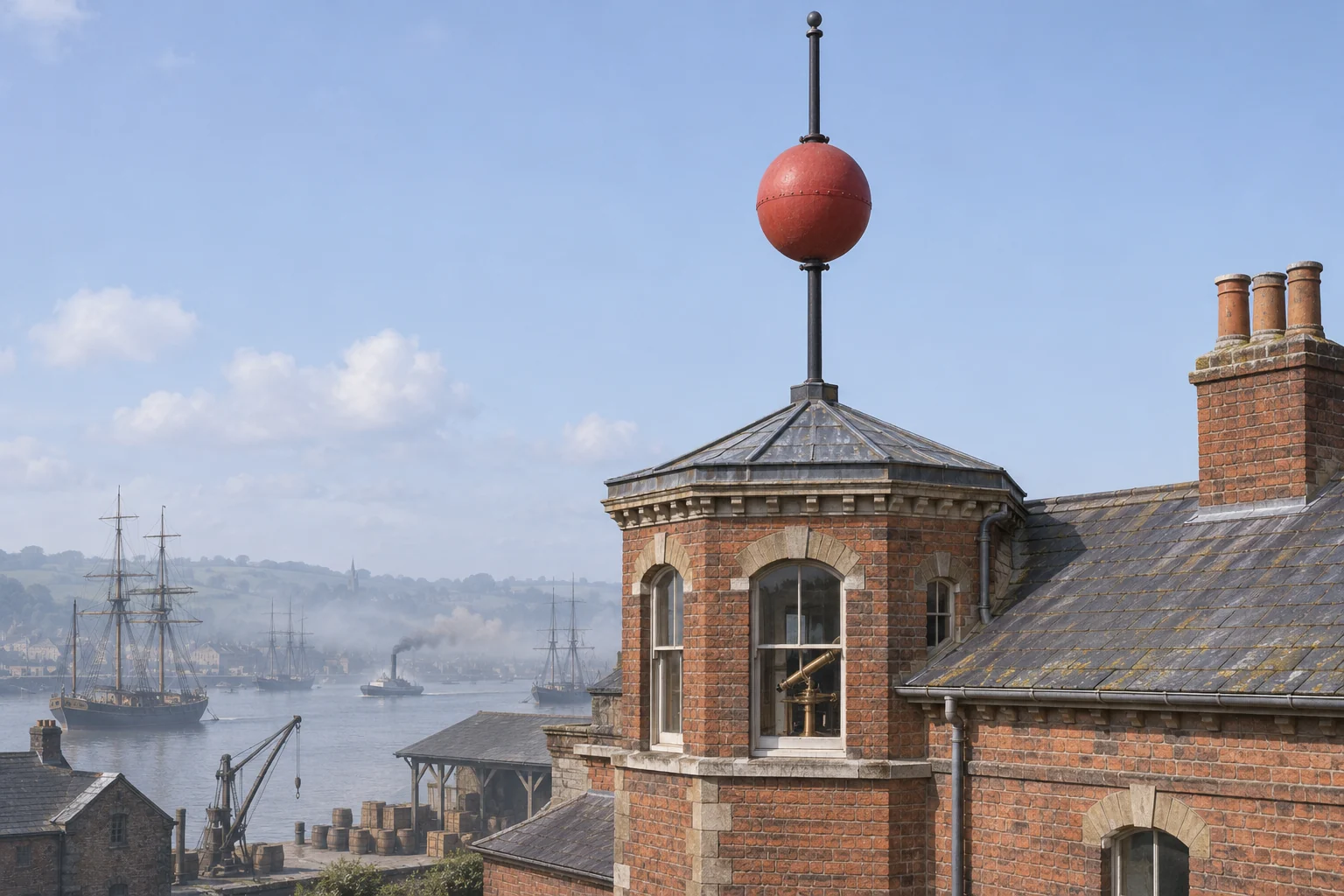
A ship lies on the Thames with a good chronometer aboard. On the hill at Greenwich, a red ball stands at the top of a mast. The officer checking the time has two things to watch and only one useful instant. It comes when the ball begins to fall. Wait for it to reach the bottom and the comparison is already late. The distance between roof and river is part of the appeal of the device. An entire anchorage can see the same instant without sending anyone ashore.[1, 2, 5]
A harbour time ball gave mariners a visible signal at a previously announced time. At Greenwich the signal was one o’clock in the afternoon. A navigator could compare the reading of a watch or chronometer with the drop and record how far the instrument was fast or slow. That small correction would travel with the ship. Out at sea, a reliable reference time helped the crew work out its longitude, even when the time ball itself was hundreds of miles behind.[1, 3, 5]
Why raise it twice?
The Greenwich sequence gave observers a chance to get ready. At five minutes to one the ball rose halfway up its mast. At two minutes to one it reached the top. At one it dropped. An officer glancing toward the observatory could tell whether the comparison was approaching or imminent. Had the ball simply fallen once each day without a visible warning, a momentary distraction at just the wrong instant could have cost the navigator a whole day’s observation.[1, 2]
The signal carried remarkably little information on its own. It didn’t count out the hours, show a minute hand or tell a newcomer which time standard the authorities were using. Those details had to be known beforehand. What it did supply was a conspicuous change between two states. Even from some distance, a watcher who could barely see the mechanism could distinguish a stationary ball from one beginning its descent. The arrangement concentrated the important part of the message into that change.[1, 2, 3]
A clock error can be more useful written down
Suppose the ball drops and the ship’s instrument reads one hour, zero minutes and twelve seconds. The chronometer is twelve seconds fast. For that observation, subtracting twelve seconds gives the correct reference time. Tomorrow the same comparison shows it is fourteen seconds fast. If both comparisons were sound and a day apart, the instrument gained about two seconds over that interval. The first number describes its error at one moment. The change between the two observations estimates its rate.[5]
A contemporary account from 1862 advised making comparisons at the same hour on several days while the ship was in dock. This gave the navigator a chance to see whether a gain or loss was reasonably consistent. Imagine an instrument with a steady daily gain and another whose reading wanders unpredictably. The first might show the larger error on departure yet prove easier to use at sea. A recorded correction and a dependable rate can be applied later, even while the hands continue to run.[5]
How time becomes a position
Earth makes a full turn relative to the mean Sun in twenty-four hours. Divide 360 degrees by twenty-four and one hour of mean solar time corresponds to fifteen degrees of longitude. Local noon comes earlier at places farther east. A navigator who determined local time by astronomical observation could compare it with the corrected reference time kept aboard. The difference supplied longitude relative to the reference meridian. Keeping time through an ocean crossing made that comparison available wherever the sky allowed an observation.[3, 5]
For a simplified example, suppose it is noon by local mean solar time and the corrected Greenwich time is two in the afternoon. Local noon has arrived two hours later there than it did at Greenwich. The ship is about thirty degrees west. Astronomical observations require reductions to get the appropriate time for the comparison. The arithmetic shows why the quality of the clock mattered. Four minutes of time correspond to a whole degree of longitude, while the physical distance represented by that degree depends on latitude.[3, 5]
The clock behind the ball
The authority of the signal came from the observatory. Astronomers could observe a known star crossing the local meridian and compare the timed event with its expected passage. A clock maintained against such observations supplied a reference between clear nights. The ball made the result available outside the building. Each ship needed a clear view of the mast for a short time, while the work of maintaining the reference took place elsewhere and on a different schedule.[3, 5]
Electric telegraphy made it possible to operate another signal much farther away. At Deal, ships lying in the Downs could check their chronometers before heading out to sea. The nineteenth-century account describes an electrical release signal from Greenwich and a return signal from Deal after the drop. From the observatory’s point of view those were separate events. Sending the instruction established what the clock had requested. Receiving a response gave the staff evidence that the distant apparatus had actually operated.[5]
Another harbour, another hill
Above Whakaraupō Lyttelton Harbour in New Zealand, a station built in 1876 supplied a daily one-o’clock signal until 1934. Keepers tended the apparatus that raised and released the ball. Radio communication eventually gave ships another way to obtain the time. That change removed a geographical restriction that no improvement in the colour or size of a ball could overcome. Once a ship sailed beyond sight of its harbour, it had lost access to the visual signal.[4]
The Lyttelton structure was badly damaged in the Canterbury earthquakes, and a rebuilt tower with its restored zinc ball rose above the harbour in 2018. For anyone watching such a signal today, the temptation is to follow the ball all the way down. The mariner’s task was different. At the first movement, attention had to turn to the clock. The real product of the entire performance was a number small enough to write in a notebook and valuable enough to take to sea.[4, 5]
Related reading
Sources
- Royal Museums Greenwich — The Greenwich Time Ball
- Royal Museums Greenwich — The Greenwich Time Ball and one time for all
- Royal Observatory Greenwich history — The Greenwich Time Service
- Tohu Whenua — Lyttelton Timeball
- Royal Observatory Greenwich history — A contemporary account from 1862
Keep exploring.
One remarkable idea at a time—nature, science, history and beyond.
Last updated November 21, 2026.

Barnakle Editorial Team
Barnakle Editorial Team is the collective byline used for Barnakle’s editorial articles. The contributor profile explains the team identity and links to the publication’s editorial policies.
More from the editorial team →