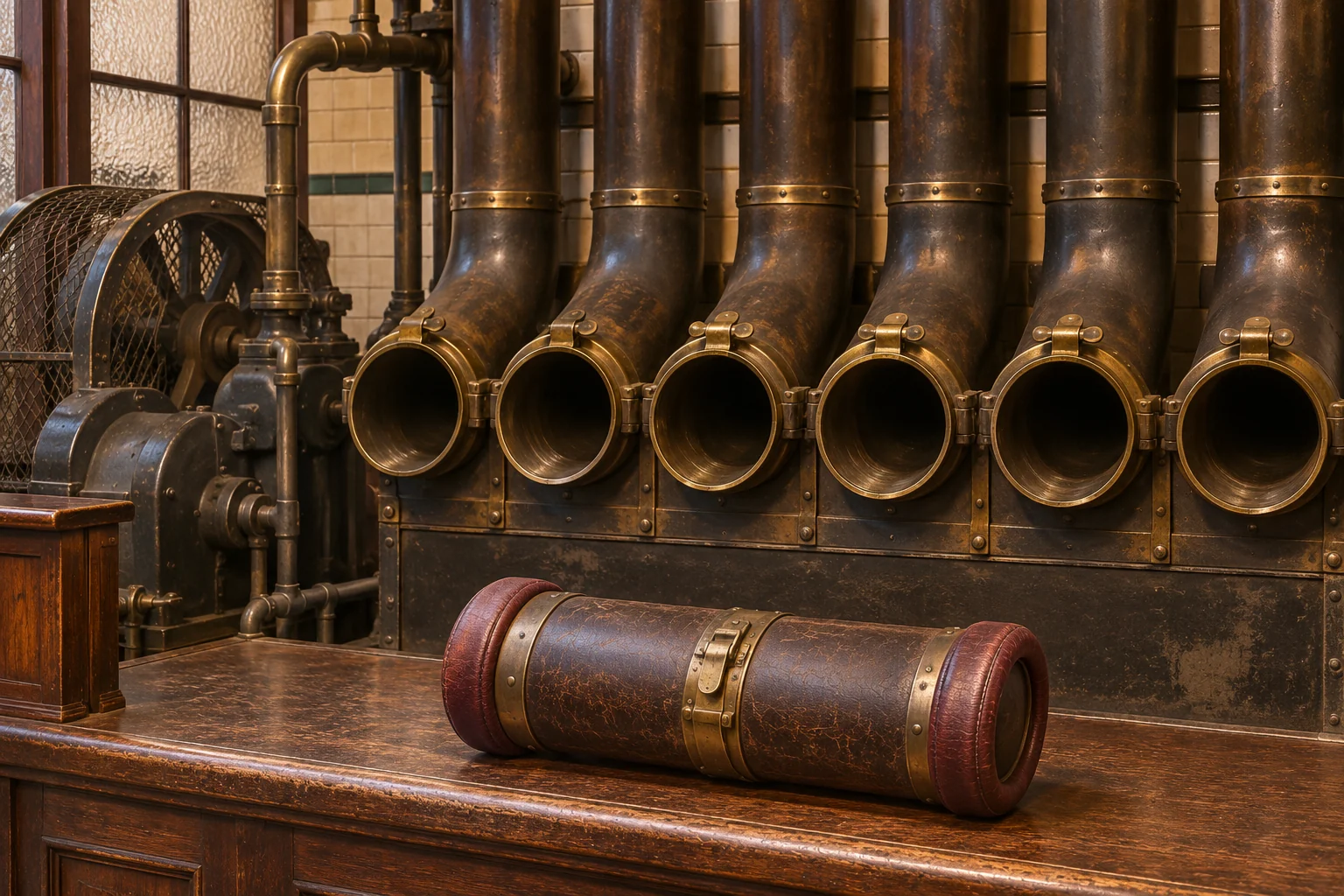
A metal canister in the Smithsonian collection once made a trip that hundreds of New Yorkers’ letters shared. It could carry as many as six hundred letters and travel about thirty-five miles an hour. There was no engine in the canister and no cable to haul it along. Its motor, in effect, was at the station. Pumps arranged the air in a long pipe so that pressure on one end of the carrier exceeded pressure on the other. The canister travelled with its contents tucked inside.[1, 4]
Philadelphia began using pneumatic tubes for postal service in 1893. New York followed in 1897, linking its main post office with a station in the Produce Exchange building. The trip beneath the streets attracted attention for its speed, but the interesting engineering happened at both ends. A clerk had to get a carrier into a pressurized line, behind the one ahead of it, and another clerk had to receive it without taking a blow from a fast-moving steel cylinder.[1, 2, 4]
What actually pushed the letters?
Picture the canister stopped halfway along a horizontal tube. Air presses on both ends. If the pressures are equal, those two pushes cancel even if the pressure throughout the line is high. Raise the pressure behind the canister, or lower it in front, and one push becomes stronger. The difference, acting over the cross-sectional area of the carrier, produces a forward force. The equipment on a particular route might use compressed air or a partial vacuum. In both cases it is the imbalance that matters.[1, 2]
The closeness of the fit is part of the mechanism. In one American design, rings near the two ends made contact with the inside of the tube while keeping the metal body clear of the wall. Air that leaked past worn rings did less work on that carrier. This posed a surprisingly specific traffic problem. A closely fitting canister could catch up with a leakier one sent earlier. A maintenance worker examining a ring was helping control the spacing of letters somewhere below the street.[2]
A station door that could open without emptying the line
In a gravity-fed transmitter described in a government report, the clerk placed a loaded carrier at an inclined opening. Gates admitted it to a chamber and then to the running line. Air supplied behind the cylinder sent it on its way. The chamber solved a familiar problem for anybody who has stepped through a vestibule on a windy day. By controlling the openings in sequence, the station could exchange a solid object with the pipe without leaving a direct, open route for the pressurized air to escape.[2]
One transmitter incorporated a time lock. Even if the next canister was already packed, it had to wait until the interval following the previous launch had elapsed. Sending a single cylinder at speed and maintaining a stream of them were different engineering tasks. The latter required gaps at the far end as well as at the sending end. The receiving machinery had to clear one canister into a clerk’s reach before the following one occupied the same space.[2]
How did a cylinder stop?
Some receiving stations put the air ahead of a carrier to a second use. As the cylinder approached a closed gate, it squeezed the air into a smaller space. The rising pressure pushed back against the approaching carrier and slowed it. A gate could then release the carrier onto the receiving table. Other receivers used a curved table and friction. There was no single pattern of machine hiding in every postal basement. Each design had to solve the same transition from rapid travel to a package someone could handle.[2, 3]
It is worth following the enclosure itself through that transition. The letter inside could be flimsy, oddly folded or addressed in delicate handwriting. The station and the pipe saw a cylinder of standard shape with a closed end. At the destination a clerk opened it, took the letters out and routed them onward. Standardizing the carrier let the machinery ignore much of the variation among its contents. The size of its opening also set a firm limit on what the route could take.[2, 4]
Fast between two addresses on a map
The network connected particular postal buildings. It did not extend to every person whose letters rode it. A bag of mail could arrive by another means, have part of its contents loaded into carriers and continue from the far station on an ordinary delivery round. On one New York run the National Postal Museum compares a seven-minute tube journey with a forty-minute wagon trip. That saving belongs to one leg of the journey. The time a particular letter spent waiting, sorting and travelling beyond either endpoint still counted.[3, 4]
London offers a useful comparison of scale. In the nineteenth century the Pneumatic Despatch Company tried moving wheeled cars on rails inside a passage using air pressure. The British Postal Museum’s history distinguishes that experiment from the electrically powered Post Office Railway that came later. Both moved mail underground, and both could disappear from the street scene. Only the air-driven system depended on maintaining a pressure difference along its route. The little American mail cylinder and the larger rail vehicle were closer cousins in this respect than two similar-looking tunnels might suggest.[1, 5]
The route map also turns up a surprise. One New York link to Brooklyn was fastened to the Brooklyn Bridge. That section carried the mail above ground. Air pressure did the same job there as under a pavement. The choice of path had more to do with how the builders could cross a river than with any need to bury the equipment.[4]
A fixed pipe ultimately shared a weakness with a fixed railway. Move a post office and the route still ends where the old building stood. Digging a new line meant negotiating foundations, utilities and groundwater again. As cities and their mail volumes changed, short travel times could no longer settle the question of whether the systems were worth keeping. The Smithsonian’s canister captures both sides of that bargain. It was an extraordinarily quick carrier between precisely the places the builders had connected, and it could not deliver a single envelope one street beyond them.[1, 3, 4]
Related reading
Sources
- Smithsonian National Postal Museum — Pneumatic transport
- United States government report — Pneumatic-tube service for the mails
- Smithsonian National Postal Museum — Pneumatic tube mail and city delivery
- Smithsonian Institution — New York pneumatic tube canister
- British Postal Museum & Archive — Post Office Underground Railway and earlier schemes
Keep exploring.
One remarkable idea at a time—nature, science, history and beyond.
Last updated November 21, 2026.

Barnakle Editorial Team
Barnakle Editorial Team is the collective byline used for Barnakle’s editorial articles. The contributor profile explains the team identity and links to the publication’s editorial policies.
More from the editorial team →