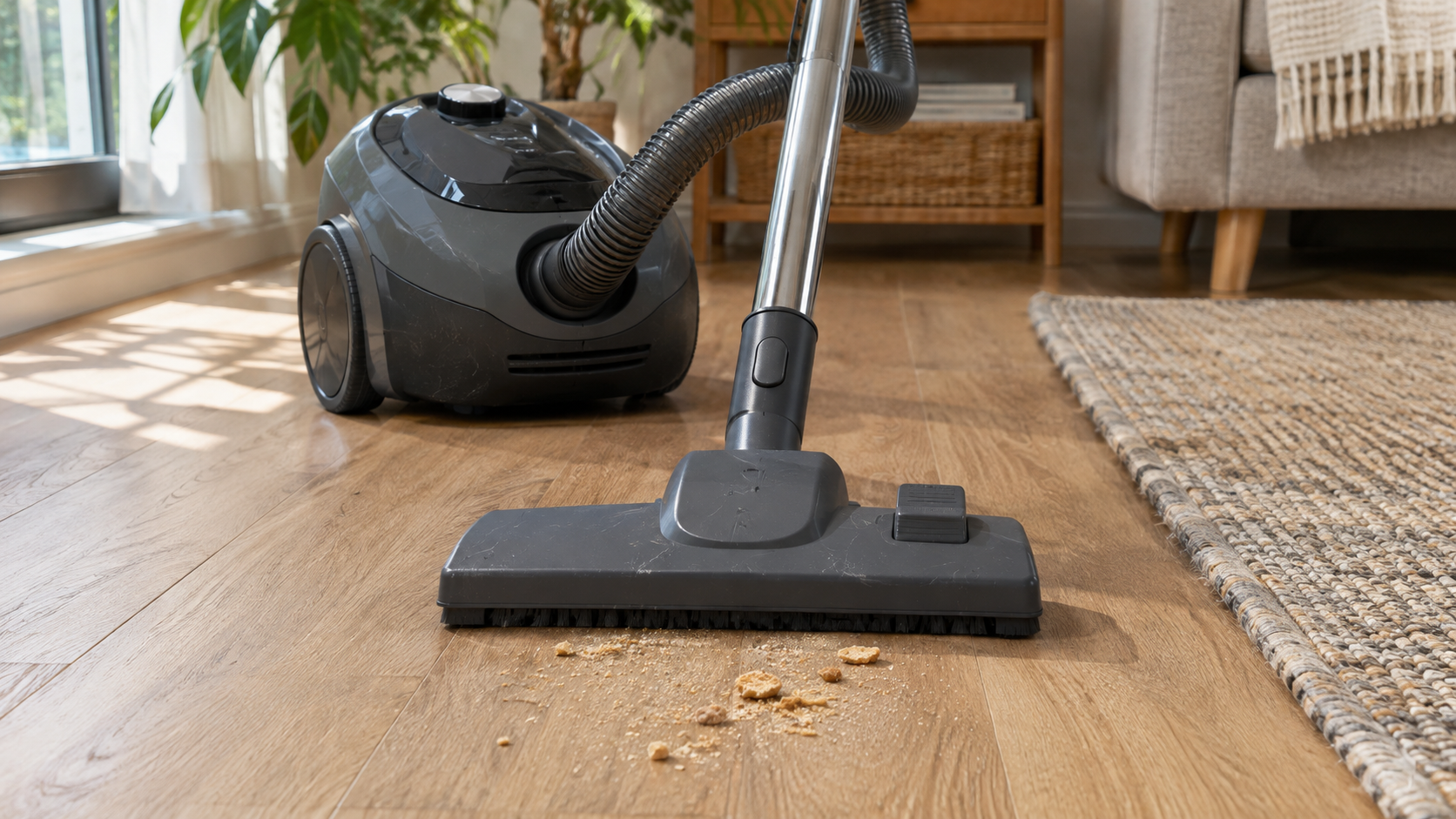
Air must move, dirt must loosen and particles must stay captured
A vacuum cleaner makes dirt disappear from the floor, but it does not make the air disappear. Air enters the cleaning head, travels through the appliance and returns to the room. The engineering challenge is to move that air usefully while keeping the collected material inside.
Following the route explains several familiar observations: a clogged filter can reduce cleaning, a brush can matter as much as a headline suction number, and a strong pull at a blocked opening is not the same as transporting dust through a hose.
Follow the mechanism
- A motor-driven fan creates a pressure difference along an air path.
- Air flows into the cleaning head and carries loosened particles.
- A bag or separator collects much of the debris.
- Filters and a sealed path help retain particles as air leaves.
A fan moves air; it does not create an empty chamber
In an ordinary electrically powered vacuum, a motor drives a fan system that moves air and establishes pressure differences. Surrounding air flows into the lower-pressure inlet region. The working flow can carry debris toward the collection system.
BISSELL’s engineering account describes the connection between the motor, pressure difference and movement of debris. The machine’s name should not be read as a claim that it creates a perfect vacuum inside the hose. It operates with air continuously passing through it.
This is why tracing the exhaust is as important as tracing the inlet. A cleaning explanation that stops at the dust container misses the rest of the air path. The appliance must manage both the incoming material and the air it releases.
Sources: [1]
Suction pressure and airflow are different measurements
A pressure difference describes how strongly one region differs from another in pressure. Airflow describes how much air passes through a system in a given time. SEBO’s technical explanation distinguishes these ideas and discusses why both matter to a vacuum.
A suction cup offers a useful comparison: it can be held in place by a pressure difference without a continuous stream of air passing through it. A cleaner needs transport as well as a pressure difference. Dust cannot travel along a hose in the absence of the relevant flow.
Do not turn that comparison into a test that blocks a running cleaner. The purpose is conceptual. A specification measured under a sealed condition and a specification measured with free airflow describe different operating points, and neither alone states the cleaning result on a real carpet.
Sources: [2]
The head has to make dirt available to the flow
Particles can be loose on a hard floor, caught among carpet fibres or entangled with other material. The cleaning head determines where air enters and how it interacts with that surface. This is a different route to removing dirt from the chemical action of soap on grease. A brush roll can agitate material so that the flow can carry it away.
BISSELL describes rotating brushes as part of the process, while LG’s account stresses that attachments and airflow design contribute to performance alongside suction. A powerful motor cannot make every head geometry suitable for every surface.
Imagine trying to remove crumbs hidden behind a narrow ridge using air moving past a different part of the floor. The flow may be strong somewhere, but its route still misses the crumbs. This is a geometric problem, not a shortage of impressive numbers on the motor label.
| Part or idea | What it does | Common misunderstanding |
|---|---|---|
| Pressure difference | Describes pressure across a measured condition. | The largest pressure number guarantees the best floor pickup. |
| Airflow | Describes the volume of air passing per unit time. | It is identical to electrical wattage. |
| Brush and floorhead | Expose and entrain material from a surface. | Every attachment cleans every surface equally. |
| Separation and filtration | Retain material from the working air stream. | A powerful fan automatically captures fine particles. |
A bag can collect particles while allowing air through
In a bagged design, the bag is part of a filtering collection system. Air can pass through the material while particles are retained. As material accumulates, resistance to flow can change.
Miele’s manual explains that fine dust can block bag pores even before the bag looks physically full. This illustrates a distinction between available storage volume and the ability of air to pass through the material. A half-empty container is not a complete airflow measurement.
The exact behaviour depends on the bag, debris and appliance design. The general lesson is to follow the manufacturer’s specified bag and maintenance guidance. An arbitrary replacement material may change both flow resistance and particle capture.
Sources: [4]
Cyclones separate particles from a moving air stream
A bagless cleaner may send air through cyclonic separators. Swirling flow changes particle trajectories so that material can be separated into a collection region. Dyson describes using stages of cyclonic separation together with filters in its designs.
The presence of a cyclone does not establish that no further filtration is needed. Large debris and much finer particles present different separation problems. In the manufacturer’s explanation, the bin, cyclones, filters and air-path sealing work as a combined system.
This is another case where a visible component can dominate the story without doing every job. A transparent bin makes collection easy to see, but it does not show every particle that remains in the air stream. An explanation needs to continue beyond the part that looks most dramatic.
Sources: [5]
A filter rating is not the whole-machine result
EPA describes HEPA as a mechanical filtration category associated with high capture efficiency for particles around 0.3 micrometres under the relevant conditions. The familiar percentage refers to filtration performance, not to a promise that every object or contaminant in a room is removed.
Air must actually pass through the intended filter rather than escape through another route. Dyson’s filtration account explicitly includes machine sealing alongside filter design. A component’s performance and an assembled appliance’s performance are related but different claims.
This article explains ordinary cleaning mechanisms; it does not assign a household cleaner to hazardous-dust work. A consumer label alone is not a complete specification for a specialised cleanup task. The intended use and whole-system design need to match the material being handled.
A simple calculation shows why the measurement conditions matter
For a simplified steady air stream, pneumatic power can be represented as pressure difference multiplied by volumetric flow rate. Suppose an imaginary operating point has a pressure difference of 2,000 pascals and a flow of 0.02 cubic metres per second. Their product is 40 watts.
These are invented teaching values. They are not the electrical input, a product rating or a comparison between cleaners. Real test definitions and the measurement location matter, and losses separate electrical input from useful air power.
The example shows why multiplying a maximum sealed-pressure figure by a maximum free-airflow figure is generally misleading: the two maxima may not occur together. A useful calculation requires values from the same operating condition, rather than selecting the most flattering number from each test.
Sources: [2]
Why filters and obstructions affect the whole route
A restriction changes the resistance of the air path. A dirty filter, obstructed hose or unsuitable head can therefore affect the operating flow. Philips and BISSELL both identify dirty filters as a reason for reduced cleaning performance.
Follow the instructions for the particular appliance: some filters are washable and others are not, and cleaning and drying requirements differ. A general explanation cannot turn every filter into an interchangeable household item.
The useful habit is to think of a complete route. Improving one section while leaving another severely restricted may not produce the expected result. The fan, head, passages, collector and filter all participate in the same moving-air system.
Questions readers ask
Does a vacuum suck in air or just dirt?
It draws in air, and the moving air can transport loosened dirt. The appliance then separates particles and exhausts the air.
Is more electrical wattage always better cleaning?
No. Electrical input does not by itself specify the flow at the head, the pressure difference under use, agitation or particle capture.
Does a bagless cleaner have no filters?
Not necessarily. Cyclonic separation and filters can be used together, with each stage handling part of the collection task.
Can a bag reduce airflow before it looks full?
Yes. Fine material can increase flow resistance by loading the filtering material, even when visible storage space remains.
Does a HEPA filter guarantee a completely sealed machine?
No. A filter category and the design of the assembled air path are different parts of the performance claim.
The cleaner works as an air-handling system
A vacuum’s useful output comes from a connected process: loosen material, entrain it in air, move it along a route, separate it and retain it while the air leaves. Suction is one part of that system.
Once the whole route is visible, the appliance becomes easier to understand. Dirt pickup is not a single number or a mysterious pull; it is the outcome of flow, surface interaction and collection working together.
Continue exploring
Sources and further reading
- BISSELL — The Race for Stronger Vacuum Suction Power
- SEBO Canada — Making Sense of Vacuum Cleaner Technical Specs
- LG — What Is Suction Power in a Vacuum Cleaner?
- Miele — S5001 operating instructions: airflow indicator and FilterBag
- Dyson — Filtration at Dyson
- US EPA — What is a HEPA filter?
- Philips — Low suction power and filter condition
Keep exploring.
One remarkable idea at a time—nature, science, history and beyond.
Last updated November 6, 2026.

Barnakle Editorial Team
Barnakle Editorial Team is the collective byline used for Barnakle’s editorial articles. The contributor profile explains the team identity and links to the publication’s editorial policies.
More from the editorial team →