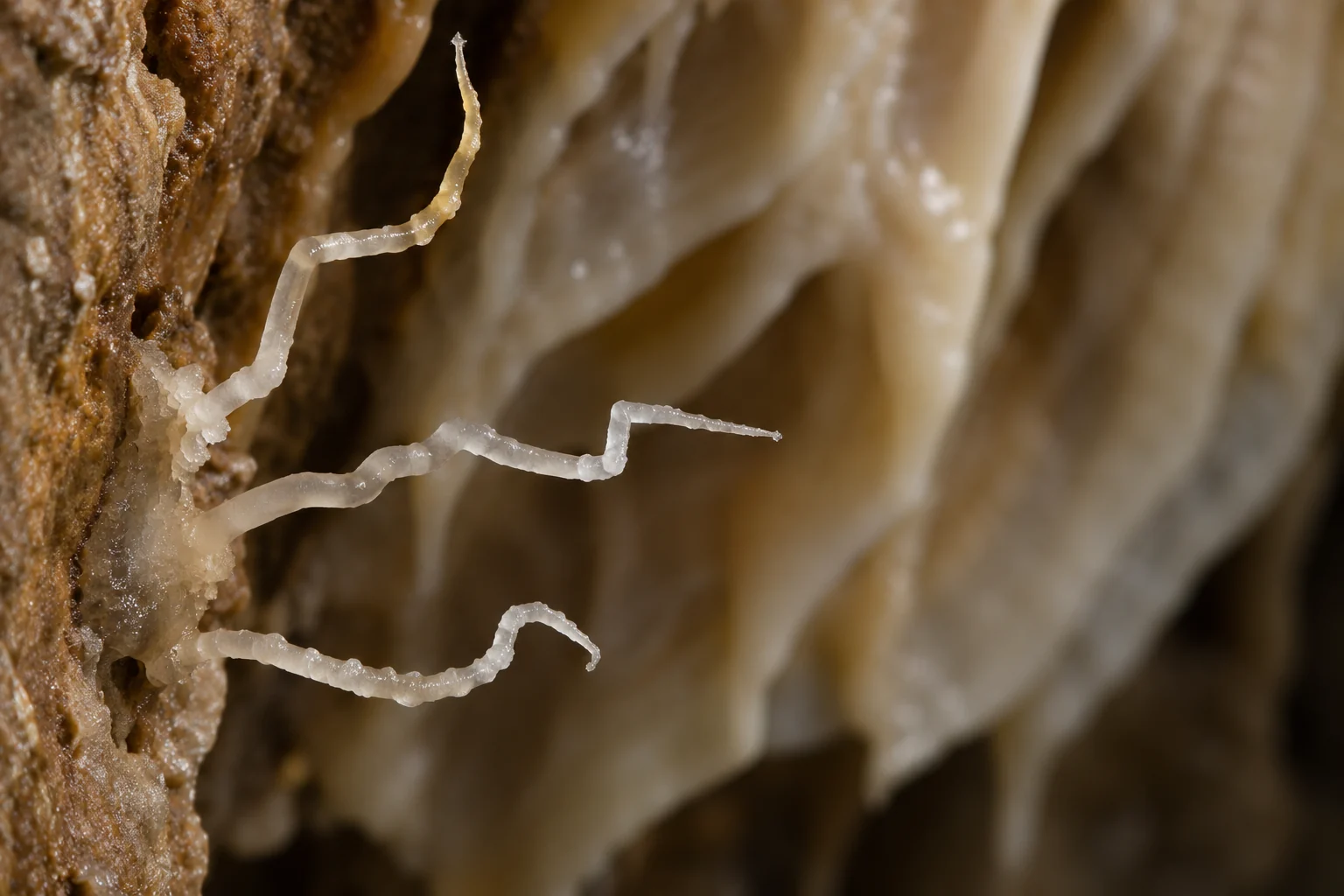
Some cave formations look as though the ceiling forgot which way was down. A thin mineral stem leaves a wall horizontally, turns a corner and points back towards the roof. Such a formation is called a helictite. Its growing tip can receive water through a tiny channel or along a wetted surface. Where that water leaves calcium carbonate behind, the mineral grows a little farther. The next addition can be made off to one side of the one before it. A finished elbow can therefore be quite rigid despite looking as though someone bent it. [1, 2, 3]
Where the water goes before the mineral stays
Start with the formation that most clearly advertises gravity: a soda-straw stalactite. Water carrying dissolved minerals reaches a cave ceiling and gathers into a hanging drop. Calcium carbonate can accumulate around the drop's edge. As drops are replaced, a rim develops into a hollow tube. The lowest point remains a good place for the next drop to hang. This arrangement repeatedly delivers mineral to a site beneath the ceiling, providing a straightforward way for a slender formation to extend downwards. [1]
A helictite changes the scale of the plumbing. Water wets the walls of very narrow passages. Surface tension and adhesion at the boundary between water, air and mineral become important at that scale. With a supply of solution behind it, a wet tip can persist at an angle where a succession of large free-hanging drops could never remain lined up. Gravity still acts on every drop. The difference is that much of the journey to the growing end can take place inside the solid or in a thin film against it. [2, 3, 4]
Separate the journey of the water from the destination of its dissolved load. A trickle can deliver dissolved calcium and bicarbonate to the end of a formation. As the water exchanges carbon dioxide with cave air or loses water by evaporation, conditions can favour deposition of calcium carbonate. The water can move on or disappear while the new crystal material stays attached. A drawing showing only falling drops would miss much of this transport, and a photograph showing only the solid would hide almost all of it. [1, 3, 4]
An elbow built one tip at a time
Imagine a pencil line tracing the centre of a small white stem. Along the first centimetre it runs horizontally. At the tip, suppose one edge remains wetter and accumulates mineral a little faster than the other. The position that receives the next addition can shift. Repeated growth around a changing outlet can make the centre line curve or branch. No long piece of crystal has to bend through a right angle after hardening. The path is a record of successive growth positions. [2, 3]
The broad idea is easier to defend than an explanation for every kink. Crystal orientation affects which faces can grow, and the route water takes can change as mineral accumulates. In some specimens tiny additional passages lead away from the principal channel. A wetted spot on the outside can thicken an existing stem while another spot extends its tip. Looking at a knob on the finished formation, it may be impossible to tell which of several changes in water supply or crystal growth first nudged the outlet to one side. [2, 3]
What researchers find inside
One study compared helictites made of calcite with others made of aragonite. Both minerals have the chemical formula calcium carbonate, but their atoms are arranged differently. In the calcite specimens the researchers described principal channels commonly about one tenth to one fifth of a millimetre in diameter. Some had a beaded internal outline rather than the smooth walls of a miniature drinking straw. That is a route for feeding a growth tip that a visitor admiring the cave wall could scarcely hope to see. [3]
In the aragonite specimens the investigators described a more elaborate network. Small channels could deliver water towards the outside, where mineral growth could produce a protrusion. The authors proposed that a shift in the small wet area at the tip could influence which direction grew fastest. These observations concern particular specimens. The chemical formula alone would not have predicted their separate internal architectures, and two similar-looking curls in a photograph need not have been fed in precisely the same fashion. [3]
A study of ribbon helictites at Jenolan Caves in Australia offers another close look. These examples can broaden from a stem into a flattened, curving ribbon. In transmitted light, the researcher could follow a canal inside a ribbon and observe its position relative to a bend. In one description the passage lay close to the middle but tended towards the outside of curves. The study also examined orientations of the surrounding crystals. The joint evidence provides a stronger test of a growth model than resemblance to a curled shaving alone. [5]
Reading a group on a cave wall
The Rose Trellis Room in Nevada's Lehman Caves gives these observations a setting. A geologic field guide describes helictites there alongside older broken cave formations with small, newer soda straws on them. In such a scene, two pale projections only a short distance apart can tell different stories about how water reached them. One may mark a place where water repeatedly accumulated into hanging drops. Beside it a crooked branch may mark the route of a much more restricted supply to a growing point. [1, 4]
If a breeze simply blew every tip aside, a collection pointing in many directions would pose an immediate puzzle. Air can matter to cave conditions, including evaporation, but the shape of a group is a poor wind gauge. An explanation for a particular growth must account for how mineral reached the end, why it accumulated in a particular place and what the interior preserves. Airflow by itself tells you little about an enclosed channel with evidence of different growth directions along its length. [2, 3, 5]
The next time you see a photograph of a helictite, follow one unbroken stem from its attachment to its tip. The curve tells you where a solid has grown. It gives you a reason to ask where water could remain in contact with that solid, even on its underside or at an upward-facing point. What looks at first like a stone defying gravity turns out to be a visible trace of water moving through spaces too small to see from the cave path. [1, 2, 3]
Related reading
Sources
- National Park Service — Speleothems
- National Speleological Society — Helictites
- Petrographic and geochemical constraints on the formation of gravity-defying speleothems
- Geologic field guide to Lehman Caves
- Jill Rowling — Ribbon helictites
Keep exploring.
We’ll email you when the first edition is ready.
Last updated November 26, 2026.

Barnakle Editorial Team
Barnakle Editorial Team is the collective byline used for Barnakle’s editorial articles. The contributor profile explains the team identity and links to the publication’s editorial policies.
More from the editorial team →