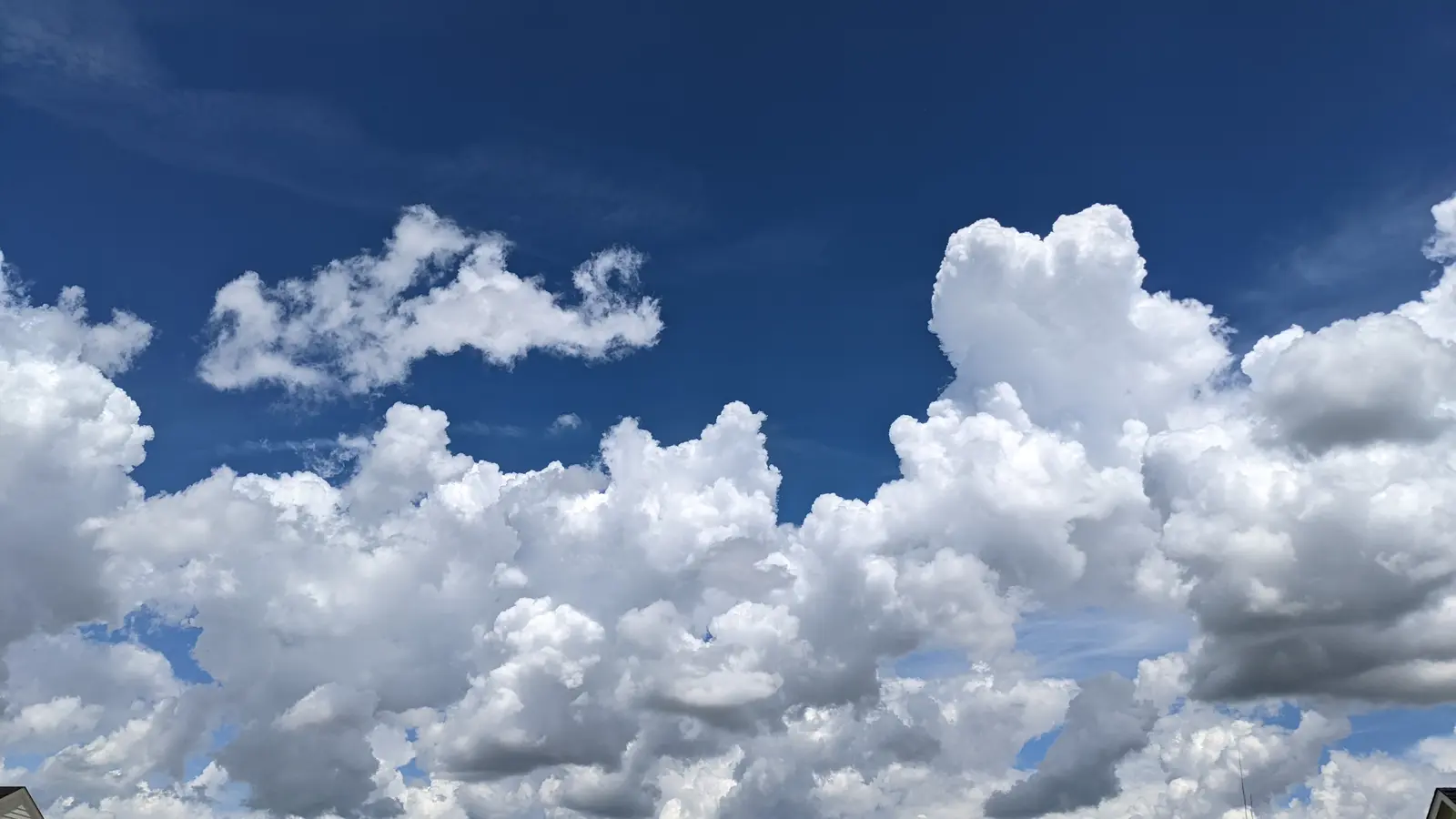
Microscopic droplets fall so slowly that rising and turbulent air can keep replenishing and suspending them
The short answer
A large cloud may contain hundreds of tonnes of liquid water, yet that total is spread among an immense number of microscopic droplets across many cubic kilometres. Mass alone does not determine whether the particles fall quickly; size, drag, air motion and phase changes do.
Condensation begins on tiny particles
Water vapour condenses onto cloud condensation nuclei such as sea salt, sulfate, dust or organic material. Without these surfaces, ordinary atmospheric supersaturation would often be insufficient.
Cloud droplets are microscopic
A typical droplet is only around tens of micrometres across. Its small mass produces a low gravitational force, while air resistance is large relative to that mass.
Terminal speed can be tiny
A falling particle accelerates until drag balances weight. Small cloud droplets may settle only centimetres per second in still air, easily offset by weak upward motion.
Updrafts supply support
Warm buoyant air rises as a parcel cools toward saturation. Continued ascent can carry droplets upward faster than they settle and condense additional water.
Turbulence mixes particles
Eddies move droplets in many directions, sometimes keeping them within a cloudy layer and sometimes transporting them into drier air where they evaporate.
A cloud is a process
Individual droplets form, grow, collide, freeze and evaporate. The visible shape persists only while airflow and humidity keep creating particles in roughly the same region.
Cloud edges mark humidity boundaries
At an edge, mixing with unsaturated air evaporates droplets and makes the boundary appear sharp or ragged. The air itself continues moving across that visual border.
Droplets eventually grow
Collision and coalescence can build larger drops in warm clouds. In cold clouds, ice crystals grow at the expense of supercooled droplets and may aggregate.
Rain begins when settling wins
Once particles become large enough, their terminal speeds exceed supporting air currents. They fall as precipitation, though some evaporates before reaching the ground.
Ice crystals need support too
Small crystals have low fall speeds and remain in cirrus or mixed-phase clouds. Shape, density and orientation change their drag and optical effects.
Clouds can contain strong vertical motion
Thunderstorms sustain large droplets, ice and hail in powerful updrafts. When those currents weaken or particles grow too heavy, precipitation descends rapidly.
Cloud weight is spread through air
A cloud’s liquid-water content is often only a fraction of a gram per cubic metre. Multiplying by huge volume gives a large total without creating a compact falling mass.
Common misconceptions
Clouds are not weightless, hollow or supported by a mysterious atmospheric surface. Water droplets continuously settle, but slowly. Updrafts, turbulence and ongoing condensation maintain the visible cloud, while particles that grow large enough become rain or snow.
How scientists know
Meteorologists sample droplets with aircraft probes, radar and lidar, measure humidity and vertical wind, and track cloud development from satellites. Laboratory cloud chambers control aerosols and supersaturation, while numerical models couple microphysics with turbulent airflow.
How much does a cloud weigh?
A cumulus may contain hundreds of tonnes of liquid water, spread through a vast volume of air.
Why do dark clouds not fall faster?
Darkness mainly reflects thickness and light scattering, not one solid mass of water.
Why does rain suddenly start?
Droplets or crystals cross growth thresholds and falling particles collect others on the way down.
Can a cloud touch the ground?
Yes. A cloud at ground level is called fog.
Are clouds warmer or colder than the air?
Temperature varies by cloud and altitude; formation depends on saturation relative to the surrounding conditions.
Key takeaways
- Cloud particles are heavy but extremely small.
- Air drag gives droplets low terminal speeds.
- Updrafts and turbulence counter settling.
- Clouds persist through continuous formation and evaporation.
Continue exploring
Sources and further reading
Keep exploring.
One remarkable idea at a time—nature, science, history and beyond.
Last updated October 29, 2026.

Barnakle Editorial Team
Barnakle Editorial Team is the collective byline used for Barnakle’s editorial articles. The contributor profile explains the team identity and links to the publication’s editorial policies.
More from the editorial team →