A motor, chains and two precisely shaped tracks turn linked steps into a continuously moving staircase
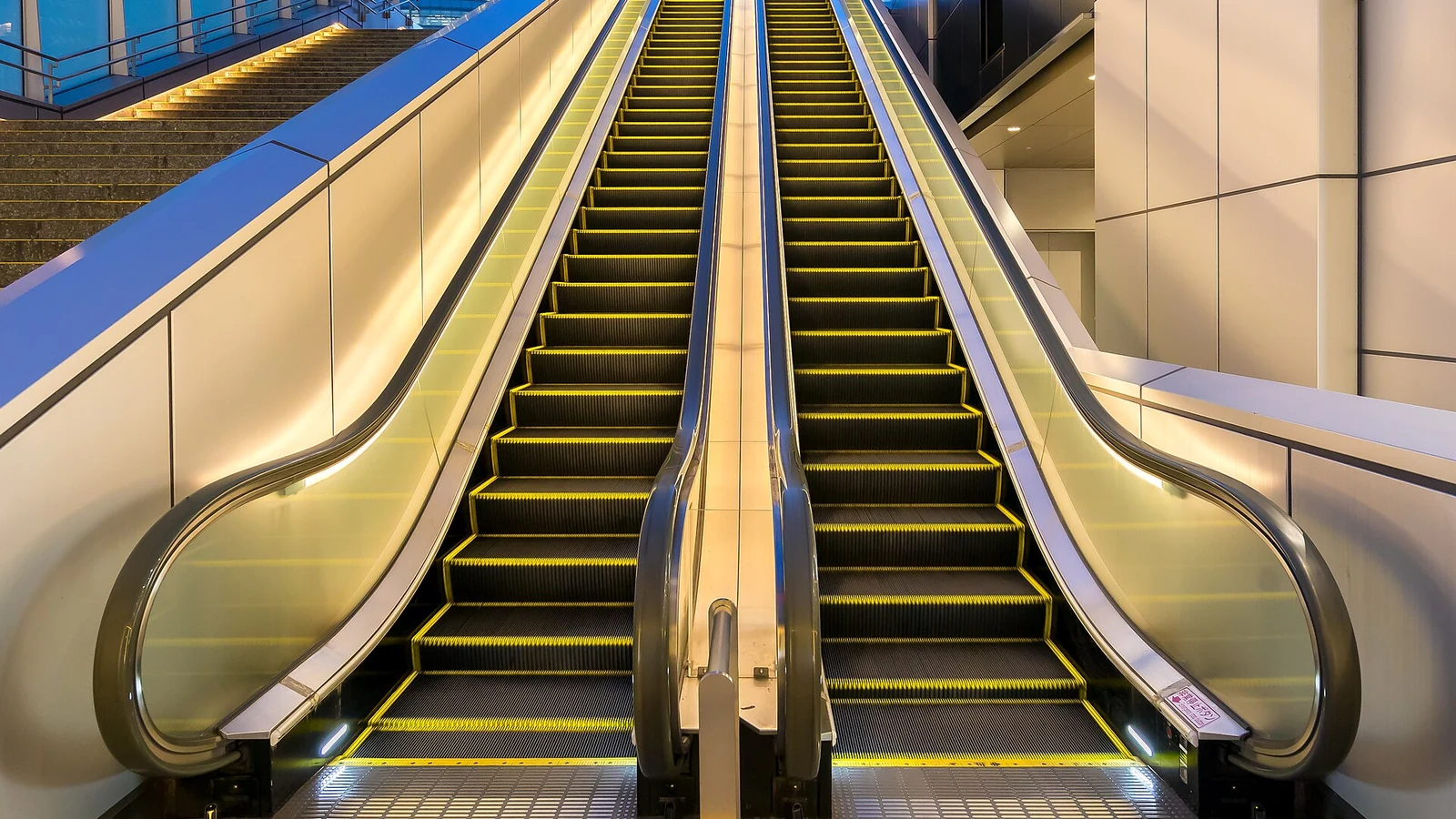
Stand beside an escalator landing and watch a staircase flatten before it disappears beneath the floor. The steps have not folded away individually or been replaced by fresh ones. They are circulating through a closed mechanical loop. The changing shape is created by tracks that guide the same rigid steps through different positions.
The visible staircase is half of a circulating loop
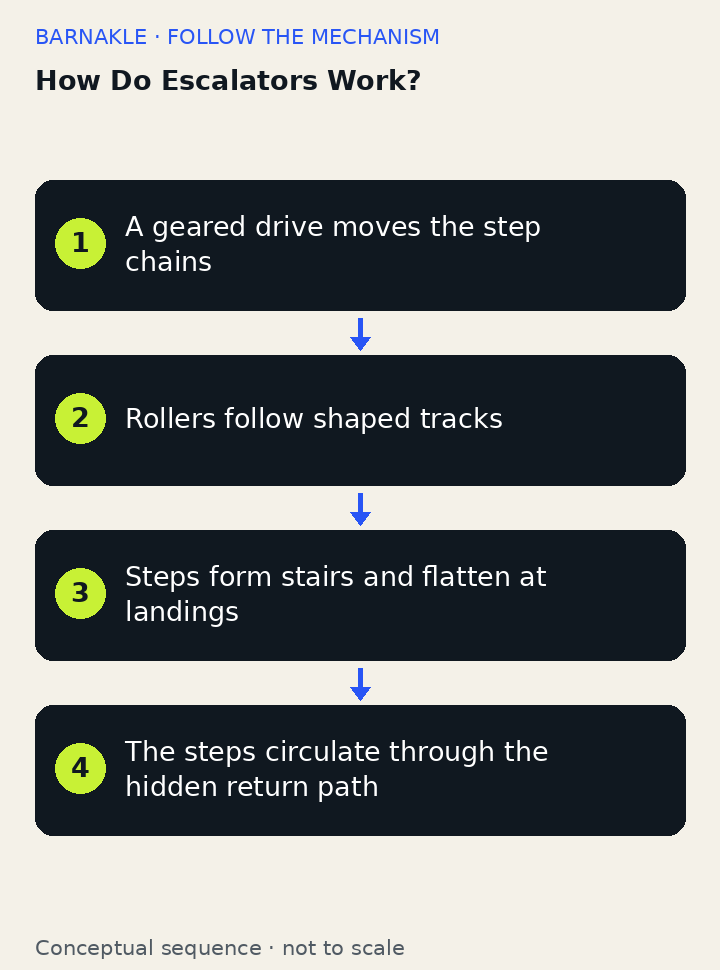
In a typical design, rigid metal steps are attached to step chains on both sides. Drive sprockets pull those chains around the upper and lower ends, so the same steps continuously circulate rather than appearing and disappearing inside the floor.
The long steel frame spanning the landings supports tracks, machinery, steps and passengers. Its alignment matters because small geometric errors can increase vibration, wear and clearances at places where clothing or objects could become trapped.
A step's appearance changes because its position relative to neighbouring steps changes. Its tread and riser remain parts of one assembly. The return path underneath the visible incline allows the same steps to come around again. Thinking in terms of a loop makes the apparent creation and disappearance of stairs much less mysterious.
Sources: [1]
Track geometry creates and removes the stairs
Each step has rollers guided along coordinated track paths. Their relative positions control the orientation of the rigid step, keeping its tread approximately horizontal while adjacent steps occupy different heights on the incline.
At a landing, the shaped track paths bring neighbouring treads to the same level. The grooves in the steps pass between fixed comb teeth as the steps enter the hidden return path. This transition geometry matters at both entry and exit.
Separate roller paths constrain a step's orientation as it moves. Their contours are designed together with the step geometry and the transition at each landing. It is therefore too simple to imagine one rail carrying an ordinary staircase upward. The rails actively determine how the moving series becomes stairs on the incline and a flatter surface near entry and exit.
Sources: [4]
Power and handrail motion have to be coordinated
In a conventional geared drive, a reduction gearbox connects a faster-running motor to the slower step-chain motion while increasing the available torque. A drive shaft turns sprockets connected to the chains. The exact drive arrangement varies between machines.
A reinforced rubber-and-fabric belt circulates through the balustrade and return path. Friction wheels or a linked drive synchronize it closely with step speed so passengers are not pulled forward or backward.
The passenger sees slow motion, but the drive must move the loaded machine in a controlled way. The handrail is another circulating component whose speed must be coordinated with the steps; it is not pulled along merely because people hold it.
Sources: [3]
Small clearances make protection and maintenance essential
A service brake stops normal motion, while additional protection can engage after overspeed, reversal or other detected faults. A stopped escalator must also resist the unbalanced weight of passengers on the incline.
Modern machines monitor chain tension, missing steps, handrail speed, skirt obstruction, comb-plate movement and emergency-stop buttons. The exact protection depends on design, code and age, but each device targets a defined hazard.
Tracks, rollers, chains, brakes and combs wear under repeated loading. Cleaning, lubrication, adjustment and inspection preserve the small clearances on which smooth and safe operation depends.
A comb plate, skirt clearance or safety switch may look like a small detail compared with the main drive. Those details are central because an operating escalator brings moving and stationary surfaces close together. Protective devices and maintenance reduce hazards, but riders still need to follow the operator's safety instructions rather than treating the mechanism as an ordinary static staircase.
Watch a single step flatten at the landing
Follow one visible step as it approaches a landing. The difference in height between it and the next step shrinks, making a flatter exit region. The step then turns into the hidden return path. That short observation reveals two ideas at once: the system is continuous, and track geometry controls its apparent shape.
The drive, tracks and protective devices
| Term or component | What it means here |
|---|---|
| Drive | Supplies controlled motion to the circulating system. |
| Tracks | Constrain the orientation and path of each step. |
| Protection | Monitors defined hazards and stops motion when appropriate. |
A stopped escalator is not an ordinary staircase
Escalator steps remain connected in a loop, while track geometry creates the staircase shape. The handrail is driven through the escalator’s machinery rather than being dragged by passengers. A stopped escalator has different step and landing geometry from a conventional staircase; follow the operator’s instructions if it stops.
How escalator operation is tested
Engineers measure speed, braking distance, chain tension, step level, clearances, structural deflection and response of safety switches. Codes and inspection procedures combine component tests with loaded operation because a safe escalator depends on the complete machine rather than one strong part.
Escalator questions
Why are there grooves in the steps?
The grooves intermesh with the landing comb fingers. Schindler describes narrow-pitch treads and comb components as parts of the entrance-and-exit safety design; the grooves are not a reason to let feet or objects slide into the comb.
Why does the handrail sometimes feel slower?
Wear, contamination, adjustment or changing grip can create a small speed difference that maintenance should assess.
Do side brushes make the edges safe to stand against?
No. Keep footwear and loose clothing clear of the sides and follow the operator’s instructions. Edge features do not remove entrapment risks.
Guided circulation makes the moving staircase
An escalator is a carefully guided circulation system, not a staircase that happens to move. Its motor supplies motion, its tracks organize that motion and its protective features manage hazards at the boundaries. Understanding those roles explains both the smooth ride and why clearances, brakes and regular professional maintenance matter.
Continue exploring
Sources and further reading
- Escalator installations in retail operations
- Important Elevator & Escalator Safety Tips for Riders & Owners | Schindler Canada
- EcoMod Escalator Modernization – KONE Canada
- KONE — What is an Escalator and How Does It Work?
- Schindler — An Owner’s Guide: escalator treads, combs, protective features and maintenance
Keep exploring.
One remarkable idea at a time—nature, science, history and beyond.
Last updated November 6, 2026.

Barnakle Editorial Team
Barnakle Editorial Team is the collective byline used for Barnakle’s editorial articles. The contributor profile explains the team identity and links to the publication’s editorial policies.
More from the editorial team →