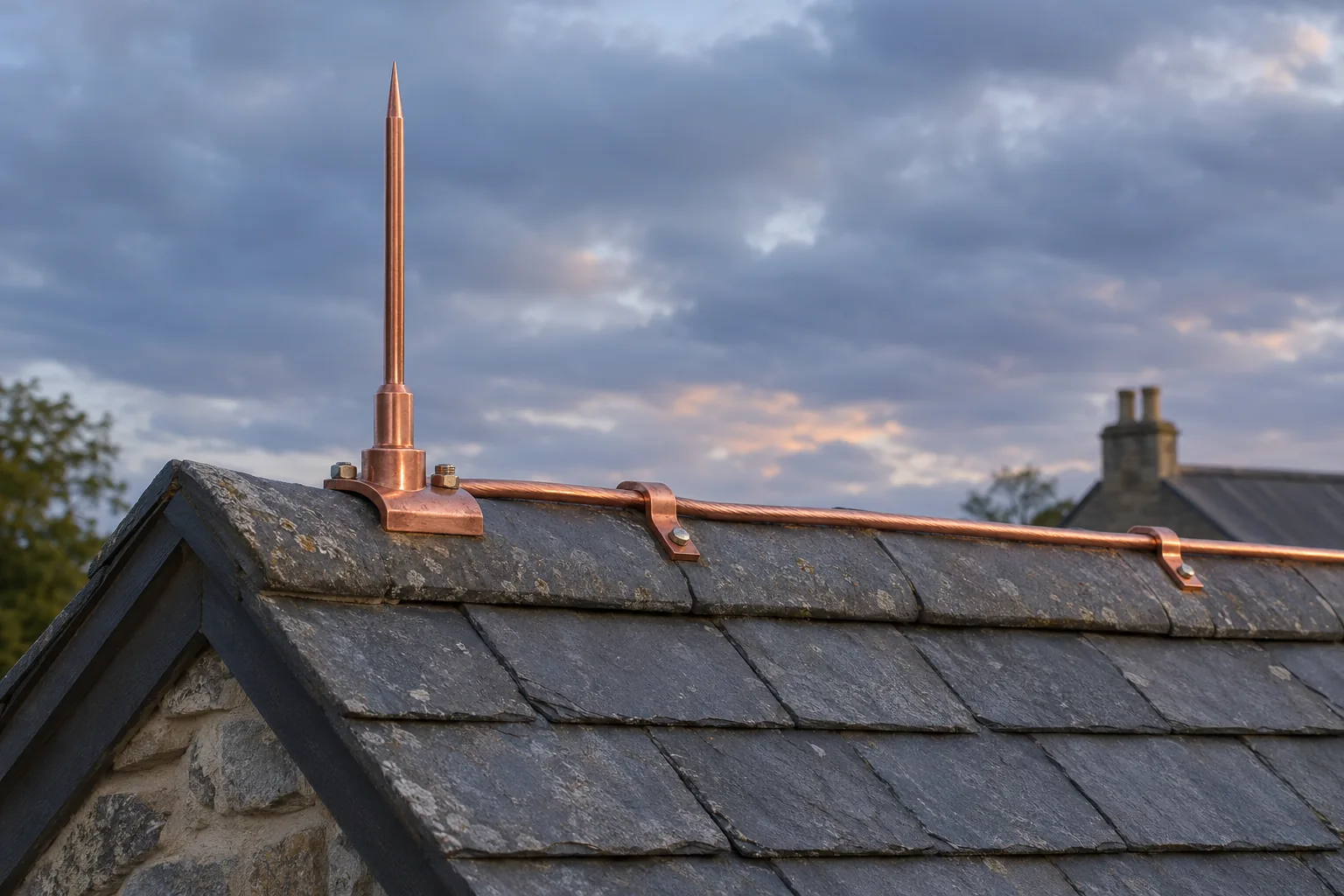
A lightning rod protects a building by helping intercept a strike and connecting it to a purpose-designed route for the current. It does not stop a thunderstorm from producing lightning or make a building impossible to strike. The rod is one component of a complete system extending from the roof to the ground and into other protective measures. [1]
That wider system explains why a pointed metal object on a roof is not enough. Protection depends on what happens after the strike attaches: where the current can travel, how nearby metalwork is treated and how surges entering through services are addressed.
What is the metal rod on the roof called?
The roof component is often called an air terminal, lightning rod or strike-termination device. Its job is to offer an intended attachment location. Conductors connect strike-termination devices with grounding electrodes, while other connections and surge-protection components complete the system. [2]
From street level, the roof pieces may be all that can be seen. This can create the misleading impression that protection resides entirely in a sharp tip. In practice, the hidden connections and the path down the structure are essential to what the roof component is meant to accomplish.
The illustration accompanying this article shows a roof component and conductor. It is not an installation plan, proof of compliance or a depiction of everything a protected building needs.
How does lightning connect with something on the ground?
In a common type of cloud-to-ground flash, a negatively charged channel develops downward through the air in steps. As it approaches the surface, upward streamers can develop from objects below. A connection between a descending leader and an upward streamer completes a conducting channel for the discharge. [4]
This is a rapidly developing electrical process, not a bolt that chooses its whole route from the cloud after spotting a rod. The National Weather Service explains that a stepped leader responds to conditions around its advancing tip and can branch as it develops. [5]
That detail is important when interpreting the phrase “path of least resistance.” It should not be taken to mean a straight, predetermined line selected all the way from cloud to earth. The protection system is designed to handle attachment and current flow at the structure; it does not remotely command the entire lightning channel.
Do lightning rods attract lightning?
The Lightning Protection Institute says conventional rods do not attract lightning; they intercept a strike and provide a route to ground. UL likewise states that conventional strike-termination devices do not increase the likelihood of a structure being struck. [2, 3]
Interception still involves an intended local attachment point. Those statements are compatible: a terminal can be designed to receive a strike that reaches the protected area without acting as a beacon pulling thunderstorms toward a neighbourhood.
Height, position and the building’s geometry affect exposure and system design. A rod on one roof is not a promise that nearby unprotected places are covered. Do not infer a safe outdoor zone from the presence of visible metalwork.
What do the conductors and grounding electrodes do?
The conductors carry lightning current between the strike-termination devices and the grounding system. Grounding electrodes make electrical contact with the earth. Copper and aluminium are commonly used for the conductive paths in recognised protection systems. [1, 2]
“Ground” is not a magic destination that makes the details irrelevant. The route to earth must remain connected and appropriate for the system. A break, an unsuitable connection or a badly conceived partial installation can undermine the function suggested by an impressive-looking roof terminal.
It is also misleading to picture the rod as a container that stores the bolt. The function is to conduct current through an engineered network rather than to hold a reservoir of lightning on the roof after the flash is over.
Why is bonding part of lightning protection?
Bonding connects relevant conductive parts to reduce dangerous differences in electrical potential. If nearby conductors rise to very different potentials during a strike, current can arc between them. This is one reason a complete system addresses connections to other metal parts rather than treating its own cables as isolated from the building. [1, 2]
A water-path analogy can help only so far. An unwanted route opening beside the planned route is an intuitive comparison, but an electrical arc is not water leaking from a pipe. Proper design must account for electrical behaviour, separation and the materials present.
This is also why attaching an improvised wire to a roof object does not establish protection. A system has to be evaluated as a connected whole, including interactions that are not obvious from a photograph of the roof.
Why are surge-protection devices needed too?
Lightning effects can enter a building through external wires and pipes as well as through a direct strike. A roof interception system and surge-protection measures therefore address related but different parts of the problem. The National Weather Service includes protection for incoming power, data and communication lines in its description of a complete system. [1, 6]
The Lightning Protection Institute specifically cautions that surge protection alone does not provide the structural protection of a complete grounding network. Conversely, seeing roof rods should not lead to an assumption that all connected electronics have appropriate surge protection. [3]
Different components do different jobs. Asking whether one can replace all the others is less useful than asking whether the entire design addresses the building’s actual routes of exposure.
Does a protected building remove every danger during a storm?
No protection system is a reason to ignore storm guidance. NWS advises using substantial buildings or suitable enclosed metal-topped vehicles as shelter. Indoors, avoid contact with plumbing, corded phones and electrical equipment during a thunderstorm; lightning can travel through those connected systems. Do not start unplugging equipment while the storm is overhead. [6]
A nearby tree is not a substitute for a building’s protection system or a safe outdoor shelter. Nor does a previous strike make an object immune: lightning can strike the same place again. [7]
Those points separate two decisions that are sometimes confused. Engineering measures can reduce risks to structures and their contents. Choosing appropriate shelter and behaviour remains a separate part of responding to a thunderstorm.
Can any metal roof fitting serve as a lightning rod?
An antenna, weather vane or other roof fitting should not be assumed to be a complete protection system. LPI warns against partial installations and describes lightning protection as specialist work rather than a do-it-yourself project. [3]
The applicable design and installation requirements depend on local rules, building characteristics and recognised standards. This article explains the purpose of the parts; it supplies no dimensions, wiring instructions or claim that a particular roof needs a particular layout.
The practical way to understand a lightning rod is to follow the intended current path beyond the visible tip. Its protective value comes from being integrated with conductors, grounding, bonding and surge protection that work together.
Keep exploring
For the electrical processes behind storms and smaller everyday discharges, continue with:
Sources and further reading
Lightning-protection references checked November 16, 2026. This account explains system functions; installation requirements depend on the building, jurisdiction and applicable standards.
- National Weather Service — Lightning Rods
- UL Solutions — Lightning Protection Application Guide
- Lightning Protection Institute — FAQ
- National Weather Service — Understanding Lightning: Making Connection With the Ground
- National Weather Service — Understanding Lightning: Initiation of a Stepped Leader
- National Weather Service — Lightning Indoors
- National Weather Service — Lightning Myths and Facts
Keep exploring.
One remarkable idea at a time—nature, science, history and beyond.
Last updated November 16, 2026.

Barnakle Editorial Team
Barnakle Editorial Team is the collective byline used for Barnakle’s editorial articles. The contributor profile explains the team identity and links to the publication’s editorial policies.
More from the editorial team →