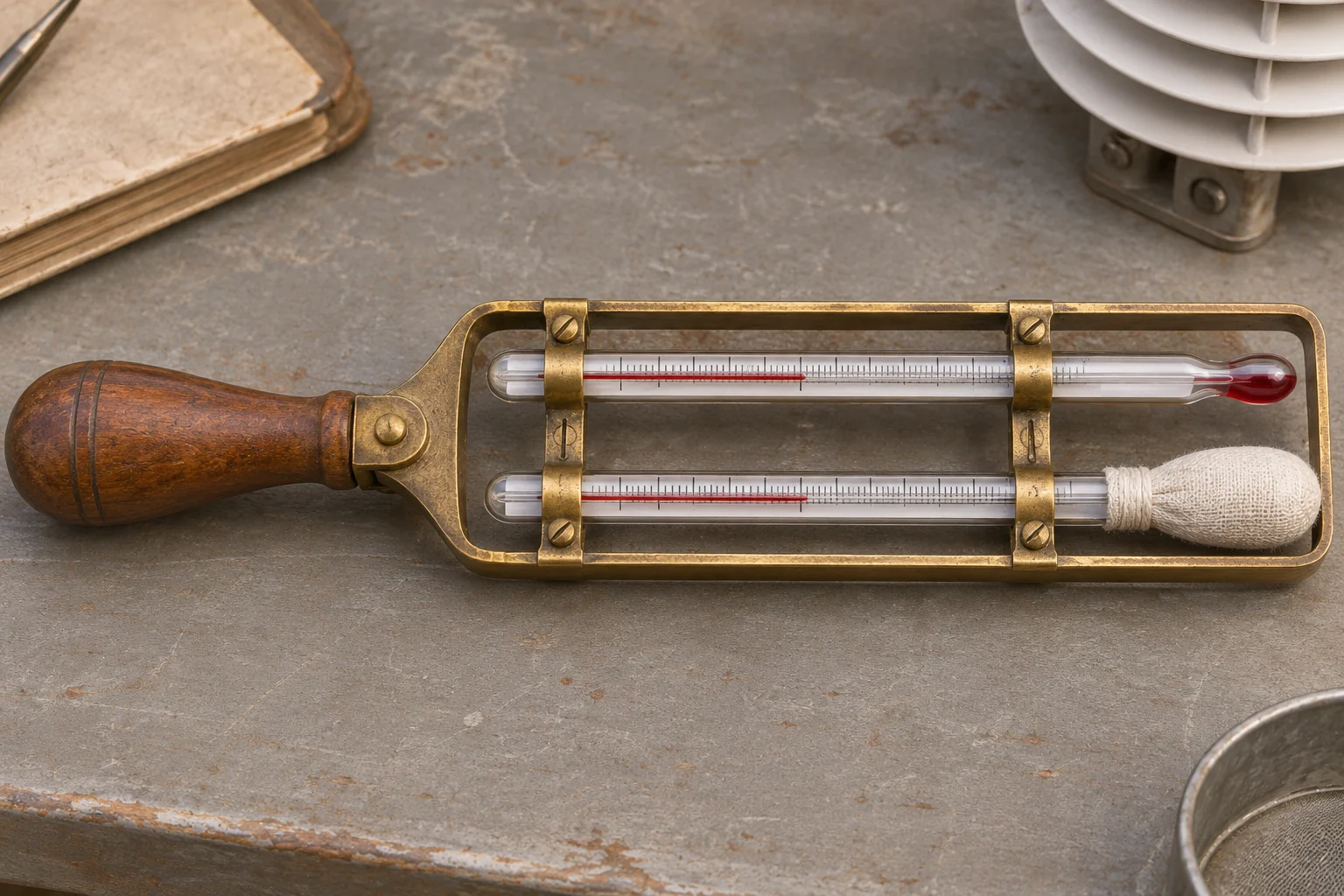
Put two identical thermometers side by side and they should agree. Wrap the bulb of one in wet cloth and move both through the air, and a gap usually opens between the readings. That gap is the working part of a sling psychrometer. Water evaporating from the cloth carries energy away, allowing the wetted thermometer to cool below the air temperature. How far it cools depends partly on how much water vapour is already in the air. Two temperatures and the right conversion table can therefore give a reading of relative humidity. [1, 2, 3]
What the wet cloth changes
The bare thermometer measures the dry-bulb temperature, the ordinary temperature of the air when the instrument is properly exposed. Its neighbour has a close-fitting absorbent cover, often cotton muslin, with water supplied to the bulb by the wetted fabric. Both instruments meet the same moving air. Only one maintains a surface of liquid water from which molecules can escape. If both covers were dry, the instrument would have lost the difference it was built to detect, even though its two scales might still give impeccably consistent readings. [1, 2, 4]
Evaporation requires energy. As water passes into the air, energy leaves the wet surface and its temperature drops. The moving air also transfers heat back to that cooler surface. After sufficient ventilation the rates of heat supply and evaporative cooling approach a balance. That balance explains why the wet-bulb temperature settles at a reproducible value above freezing in an ordinary warm-room example. Continuous evaporation can continue at that temperature. The thermometer does not have to keep dropping until the wick is dry. [3, 4]
Now compare two rooms at the same dry-bulb temperature. In one, the air is close to saturation. In the other it is much drier. At first the wet bulbs are at room temperature. The drier air permits a larger net loss of water vapour from the wet surface, so its wetted thermometer can cool farther before the heat and moisture transfers balance. In saturated air at the same temperature as the wetted bulb, net evaporation is negligible and the two readings coincide in the ideal case. [2, 3]
Why give the instrument a handle?
Think about the tiny volume of air immediately next to a damp thread. If it remains in place, evaporation raises its humidity. The air experienced by the cloth increasingly differs from the room you intended to measure. Whirling the frame carries fresh air past both thermometers and makes the transfer of heat and vapour more repeatable. The handle is a simple way to obtain the ventilation required by the method. Other psychrometers draw air past stationary thermometers with a fan and use the same underlying principle. [2, 3, 4]
The Hong Kong Observatory describes an instrument with a crank handle and a moistened muslin sleeve. The operator rotated it to ventilate the bulbs and used a table or humidity slide rule to convert the readings. Colorado State University's demonstration emphasizes comparing successive readings until the wet bulb settles at the lowest repeatable value. The useful criterion is the settled temperature under the specified conditions. Two instruments of different size and construction need not achieve that state after exactly the same number of turns. [1, 2, 4]
The difference is in degrees, the answer in percent
Suppose the dry bulb reads 20 degrees Celsius and the wet bulb reads 15. The wet-bulb depression is five degrees. That is neither a humidity of five percent nor a reason to divide fifteen by twenty. Relative humidity compares the amount of water vapour present, expressed as a vapour pressure, with the saturation vapour pressure at the actual air temperature. The conversion accounts for the wet bulb's balance of heat and vapour exchange. A psychrometric table is a convenient way to do that calculation without rebuilding the physics at the observation site. [3, 4, 5]
This explains why copying only the difference onto a field sheet can ruin an otherwise good measurement. A five-degree difference on a cool day and a five-degree difference on a hot day do not in general represent the same relative humidity. The observer needs the corresponding dry-bulb temperature and a table appropriate for the instrument and pressure conditions. A useful record preserves both original thermometer readings as well as the result, so a later reader can check a subtraction or recalculate using the appropriate table. [3, 4, 5]
A table can make the measurement easier to picture. Two entries with the same air temperature occupy the same row in a table arranged by dry-bulb temperature. Move along that row toward a larger difference between the bulbs and the indicated relative humidity falls. Switch to another air temperature and you must change rows, even if the difference between the two glass columns looks exactly the same. [3, 4]
When agreement is suspicious
A pair of matching readings can mean saturated air. It can also mean that somebody forgot the water. A dirty wick, poor contact with the bulb or an inadequate supply of clean water can compromise the comparison. Direct sunlight can warm the instrument independently of the air. A hasty reading after the instrument stops moving can let the wet bulb climb again. Each problem breaks a different link between the temperature displayed on the glass and the air the observer hopes to describe. [1, 4, 5]
Imagine a museum worker comparing the air in two rooms. If an instrument has just been carried from the colder room into the warmer one, the bare thermometer itself may still be warming. A narrowing gap could reflect the instrument's recent history as well as the air surrounding it. Letting the instrument respond to its surroundings and checking the wet-bulb reading again makes the pair meaningful. This is one reason guidance written for collections staff discusses the observer's actions alongside the apparently simple instrument. [4, 5]
There is an appealing check on the logic the next time you see a photograph of a psychrometer. Cover the image of the dry thermometer with a finger. The remaining reading tells you the temperature reached by one wet, ventilated surface. Now cover the wet thermometer instead. You have the air temperature but have lost the evidence about how readily water evaporated. The humidity measurement resides in the comparison. Neither glass tube has a humidity sensor hidden inside it. [1, 2, 3]
Related reading
Sources
- Colorado State University — Sling psychrometer demonstration
- Hong Kong Observatory — Sling psychrometer
- Cornell University — Psychrometrics
- National Weather Service — Cooperative station observations
- National Park Service — Using a psychrometer to measure relative humidity
Keep exploring.
We’ll email you when the first edition is ready.
Last updated November 27, 2026.

Barnakle Editorial Team
Barnakle Editorial Team is the collective byline used for Barnakle’s editorial articles. The contributor profile explains the team identity and links to the publication’s editorial policies.
More from the editorial team →