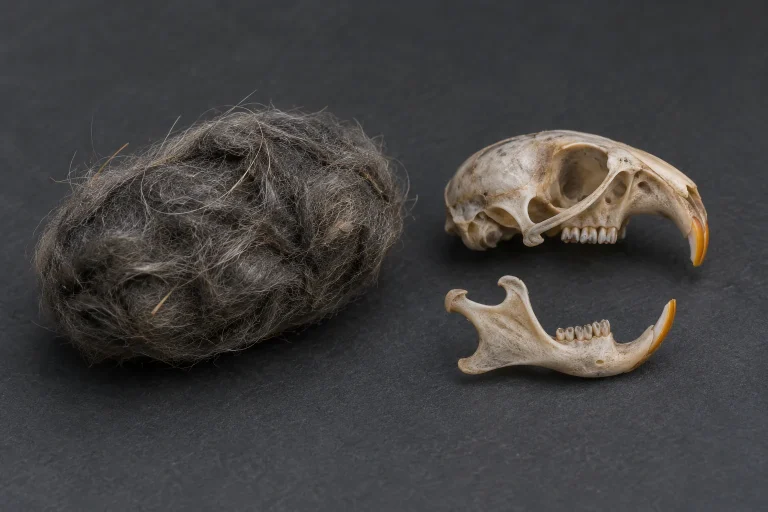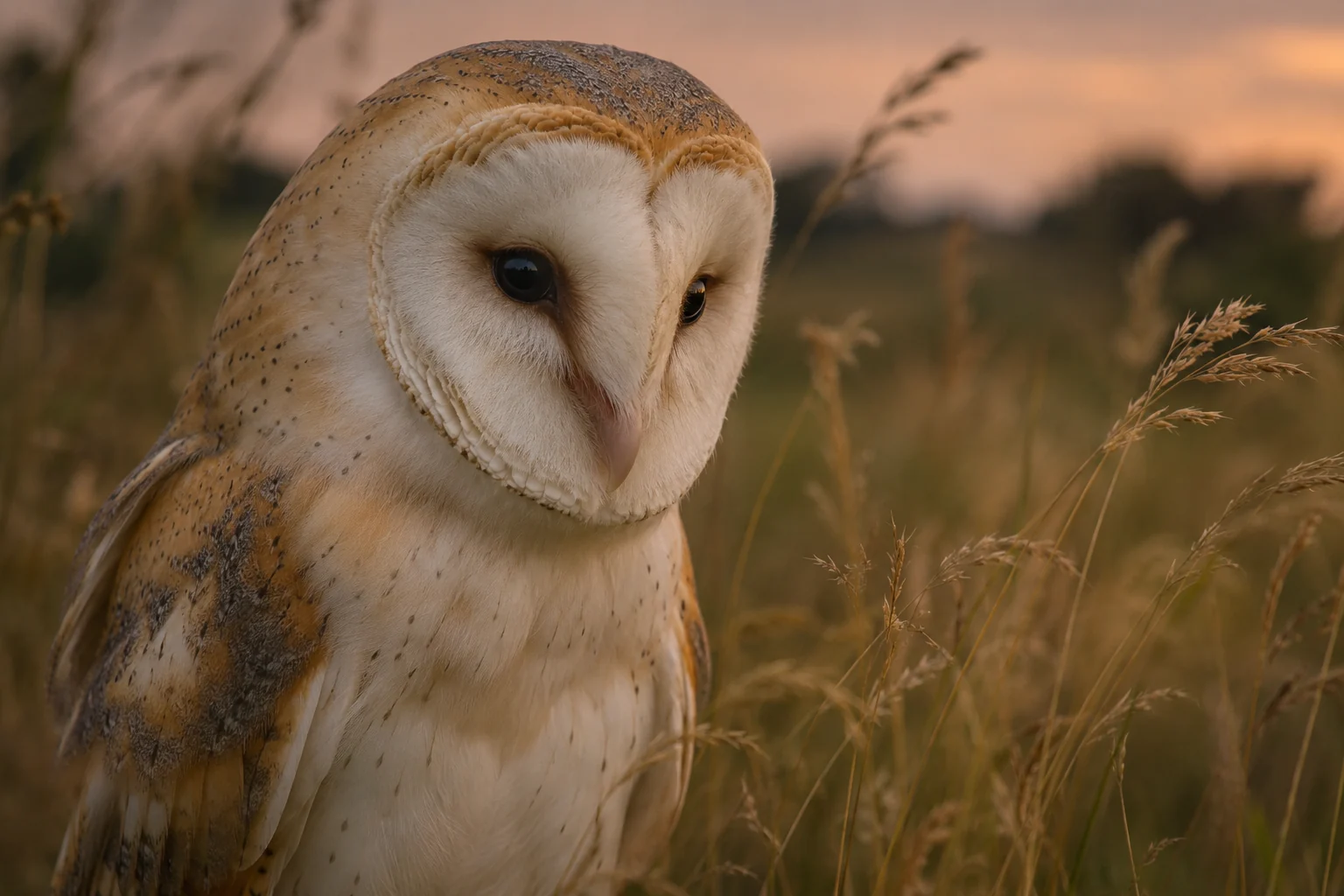
A barn owl can turn toward a sound it has never seen. A rustle in grass reaches the bird's ears at slightly different times and with a different mix of levels at different frequencies. Those differences change systematically with the direction of the source. The owl's head and its heart-shaped facial ruff help create the differences, and its auditory system uses them to steer a turn. Researchers have tested this by changing what reaches the two ears while keeping the actual position of a sound source fixed. [1, 2, 3]
What a pair of ears adds
Imagine a mouse stepping on a dry leaf just to the owl's left. The sound has a shorter path to the left ear. No stopwatch starts at the mouse, and the owl has no way of knowing the instant the leaf first moved. It does have something almost as useful: two versions of the same event. An edge in the rustle reaches one ear before its partner reaches the other. Comparing those signals gives information about direction even when the time of emission is unknown. [1, 3]
Now let the mouse move to a point directly in front of the owl. Its sound can reach the two sides at nearly the same time. Move the mouse towards the right and the sign of the difference reverses. This is why changing the relative arrival times in sounds delivered through earphones can shift the direction of a bird's head turn. A turn towards a source is a behavioural answer that an observer can measure without needing to put a visible object in the direction being tested. [1, 3]
Timing alone leaves a puzzle. Two sounds at different heights can have very similar differences in travel time to the left and right ears. A bird trying to turn towards a particular tuft of grass needs a way to distinguish a sound below its line of sight from one higher up. Here the shape of the bird matters as much as the separation between its ears. [1, 2]
Listening with a face
The pale outline around the eyes is what most people notice first about a barn owl. Around the face, rows of specialised feathers form a ruff that changes the paths sound can take to the ear openings. The openings and their surrounding structures are asymmetric. Sound arriving from a given direction therefore reaches the ears with a characteristic difference in level. In the space in front of the bird, level differences at relevant frequencies can change strongly with elevation. The face has already filtered the rustle before either ear begins to encode it. [1, 2]
A change in level at one ear alone would be hard to interpret. Perhaps the mouse took a heavier step. But if a leaf happens to crackle more loudly while staying in the same place, both ears receive the stronger signal. A comparison between the ears can retain directional information that either ear's loudness would lose. Which frequencies are present matters too. The same face does not modify a low note and a high note equally, any more than one feather reflects every wavelength of sound with the same efficiency. [1, 2, 4]
How to remove a ruff without changing the bird
One experiment turned that filtering into a sound recording problem. Researchers measured how sound from different directions reached the ears with the ruff present and how it arrived when the ruff's contribution was removed. Those measurements could then be used to filter a sound before playing it through small earphones. A listening owl could experience much of the acoustic effect of a change in facial anatomy while its own listening posture and surroundings stayed the same. The resulting head turns supplied the test. [2]
The experiment makes a distinction that a portrait cannot. The feathers could simply have made everything a little louder. Alternatively, they could have sharpened the differences that distinguish one direction from the next. Removing the ruff's acoustic contribution altered localization, including the birds' ability to orient in elevation. Patterns of error reveal more than a general failure to hear a quiet sound. An owl can plainly hear the noise well enough to turn and still turn to the wrong height. [1, 2]
Why a rustle is different from a whistle
A rustle contains many frequencies. A pure tone repeats the same cycle over and over. Think of aligning two strips of paper printed with identical rows of evenly spaced dots. Slide one strip by a whole dot spacing and the rows line up again. Comparing a repeating sound across two ears can produce a similar ambiguity. For some high-frequency signals, more than one direction could explain the timing relationship. In carefully controlled listening tests an owl can turn towards a phantom source. [4]
Researchers also found that the level difference between ears could help the owl resolve an ambiguous side-to-side location. This puts an important qualification on the convenient shorthand that timing tells the bird left or right and level tells it up or down. Those are strong tendencies, especially in front of the bird. They are not two sealed channels of information. A small level difference can matter a great deal when the timing cue offers two plausible answers. [1, 4]
Work on the auditory midbrain asks why neurons responding to different parts of space favour particular frequency ranges. A sound carries better directional information at some frequencies and positions than at others. By comparing such acoustic information with the responses of neurons, researchers can investigate which parts of a sound the brain gives greater weight. This helps explain why sending an owl one steady electronic note is an illuminating test of the system, yet a poor substitute for all the information in a moving animal's rustle. [4, 5]
Return to the owl over the field. From its turn you can infer a direction it judged worth investigating. Direction is distinct from distance: something close and quiet and something farther away and louder could both lie along the same line of sight. A head turn also cannot tell you whether the bird recognized the source as a mouse. What these experiments establish is more precise. Before the owl can see what moved, differences in the sound at its two ears can tell it where to look. [1, 2, 3]
Related reading
Sources
- Knudsen and Konishi — Mechanisms of sound localization in the barn owl
- PLOS ONE — Testing the acoustic contribution of the facial ruff
- Journal of Comparative Physiology A — Head turns in virtual acoustic space
- Combination of interaural level and time difference in azimuthal sound localization in owls
- Frequency tuning and the reliability of spatial cues in the barn owl’s auditory midbrain
Keep exploring.
We’ll email you when the first edition is ready.
Last updated November 26, 2026.

Barnakle Editorial Team
Barnakle Editorial Team is the collective byline used for Barnakle’s editorial articles. The contributor profile explains the team identity and links to the publication’s editorial policies.
More from the editorial team →