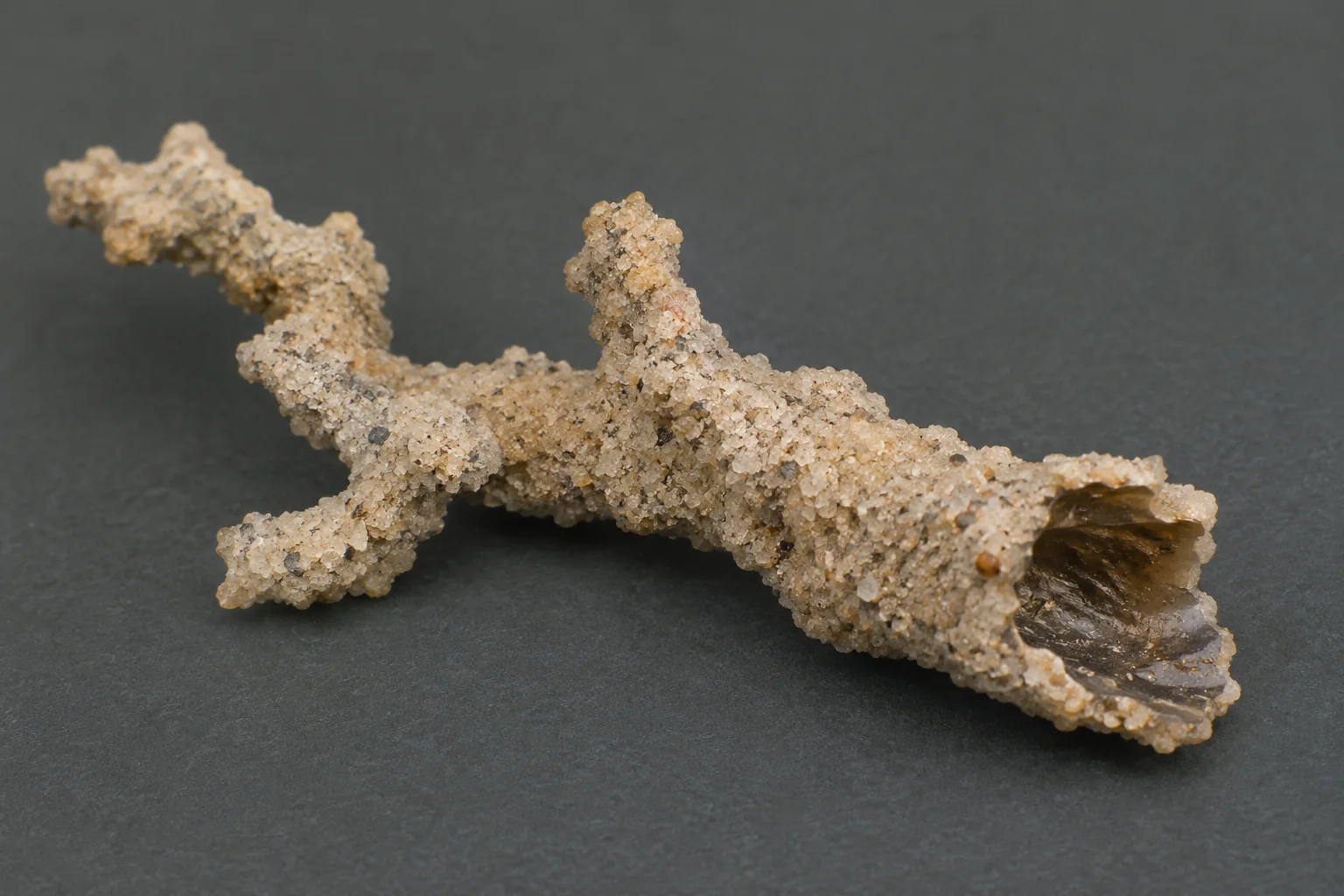
The least glassy-looking part of a sand fulgurite is often the outside. It may be tan, gritty and so like a broken root that you could overlook it in a museum tray. Look into a broken end, however, and there is a hollow with a smoother, sometimes shiny lining. Those two surfaces sat only millimetres apart during one of the most uneven heating events a handful of sand can experience. Lightning passed through the ground.[1, 2]
A fulgurite forms when an electrical discharge heats a narrow path in sand, soil or rock intensely enough to fuse or melt material. A familiar sand example is a branching tube. Grains nearest the path became hot enough to lose their separate shapes. Some farther out remained recognisable and are still stuck to the outer wall. The glass preserves a short-lived event in a form that can survive long after any mark at the surface has gone.[1, 2]
Why the sand melts in a narrow path
Start with what a photograph of lightning leaves out. The brilliant channel overhead shows where the air carried a strong electric current. At the ground the current also has to find a route. Energy is deposited along that route in a short time. If sufficient energy reaches a small enough volume, its temperature rises dramatically before heat can spread very far into the surrounding material. A nearby grain can experience a completely different history from one directly beside the channel.[1, 3]
That last point resolves a small paradox. Sand is familiar as something hot enough to make a beach uncomfortable in summer. An entire hot beach still looks like a beach. A fulgurite demands a far more concentrated input of energy. The useful question is how much energy a particular length of discharge deposits in the material immediately around it. The amount of ground affected can be small even when the change within that narrow volume is extreme.[3, 4]
In quartz-rich sand, material nearest the hot channel can be melted or vaporised. Around the centre, fused material forms a wall. Heat escapes into the surrounding cooler sand and the melt solidifies, often as glass. An irregular central opening can remain. Think of the tube as a cast of part of the route through the ground, with important qualifications. Its thickness includes the material affected around that route, while a surviving broken fragment records only a portion of what originally formed.[1, 2, 3]
A cross-section makes a better witness than the silhouette
A forked outline is eye-catching, but branching occurs in roots, cracks and mineral deposits as well. Follow a sand fulgurite from the middle outwards instead. The sequence can include a hollow centre, a fused inner surface, a partly melted wall and ordinary grains attached to the exterior. Each zone tells you about different degrees of heating. An original grain cemented to the outside can survive beside glass made from material that was once equally granular.[2, 3]
Rapid cooling matters because molten material can solidify before its atoms organise themselves into a regular crystal structure. Silica-rich natural glass in fulgurites is called lechatelierite. The whole object need not consist of one pure substance. Soil contains materials besides quartz, and researchers describe mixtures of silica glass and a more chemically variable surrounding material. That is one reason the inside of a fulgurite need not look like clear glass from a window.[2, 3]
Nor is every fulgurite a delicate straw. A classification based on specimens from different ground materials distinguishes thin-walled tubes in sand from thicker melt-rich forms in clay and glass-poor thick-walled forms in carbonate-rich ground known as caliche. On solid rock, glass can occur against unmelted rock. A collector who only recognised the hollow sand form would be selecting for one kind of lightning record before the scientific investigation even began.[3]
Can you measure a lightning strike from the glass?
Imagine two cylindrical tracks of equal length, one twice the diameter of the other. In an idealised solid cylinder that would mean four times the volume. A real fulgurite is hollow and uneven, so one cannot simply turn that ratio into an energy estimate. But diameter is a physically meaningful measurement. More material affected along the same length generally requires a different energy budget, and the starting material can be studied to constrain that budget.[3, 4]
Researchers took this approach with fulgurites collected from quartz sand mines in Florida. They used the dimensions of many specimens to estimate energy deposited per unit length, obtaining a geometric mean of about one megajoule per metre in their sample. That figure concerns the channel’s interaction with the sand. It does not give the total electrical energy of the storm, the exact peak current of an individual flash or the amount that reached every branch.[4]
Why work with a collection? One unusually large specimen might survive because it had a thick wall. A finer branch might have broken before anyone could measure it. A collection drawn from similar sand lets researchers examine a distribution and make explicit assumptions about what their samples represent. The material can answer a surprisingly quantitative question, provided the question stays tied to the portion of the event that actually left glass behind.[4]
Tiny bubbles with a much older story
One specimen from the Libyan Desert yielded evidence about an environment that no longer looked like the place where the fulgurite formed. Researchers analysed gases trapped in bubbles in the glass and used thermoluminescence dating to estimate when the discharge occurred. They placed it roughly 15,000 years ago. The gas chemistry gave information about organic matter in the ground during the strike. The reconstructed conditions resembled a semiarid environment farther south today.[5]
An important detail is what those bubbles sampled. The discharge heated local material and produced gases during the event. A bubble is therefore a little chemical record that needs interpretation. Treating it as a jar of untouched ancient air would give the wrong picture of the experiment. The dating and the chemistry answer separate questions, and together link that specimen to conditions at a particular place and time.[5]
A sand fulgurite rewards looking at successively smaller scales. From across a room it resembles a root. From one end its hollow and glassy wall become visible. Inside the wall a bubble can preserve information about the soil the lightning crossed. An event over almost before a witness could blink can leave evidence at all three scales.
Keep exploring
Trace the electrical discharge in a storm, then see how ancient craftspeople made and coloured glass under controlled heat.
Sources and further reading
- Environment and Climate Change Canada — Lightning and fulgurites
- Utah Geological Survey — Identifying sand and rock fulgurites
- Pasek, Block and Pasek — Fulgurite morphology and formation
- Pasek and Hurst — Estimating lightning energy from glass in Florida sand
- Navarro-González and colleagues — Trapped gases in a late Pleistocene fulgurite
Keep exploring.
One remarkable idea at a time—nature, science, history and beyond.
Last updated November 20, 2026.

Barnakle Editorial Team
Barnakle Editorial Team is the collective byline used for Barnakle’s editorial articles. The contributor profile explains the team identity and links to the publication’s editorial policies.
More from the editorial team →