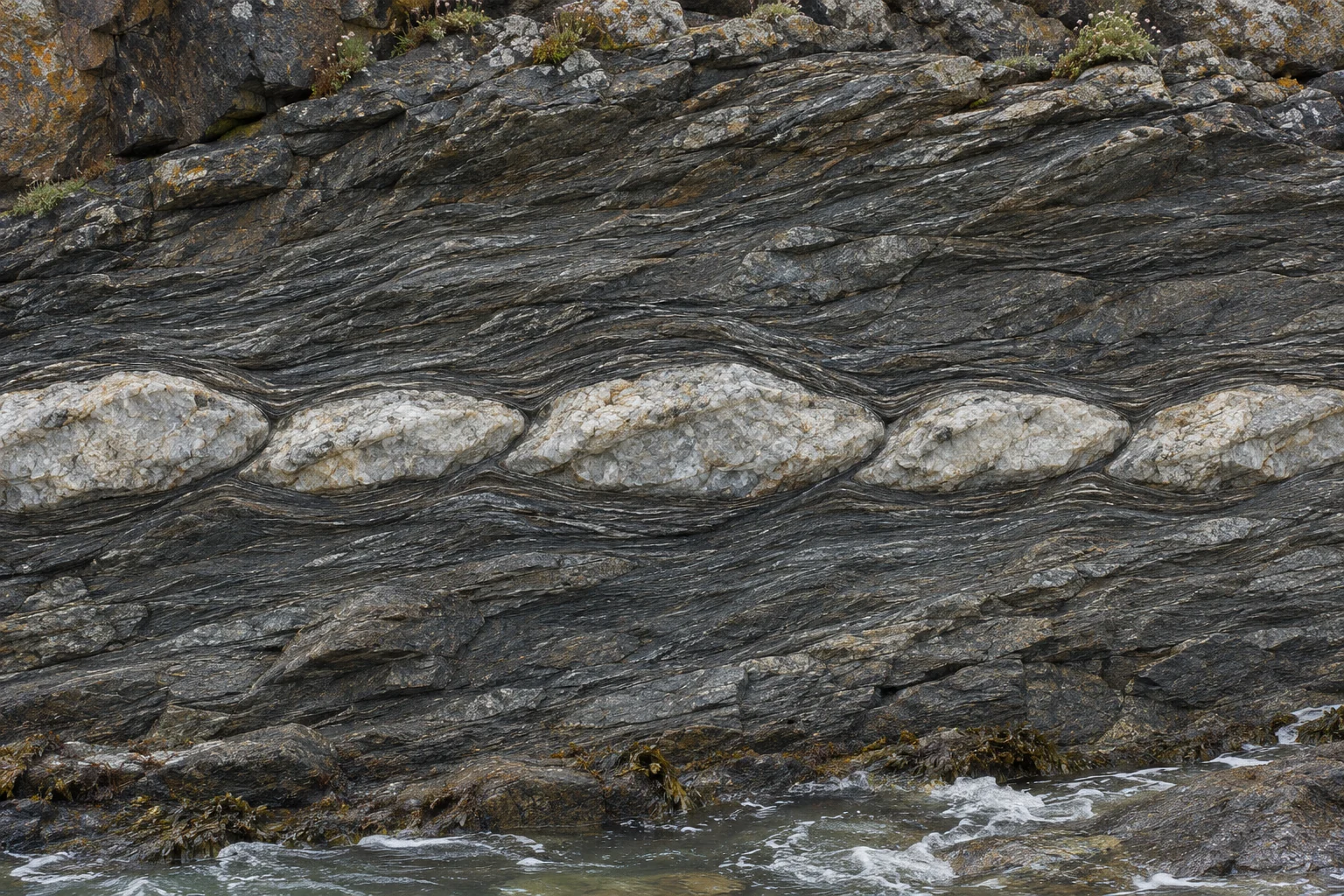
At Carmanville, Newfoundland, a quartz vein preserved in rock looks as if it has been pulled apart like a string of sausages. Pieces of the pale vein occupy roughly the same band in the outcrop, yet a geologist cannot follow it as an uninterrupted stripe. Each surviving piece is called a boudin, from the French word for a kind of sausage. The process, boudinage, records stretching along a layer. Even without knowing what the rock looked like beforehand, the neighbouring pieces offer clues to what once went between them.[1]
Start with a continuous band of relatively strong rock enclosed in material that can deform more readily. If the whole package lengthens along the band, every part has to accommodate that change somehow. The enclosing material may spread it over a large area. In the stronger band, much of the extension may be concentrated in a few narrow places. Thick segments then persist between thinning necks. Given enough extension, some segments separate entirely.[1, 2]
A neck can form before a gap opens
Imagine tracing the two margins of a pale band across an outcrop with a pencil. Over one stretch they run almost parallel. Farther along they converge, then open apart again without ever touching. This is pinch-and-swell structure. The rock forming the pinched connection is still there. Trace both margins for a little longer and they may come together at a pointed end, with a separate thick segment starting beyond it. Finding both arrangements in one band gives a field observer an immediate way to picture localized stretching.[1, 4]
The sausage comparison fits rounded ends particularly well, but a rock need not pass through a picturesque series of smooth pinches. Some boudins have abrupt, nearly straight ends. Others taper. In a large field survey, structural geologists distinguished shapes associated with necking from others associated with tearing, as well as groups where neighbouring pieces had slipped or rotated. The name identifies a family of structures. The shape of a particular pair of ends is evidence about how that pair parted.[2]
Strong compared with what?
The word competent in a geological description can sound like a permanent rating assigned to a rock. Here it is a comparison under the conditions of deformation. A vein can remain relatively coherent while the neighbouring material changes shape around it. The same band plainly has some capacity to deform if its once parallel margins narrow into a neck. There is no contradiction between calling the vein the stronger material and finding that parts of it have stretched substantially.[1, 2]
The gap is worth just as much attention as the segment. Sometimes the surrounding rock is drawn in between two ends. Sometimes new mineral material occupies the separation. A pale filling across a narrow gap might be younger than the pale layer on either side. A good sketch therefore distinguishes the outline of the old layer from the material that now joins it. Colour alone can make different generations of mineral growth look like one continuous feature.[3, 4, 5]
What one flat rock face can hide
A roadcut usually gives a geologist one slice through a three-dimensional structure. Cut across a row of long boudins and the face can show a succession of isolated lenses. Follow a face that runs along one surviving segment instead, and the same structure can look like a long unbroken bar. Where erosion exposes two adjoining faces, matching a particular lens across the corner is often more informative than drawing a whole row viewed from one direction. The corner shows which apparent ends actually continue out of the plane of view.[1, 4]
Stretching in two directions along a layer can divide a sheet into blocks separated by intersecting gaps, a pattern often compared with a scored chocolate bar. A slice through just one row of blocks may resemble the familiar single train of boudins. Establishing the grid takes a view along the layer or enough intersecting exposures to see the second set of separations. This is a case in which an oblique photograph with the top of the slab visible can answer a question that a sharper, straight-on photograph leaves open.[1]
Can the gaps tell us how much the rock stretched?
Take an imaginary row that measures one metre from end to end today. Suppose the intact pieces add up to eighty centimetres and the spaces between them account for twenty. If the pieces had once fitted exactly together, had kept their original lengths, and had separated without rotating, the row would have lengthened from eighty centimetres to a hundred. That is a twenty-five percent extension relative to the starting length. Dividing by today’s length instead would answer a different question.[2, 3]
Real rocks can violate every assumption in that neat little calculation. The segments themselves can stretch. Their ends can rotate out of the plane of the exposure. A thin vein between them can affect how much additional deformation goes into the pieces and how much goes into widening the separation. A study of boudins in Austria’s Spitz Marble found that gaps alone could substantially underestimate extension. Two trains with similar visible gaps need not have shared the same deformation history.[3]
When the neighbouring stripes matter most
Look beyond the conspicuous vein to the fine layering or foliation of the surrounding rock. Does it bend towards a neck? Does an entire train of boudins curve around a fold? A layer can preserve both folding and boudinage, and some related structures even develop within foliated rock without a separate strong bed. Researchers have documented mineral-filled necks in such examples in Turkey and Switzerland. Those cases expand the field question from what a single vein did to how the whole rock mass was deforming.[1, 5]
Back at the Newfoundland example, the value of the sausage shape is that it invites a simple test. Pick one pale segment and try to follow both of its margins into the next. Notice where each thins, what fills the intervening space and which way the neighbouring rock turns. The interrupted line becomes a record of movement precisely because different parts of an originally continuous feature kept different pieces of its history.[1, 2]
Related reading
Sources
- Geological Structures — Boudinage and the Carmanville quartz vein
- Goscombe, Passchier and Hand — Boudinage classification
- Vein-controlled boudin segment separation in the Spitz Marble, Austria
- ETH Zürich — Linear structural elements
- Foliation boudinage in Turkey and Switzerland
Keep exploring.
One remarkable idea at a time—nature, science, history and beyond.
Last updated November 21, 2026.

Barnakle Editorial Team
Barnakle Editorial Team is the collective byline used for Barnakle’s editorial articles. The contributor profile explains the team identity and links to the publication’s editorial policies.
More from the editorial team →