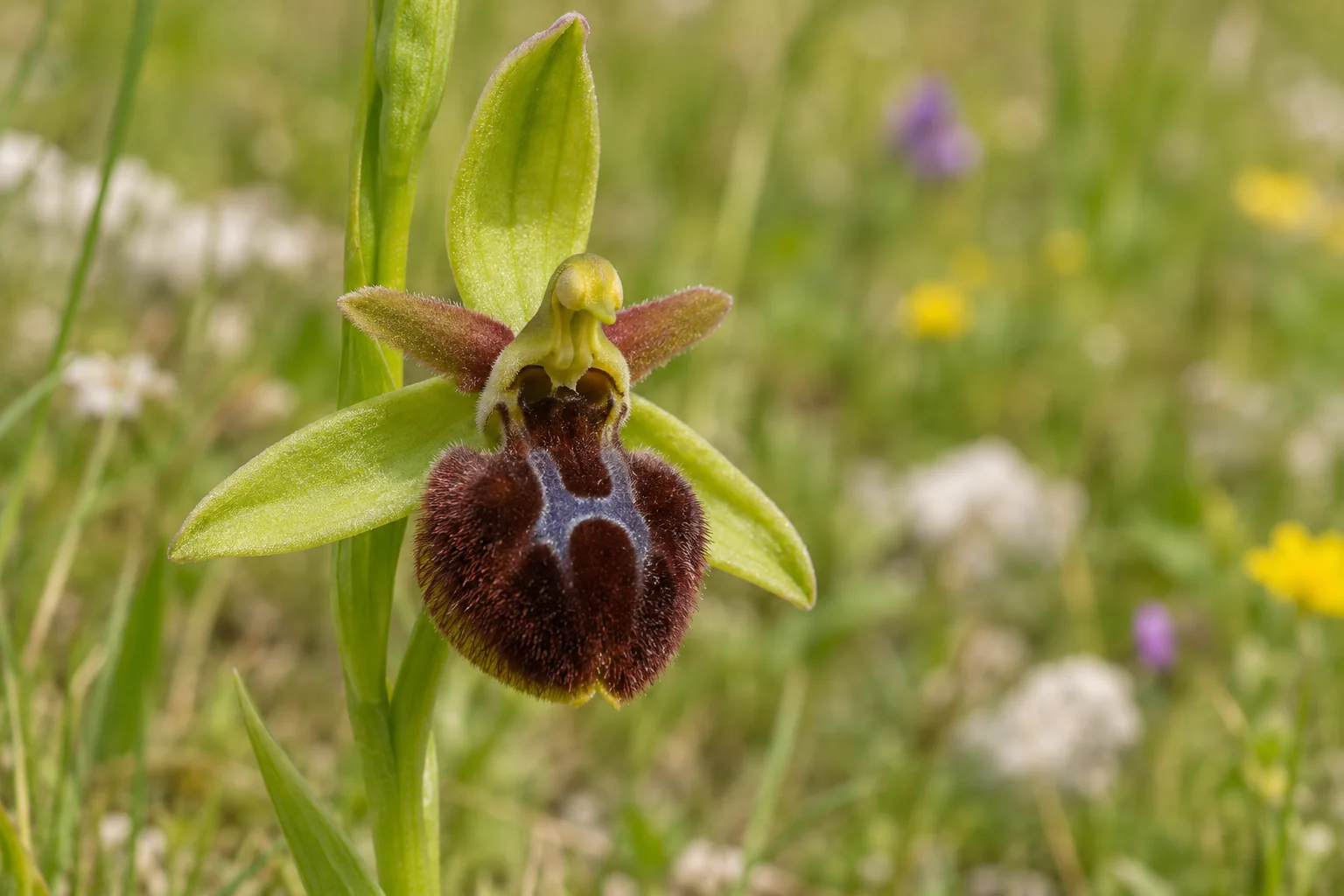
The early spider orchid owes its English name to something a person can see. Its dark, velvety lower petal looks a little like a spider crouched among the green parts of the flower. The creature that matters to the orchid, though, is a male mining bee. And the most persuasive part of the flower is one that a photograph leaves out.[1]
The orchid, Ophrys sphegodes, produces a scent blend resembling the one on a female bee of the species Andrena nigroaenea. A male following that signal may land on the flower and try to mate with it. In the process, a packet of pollen can stick to him and travel to another orchid. For a flower rooted to a patch of grassland, that brief mistake can deliver pollen across a distance the plant could never cover on its own.[1, 2]
The difference between attracting a bee and moving pollen
Imagine watching the encounter from a few steps away. A male flies close to a flower, circles and leaves. On his next pass he lands. Both approaches might count as visits in a quick field note. Only the second offers much chance of pollen pickup. Even then, landing on a green sepal would do little good. His body has to come into contact with the right part of the flower.[1]
The enlarged lower petal is called the labellum, or lip. Its shape and hairs give the insect a surface to hold as it attempts to mate. Above the lip sit the flower’s reproductive structures. The pollen is grouped into masses called pollinia, with an attachment that can adhere to a visitor. Think of the difference between brushing flour off a counter and lifting a little parcel with a sticky tab. On departure, a bee can be carrying an appreciable package even if little loose pollen is visible on his body.[1, 3]
Removal is only the first half of a successful transfer. If that bee lands in a suitable position on another receptive flower, carried pollen can meet its stigma. A missing pollen packet on a flower therefore tells a botanist something quite specific. A visitor probably took it. The gap alone cannot say which flower received the delivery, or whether any seeds developed. These are different observations along the same journey.[1, 3]
Testing a scent that people cannot identify by eye
How could anyone tell whether the bee came for the dark lip, its hairy surface or its smell? Comparing photographs of a bee and an orchid would leave all three possibilities open. Florian Schiestl and colleagues took a more revealing approach. They offered male bees scent-treated dummies made from female bees whose original surface odours had been removed. The object stayed bee-shaped while the researchers varied what it smelled like.[2]
They also separated mixtures into their chemical components and recorded which ones stimulated a male bee’s antenna. That was a way of narrowing the list. An antenna registering a molecule does not tell you what the whole bee will do next. The field tests supplied that missing step. Researchers could distinguish a male merely flying close from one landing and attempting to mate. Scent blends drawn from the orchid’s lip elicited the kind of behaviour that makes pollen transfer possible.[2]
The oddest part of the result is the ingredient list. The attractive mixture includes hydrocarbons of kinds also found in plant surface waxes. Their relative amounts matter. Imagine recognising a tune from familiar notes in a particular arrangement. Finding that all the notes occur in another piece of music tells you surprisingly little about whether the two sound alike. Likewise, listing a compound shared by a bee and a flower tells only part of the chemical story.[2, 4]
A spring with three dates on the calendar
Now put the scent experiment back outdoors. Three dates matter in a patch of early spider orchids. When do male bees start flying? When do females appear? When are the flowers open? Males tend to emerge ahead of females. A flower can take advantage of a period when males are searching for mates and relatively few females are available. Its odds change when more females are flying, even if the scent of the orchid stays exactly the same.[5]
Those dates can move by different amounts in a warm spring. Karen Robbirt and colleagues brought museum specimens together with more recent field records to examine the timing of bees and blooms. Bee flight shifted earlier with warmer conditions more strongly than the orchid’s flowering did. The researchers identified a risk that warmer springs could bring more females into flight ahead of flowering. That is a prediction about the opportunity for pollination, rather than a count of the seeds lost from any particular meadow.[5]
There is a lovely consequence for anyone who has ever wondered why a museum keeps the date on a pressed flower. One specimen confirms that an orchid was in bloom at one place on one day. It cannot establish the opening date of every flower there. Many records, set beside dated bee observations and temperature records, can reveal a relationship that even a very attentive visitor would struggle to see during a single spring.[5]
Which resemblance does natural selection preserve?
Put two flowering plants side by side in imagination. Each smells a little different. If males regularly carry more pollen between plants with one blend, those plants can have a reproductive advantage. No bee has to decide that an orchid looks like a perfect female, and no plant has to produce something a human nose would find particularly fragrant. It is the behaviour of the particular pollinator that connects a difference in scent to a difference in reproduction. Recent work on the orchid’s genome has identified gene duplications implicated in the evolution of this chemical mimicry.[4]
That brings us back to the name. A visitor can correctly identify the flower by the spider-like shape of its lip without noticing a bee at all. A male mining bee can follow a chemically convincing signal without ever sharing our impression of a spider. The two observers attend to different features of exactly the same flower. Only one leaves with pollen attached.
Keep exploring
A honeybee dance sends information between nestmates. Pollen preserved in sediment tells scientists which plants once grew nearby.
Sources and further reading
- Jacquemyn and Hutchings — Biological Flora of the British Isles account of Ophrys sphegodes
- Schiestl and colleagues, Nature — Field tests of orchid scent and male bee behaviour
- Morley, Botanical Society of Britain and Ireland — Tracking pollinator activity in orchid specimens
- Nature Communications — The early spider-orchid genome and pollinator adaptation
- Robbirt and colleagues, Current Biology — Spring temperatures and timing in an orchid and its pollinator
Keep exploring.
One remarkable idea at a time—nature, science, history and beyond.
Last updated November 19, 2026.

Barnakle Editorial Team
Barnakle Editorial Team is the collective byline used for Barnakle’s editorial articles. The contributor profile explains the team identity and links to the publication’s editorial policies.
More from the editorial team →