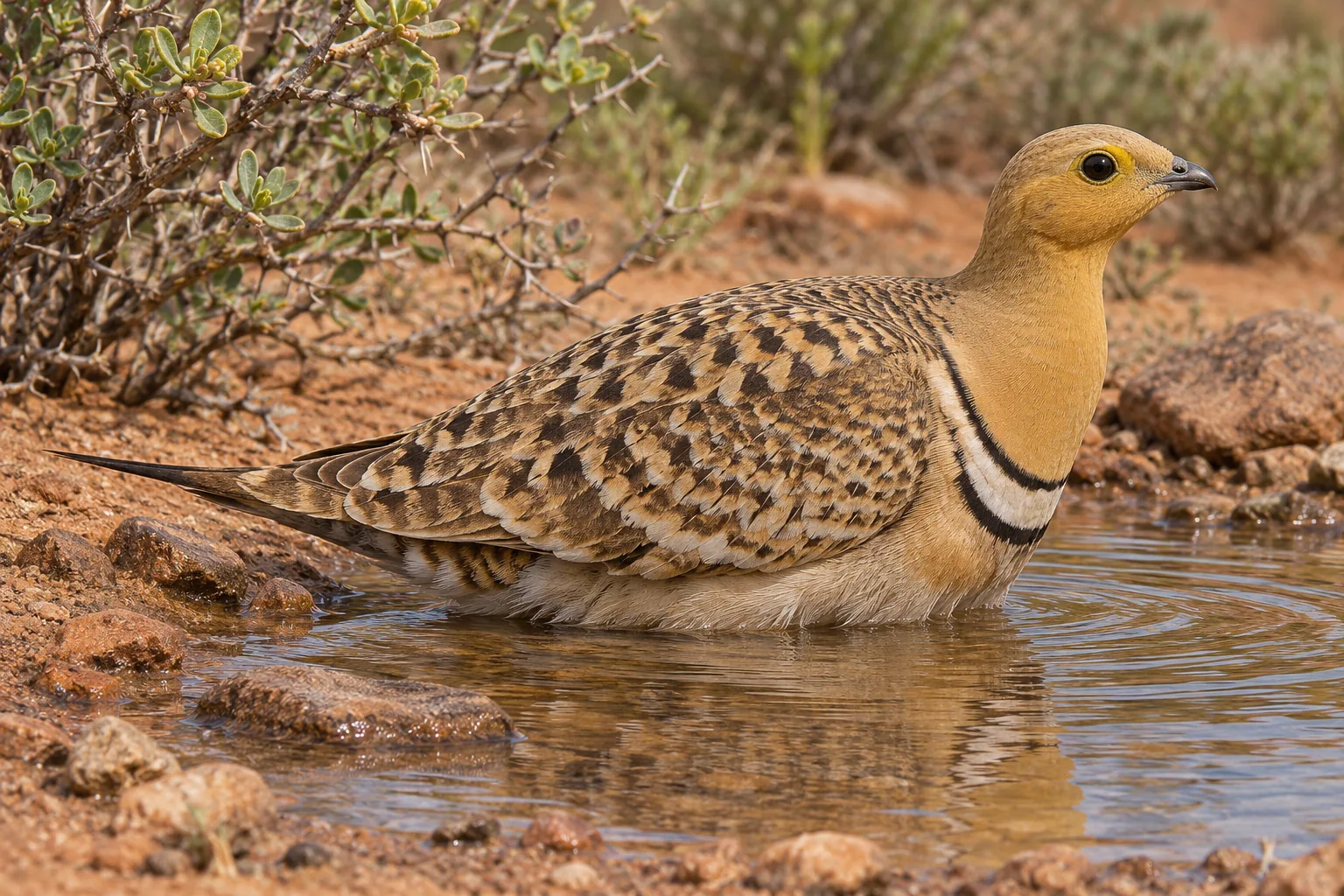
At a desert waterhole, an adult male sandgrouse has two ways to take on water. He can drink, and he can lower his belly into the shallows and wet a patch of specialized feathers. The second supply is for his chicks. When he returns, the young birds reach into his belly plumage with their bills and take water directly from it. The supply travels outside the parent’s body through dry air.[1, 3]
In the Namaqua sandgrouse, the belly feathers change shape as they become wet. Fine branches lift, spread and curve to hold water in small spaces. More flexible branches around the edge help enclose the wet interior. The water remains accessible to the chicks because it sits between fibres. It does not have to pass through the adult’s digestive system to reach them.[1, 2]
Why getting wet is only half the job
Many materials get wet. Fewer can pick up a useful drink, carry it through a flight and then release it to a waiting chick. Imagine dipping a smooth spoon into shallow water and lifting it edge first. A thin film remains on the metal, but much of the water runs away. Give the wetted surface closely spaced fine fibres and there are many more places for a small curved water surface to form and hold on.[2, 3]
The challenge changes over the course of the trip. At the waterhole, the feather must admit water to its interior. Once the bird lifts clear, the wet structure must resist drainage. In flight it is exposed to moving air, so some water evaporates. At the destination the contents must be reachable by a chick’s bill. A completely sealed container would solve only the middle part of that problem.
The behaviour was reported by bird keepers well before researchers understood the structure that made it possible. In 1967 ornithologists Tom Cade and Gordon Maclean published a study of water transport by adult sandgrouse. Decades later, researchers could ask what changed inside an individual feather during wetting, using microscopes and imaging methods that the earlier field observers did not have. The field observations established the delivery. The imaging investigated the container.[1, 2, 3]
What a feather looks like at three different scales
Start at the largest scale, with the central shaft of the feather. Smaller branches called barbs extend out from it. Finer branches called barbules project from those barbs. On familiar flight feathers, many barbules help keep neighbouring branches joined into a smooth vane. The water-holding belly feathers have a different arrangement. Their fine branches can change position enough to open spaces that a flat view of the dry feather would hide.[2, 3]
In the inner zone of a male Namaqua sandgrouse belly feather, a barbule has a coiled section near its base and a straighter extension beyond it. When the feather becomes wet, the coiled parts unwind and the extensions lift out of the original plane. The change creates depth. Where the dry feather looked fairly flat, the wet one now has numerous fibres standing up from a comparatively stiff supporting framework.[2, 3]
Farther out, the flexible parts behave differently. Structures in the outer zone curl around the wet inner region. It is worth imagining the two movements separately. Lifting the inner fibres creates room among them. Curving the outer ones helps the water stay in that space. An isolated barbule in a microscope image makes much more sense once its original position in the feather is known.[2, 4]
A water surface can bend a tiny branch
At the scale of a chick’s bill, a drop seems to sit passively on the feather. At the scale of a barbule, its surface can apply enough force to pull slender elements together. Researchers compared the dimensions and bending stiffnesses of the feather parts with forces from surface tension. The thicker internal supports could hold their form while much finer extensions bent into arrangements that retained water.[2, 3]
For a familiar comparison, look at the tip of a fine paintbrush just after it leaves water. Its wet hairs gather into clusters that separate differently as the brush dries. The sandgrouse feather adds something more specific than a brush can demonstrate. The bases of particular branches change their orientation when wetted, and different zones have different stiffnesses. The sequence depends on the construction of the feather as well as on the water between its parts.[2]
That also puts the word “absorb” into perspective. A wet sandgrouse carries a significant volume in spaces between branches. The branches do not each have to swell to the volume of a tiny drinking flask. As a result, a chick can take water by manipulating the plumage. A description based solely on a mass difference between a dry feather and a wet one would miss this important feature of how the drink is delivered.[1, 2]
How much reaches the chicks?
MIT’s account of the field work gives a representative load of about 25 millilitres after several minutes of soaking. That is roughly five metric teaspoons distributed through the belly feathers. A flight of around half an hour can cost about half of that load through evaporation. The figures convey a scale for the journey. They are not a fixed delivery schedule for every bird, waterhole or weather condition.[1, 3]
In that example, about twelve or thirteen millilitres would remain, equivalent to a little more than two metric teaspoons. For a small chick unable to make the flight to water, that is an accessible drink at the far end of an otherwise difficult route. Counting the volume picked up and counting the volume delivered are therefore two different measurements. A wet patch immediately after departure tells only the first part of the story.[1, 3]
What the museum feathers contributed
For the later structural work, investigators studied specimens from a museum collection. Imaging a dry structure gave them dimensions, including the very different sizes of neighbouring parts. Watching wetting in progress showed which parts moved and in what direction. Mechanical analysis then tested whether the proposed forces could plausibly bend the measured branches. Each observation answered a question that a photograph of a bird at a pool could not settle.[2, 3]
The photograph still supplies the scale that makes the experiment matter. A small bird can cross a stretch of dry country carrying water among fibres too fine to distinguish from a few steps away. The chicks complete the demonstration when they take the water back out. What looks like a parent briefly settling into a puddle is the first stage of a delivery whose last stage happens somewhere else entirely.
Keep exploring
Compare water-repellent duck plumage and the capillary action that draws liquid between fibres in a paper towel.
Sources and further reading
- Cade and Maclean — Transport of Water by Adult Sandgrouse to Their Young
- Mueller and Gibson — Structure and mechanics of water-holding feathers of Namaqua sandgrouse
- MIT News — Scientists uncover the way sandgrouse hold water in their feathers
- The Royal Society — How the Namaqua sandgrouse defies the desert with its water-carrying capabilities
Keep exploring.
One remarkable idea at a time—nature, science, history and beyond.
Last updated November 19, 2026.

Barnakle Editorial Team
Barnakle Editorial Team is the collective byline used for Barnakle’s editorial articles. The contributor profile explains the team identity and links to the publication’s editorial policies.
More from the editorial team →