The short answer
Ducks’ outer feathers resist wetting because their branching structure and surface properties make it difficult for water to spread through an intact feather coat. Fine spaces can retain air, while overlapping feathers help protect the layers beneath. Preening maintains that coat, and preen-gland secretions help keep feathers in good condition. The familiar explanation that a duck simply oils itself into waterproofness misses much of the mechanism. [1][2]
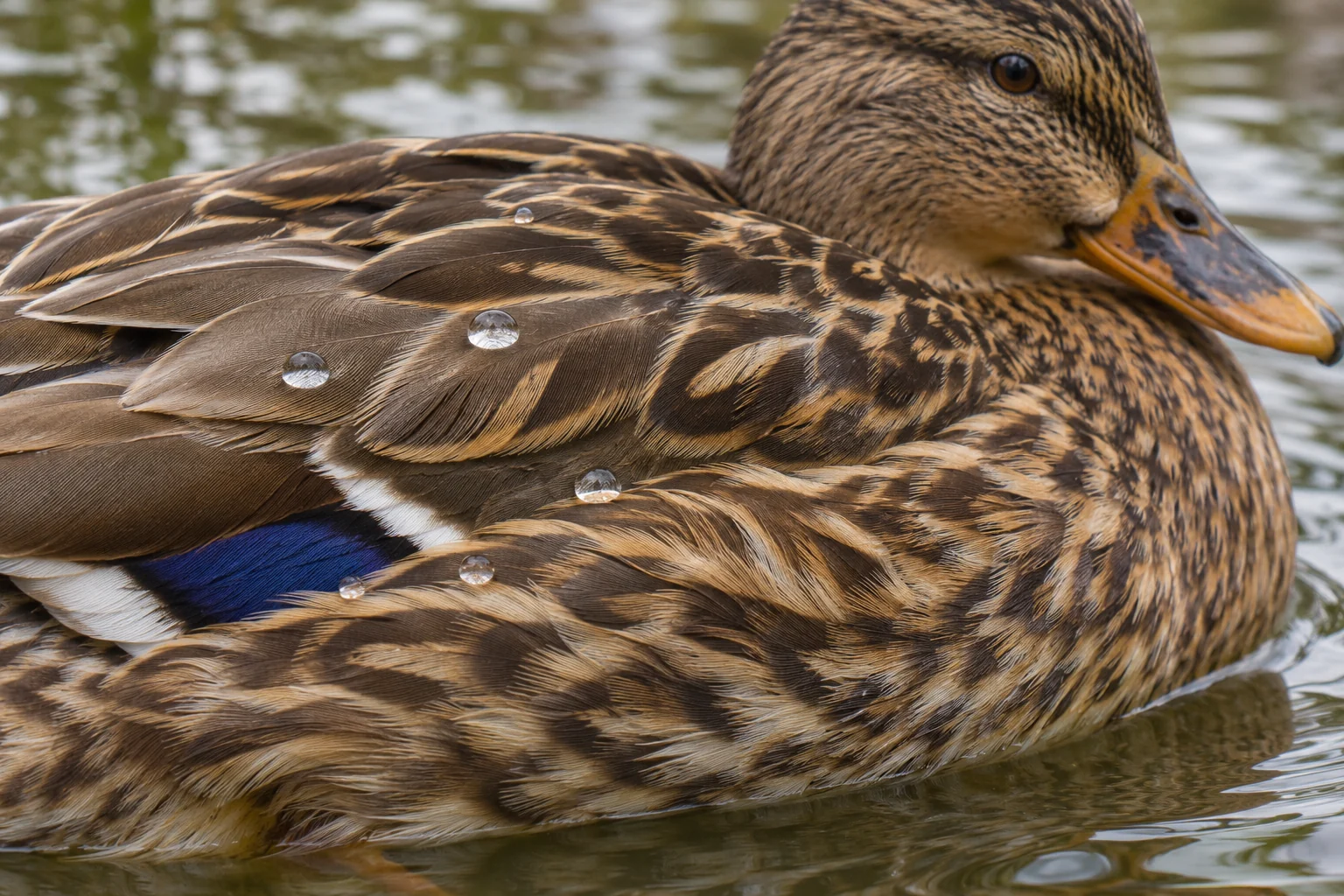
A drop landing on a healthy duck’s back often sits like a tiny glass bead before rolling away. Underneath it is not a smooth plastic raincoat. It is a flexible surface assembled from thousands of structures, each shaped and maintained by a living bird.
A feather is a branching surface
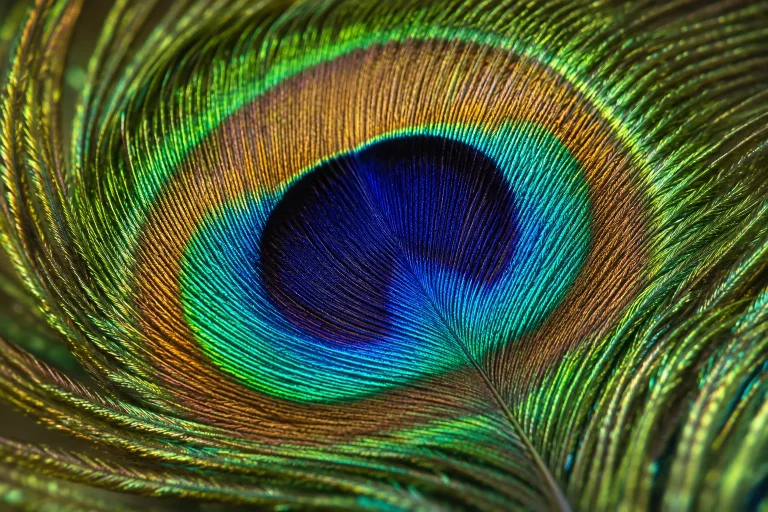
A typical contour feather has a central shaft with branches called barbs. Smaller barbules extend from those branches and help form the vane. This hierarchy creates a surface with fine-scale texture and spaces rather than a continuous flat sheet.
The arrangement affects how a liquid contacts the feather. A drop may rest partly on solid material and partly over trapped air. In that state, it does not occupy every gap below it. Researchers study these relationships using microscopy, measurements of droplet shape and tests of liquid penetration. [3]
That does not make every feather identical. Wing, breast and other feathers have different structures and jobs. A diagram showing one neat feather cannot specify the properties of a duck’s entire body covering.
Why water forms beads instead of a film
A water drop’s shape reflects the balance between interactions within the liquid and interactions with the surface beneath it. On a readily wetted surface, water spreads more easily. On a water-repellent surface, it tends to remain more rounded.
Surface texture can strengthen that effect when it supports a state with air beneath parts of the drop. But roughness is not automatically water-repellent. Whether a textured surface promotes or resists wetting also depends on its chemistry and geometry. Research on duck feathers has investigated both their multi-scale structure and their surface coatings. [4]
A useful everyday comparison is the difference between water on a clean window and water on a water-repellent fabric. The same liquid behaves differently because the contact conditions change. A duck’s coat adds biological maintenance and movement to that physical problem.
What preen oil actually contributes
Many birds have a uropygial gland near the base of the tail. During preening, a bird can collect its secretions and distribute them through the plumage. That behaviour helped make oil the popular explanation for water running off a duck’s back.
The evidence supports a more careful account. Work on mallards found that access to preen secretions matters for maintaining plumage condition. The 2024 review argues that structure provides much of feathers’ repellency, while preen oil helps preserve feathers until they are replaced. [2]
A broader review also emphasizes that proposed benefits of preen oil need to be assessed separately. Conditioning, resistance to feather damage and changes in surface behaviour are related possibilities, not one single demonstrated function in every species. The contribution of a coating can depend on the bird and on how it is tested. [5]
Preening does more than spread a substance
Running the bill through plumage helps maintain an organized feather coat. A duck’s covering must remain flexible while the bird swims, stretches, flies and rests. Water resistance depends on the resulting condition of that whole system.
Think of a jacket whose fabric is water-repellent but whose seams are pulled apart. A good surface treatment cannot compensate for every structural failure. The analogy is imperfect, but it explains why feather arrangement and feather condition deserve attention alongside oil.
This is also why pouring oil onto a feather is not a valid recreation of preening. It changes the substance, quantity and arrangement involved. An observation of one heavily coated feather would answer a different question from how a duck maintains its own plumage.
The dry-looking outside protects an insulating layer
Outer contour feathers form the visible covering. Beneath them, finer feathers and retained air contribute to insulation. Air in a well-maintained coat limits heat transfer compared with water penetrating the same spaces.
The thermal benefit is especially relevant to an animal swimming in cool water. A coat that resists wetting helps protect the air-containing layers close to the body. But the feather system works alongside physiology, behaviour and the rest of the animal’s anatomy.
Beading alone is not a measurement of insulation. A close-up photograph shows how visible drops interact with the outside surface. It cannot establish the temperature at the skin, the amount of trapped air or the condition of every layer beneath it.
Water-repellent is more accurate than absolutely waterproof
Water repellency and resistance to penetration are not identical properties. A drop may bead on a surface that liquid can penetrate when pressure rises or when the structure is damaged. The distinction matters for birds that swim and dive. [1]
A 2014 study of aquatic-bird feathers connected structural measurements with wetting behaviour and the pressure required to disrupt trapped air. Its results show why the amount of pressure matters; they should not be turned into a universal depth limit for every duck or every intact feather coat. [3]
“Waterproof” is therefore a useful everyday shortcut, provided it does not imply unlimited protection. The actual question is how strongly a particular coat resists wetting under particular conditions.
Why spilled petroleum is a different problem
Petroleum contamination can disrupt feather structure and the air-holding properties of plumage. It is not equivalent to the bird’s own carefully distributed preen secretions. A substance being called an oil does not make it beneficial to feathers.
In a study on Manx shearwater feathers, even relatively light oil-sheen exposures increased permeability under the tested conditions. Those results concern a different species from mallards, but they demonstrate why contamination can interfere with an aquatic feather surface. [6]
The study should not be used to diagnose a particular bird from a photograph. Its value here is mechanistic: liquid penetration changes when feather condition changes. The same overall appearance can conceal differences that require measurements to establish.
How scientists separate structure from chemistry
Researchers can compare untreated feathers with feathers whose coatings have been altered, examine their branching geometry, and measure how drops behave. Experiments involving access to preen secretions provide another line of evidence about maintenance over time.
Each approach has limits. Flattening or mounting a feather can change its natural shape. Removing a coating can affect other properties. A single contact-angle measurement describes one interaction under chosen conditions, not every exposure a bird experiences. [1]
That is why several kinds of evidence are useful. A persuasive explanation must account for immediate water beading, resistance to penetration and the condition of feathers over time. Those are connected outcomes, but a test of one does not automatically prove all three.
Common questions
### Do duck feathers stay completely dry? Their outer surfaces can carry visible drops, and their resistance has limits. The important protection is against water spreading and penetrating through the coat under the conditions it normally encounters.
Is preen oil useless?
No. Challenging the simple oil-coating story does not remove the importance of plumage maintenance. The evidence points to structure and maintenance working together, while the exact contribution of secretions can vary.
Is this the same mechanism as the lotus effect?
There is a useful connection: surface structure can help water remain in rounded drops. But a feather is a flexible, branching biological assembly, while a lotus leaf has a different surface architecture. Similar droplet behaviour does not mean identical construction.
Why does the duck need to keep preening?
A feather coat is continually exposed to movement, wear and contamination. Maintaining the arrangement and condition of its parts helps sustain functions that a newly formed feather cannot guarantee forever.
Keep exploring
Sources and further reading
- Muzio and Rubega (2024) — What do we really know about the water repellency of feathers? (open research review)
- Giraudeau and colleagues (2010) — Effects of access to preen gland secretions on mallard plumage (abstract)
- Srinivasan and colleagues (2014) — Quantification of feather structure, wettability and resistance to liquid penetration
- Liu and colleagues (2008) — Hydrophobic duck feathers and their simulation on textile substrates (abstract)
- Moreno-Rueda (2017) — Preen oil and bird fitness: a critical review of the evidence
- Research study (2022) — Light to intermediate oil sheens increase Manx shearwater feather permeability
Reference review: November 12, 2026.
Keep exploring.
One remarkable idea at a time—nature, science, history and beyond.
Last updated November 13, 2026.

Barnakle Editorial Team
Barnakle Editorial Team is the collective byline used for Barnakle’s editorial articles. The contributor profile explains the team identity and links to the publication’s editorial policies.
More from the editorial team →