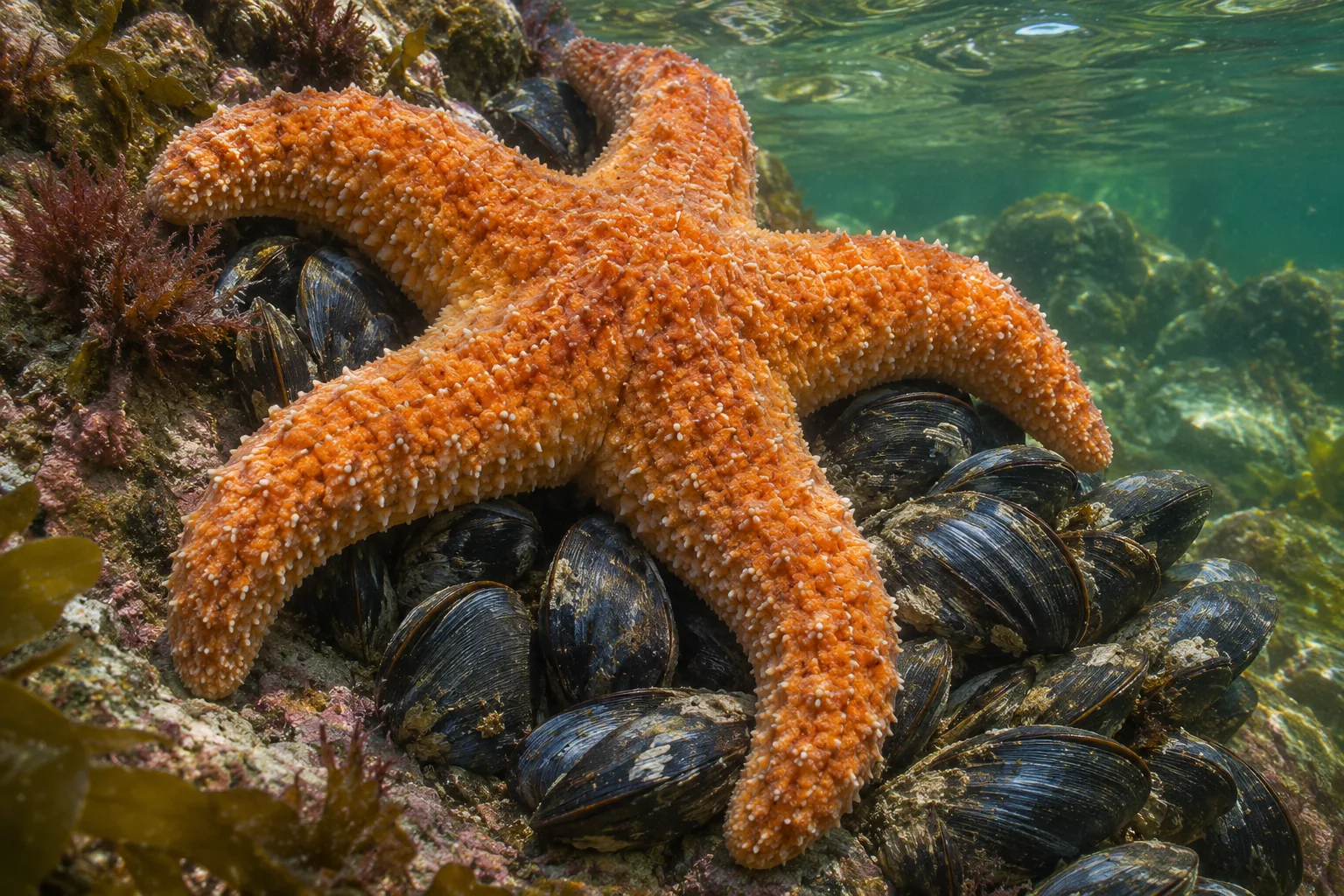
A sea star feeding on a mussel rarely leaves a spectacular pile of broken shell. A more revealing sight is an intact mussel with a sea star drawn up over it, arms curved around the two halves. Some sea stars attach tube feet to the shells and pull the halves slightly apart. They can then extend part of their stomach through the opening and begin digesting the animal inside. The meal can start while the hard parts that protected it are still largely in place. [1, 2]
What keeps a clam or mussel shut?
A clam or a mussel is a bivalve. Its two shell halves, called valves, meet at a hinge. Adductor muscles drawing the valves together work against an elastic ligament at the hinge that tends to open them. A living shell can clamp down when disturbed, and a gap visible a moment earlier may close. To reach the soft body, a feeding sea star must deal with a shell whose occupant actively changes the size of the opening. [2, 3]
Imagine trying to read a folded note inside a hinged box that someone is holding shut. Pulling on the outside of one panel while leaving the other panel free would mostly move the whole box. Pulling on the two panels in different directions changes the opening itself. A sea star can place its arms around prey and establish many points of attachment on opposing surfaces. Its posture matters as much as the sheer number of small feet on view. [1, 2]
A grip that works underwater
Turn a sea star over in your imagination. Its mouth is near the middle of the underside, and rows of tube feet run outward along the arms. These flexible feet can extend, attach, shorten and release. As a sea star arches over a shell, the feet can reach its curved exterior and hold on in different places. Contact is spread across a series of small patches, so the whole animal can work against a bivalve even though any one foot is tiny beside it. [1, 2]
The round ends of the feet look remarkably like little suction cups. In the common sea star Asterias rubens, researchers studied the material left on a surface after the feet had detached. Those footprints provided evidence of adhesive secretions used to make temporary attachments. A foot can form a bond under water and subsequently leave that spot. The appearance of a circular disk alone would not tell an observer what supplied its grip. [4]
Consider how useful release is to a predator that also walks on these same structures. A permanently stuck foot would make a poor stepping foot. A foot that could never hold would do little to help maintain a pull. Different feet can be contacting, holding or changing position during an encounter. From above, a star can appear motionless through much of a meal even while the hidden contact points beneath it are doing the work. [1, 4]
How far apart do the valves have to move?
One study examined the sea star Evasterias troschelii feeding on live clams. The researcher recorded movements at the edge of the shell, where a change in the gap was easiest to detect. In 21 trials with clams of a specified size range, the valves initially opened at an average rate of roughly a millimetre per minute at the measurement point. The clams continued trying to close. The slow change in a recorder’s trace revealed an interaction largely invisible to an observer watching the top of the star. [2]
The measurement applies to those trials and to that part of the shell. Near the hinge two valves can barely move apart while their outer margins separate visibly, just as the handle end of a door moves farther than a point close to its hinges. The study also used an artificial clam with a known resistance. That let the investigator ask a question a live animal alone could not settle easily. How much of the observed opening could the sea star produce against a measured opposing load? [2]
A sea star does not have to spread the valves wide enough for an arm, much less its whole body, to fit between them. Soft tissue from its stomach can enter a much narrower opening. That changes the terms of the encounter. Maintaining a small gap long enough to gain access can be sufficient even while the shell remains a formidable barrier to the rest of the star. [1, 2]
Eating with part of the stomach outside
The portion that emerges through the mouth is called the cardiac stomach. In a feeding star it can turn outward, a movement known as eversion, and contact the prey. Digestive fluids begin breaking down soft tissues in a space enclosed largely by the prey’s own valves. Material can then pass into the sea star’s digestive system. After feeding, the stomach is drawn back inside. This is why a predator with a relatively small mouth can exploit a meal far too large to swallow shell and all. [1, 2]
Follow a mussel beside the feeding star and you may see threads tethering it to the rock. California mussels use these byssal threads to hold on to one another and to their surroundings. A star opening the valves and a wave trying to carry the whole mussel away are challenging two different attachments. The threads can keep the shell on the ledge even while the muscles inside are resisting the movements of the valves. [3]
Reading the scene on a rocky shore
Ochre sea stars of the northeastern Pacific are familiar predators of mussels on rocky shores. Other sea stars take other foods or handle them differently. A picture of an orange star beside a blue mussel is therefore only the start of an observation. A star arched over the mussel with feet on opposite valves is better evidence of a feeding attempt. A sequence that shows the posture persist and the valve edges slowly separate tells more than any single still image. [1, 2]
If a video lasts only a few seconds, use the edge of the shell as your reference. It is easier to notice the change in a dark line between two valves than to judge the effort of the sea star from the sweep of its arms. The striking part of this meal is just how little has to move for the animal inside its shell to become accessible.
Keep exploring
Compare the moving valves of a swimming scallop and another animal’s way of making a strong, reversible grip.
Sources and further reading
- Walla Walla University, Invertebrates of the Salish Sea — Pisaster ochraceus
- The Feeding Behavior of the Seastar Evasterias troschelii Stimpson — Limnology and Oceanography
- Monterey Bay Aquarium — California mussel
- A study of temporary adhesion in Asterias rubens through tube-foot footprints — PubMed
Keep exploring.
One remarkable idea at a time—nature, science, history and beyond.
Last updated November 19, 2026.

Barnakle Editorial Team
Barnakle Editorial Team is the collective byline used for Barnakle’s editorial articles. The contributor profile explains the team identity and links to the publication’s editorial policies.
More from the editorial team →