
The observatories measuring ripples in spacetime
What to know
- LIGO measures differential arm-length strain with laser interference.
- Multiple detectors distinguish celestial signals from local noise.
- Waveform phase reveals masses, spins and orbital evolution.
- Catalogs require calibration, selection modelling and statistical background tests.
When spacetime carries news
Gravitational waves are travelling distortions in spacetime produced when masses accelerate asymmetrically. Einstein’s general relativity predicted them, but most are extraordinarily weak by the time they reach Earth. The strongest signals measured so far usually come from compact objects—black holes or neutron stars—moving at enormous speeds during their final orbits and merger. Unlike light, the waves are not radiation moving through a fixed stage. They are changes in the geometry used to measure distance and time. Detecting them required instruments able to notice a fractional change far smaller than the width of a proton across kilometre-scale arms.
Why ordinary motion is not enough
Any accelerating mass can contribute to gravitational radiation in principle, but a perfectly spherical change does not radiate in the same way an uneven, time-varying mass distribution does. The leading term is quadrupolar. A rotating dumbbell-shaped system changes its quadrupole moment; an isolated spinning sphere does not. Everyday objects generate waves far too small to measure. Compact binaries are different because enormous masses orbit close together. As they radiate energy and angular momentum, their orbit shrinks and speeds up. The rising frequency and amplitude create a “chirp” that encodes the system’s masses, distance, orientation and dynamics.
An interferometer turns length into light
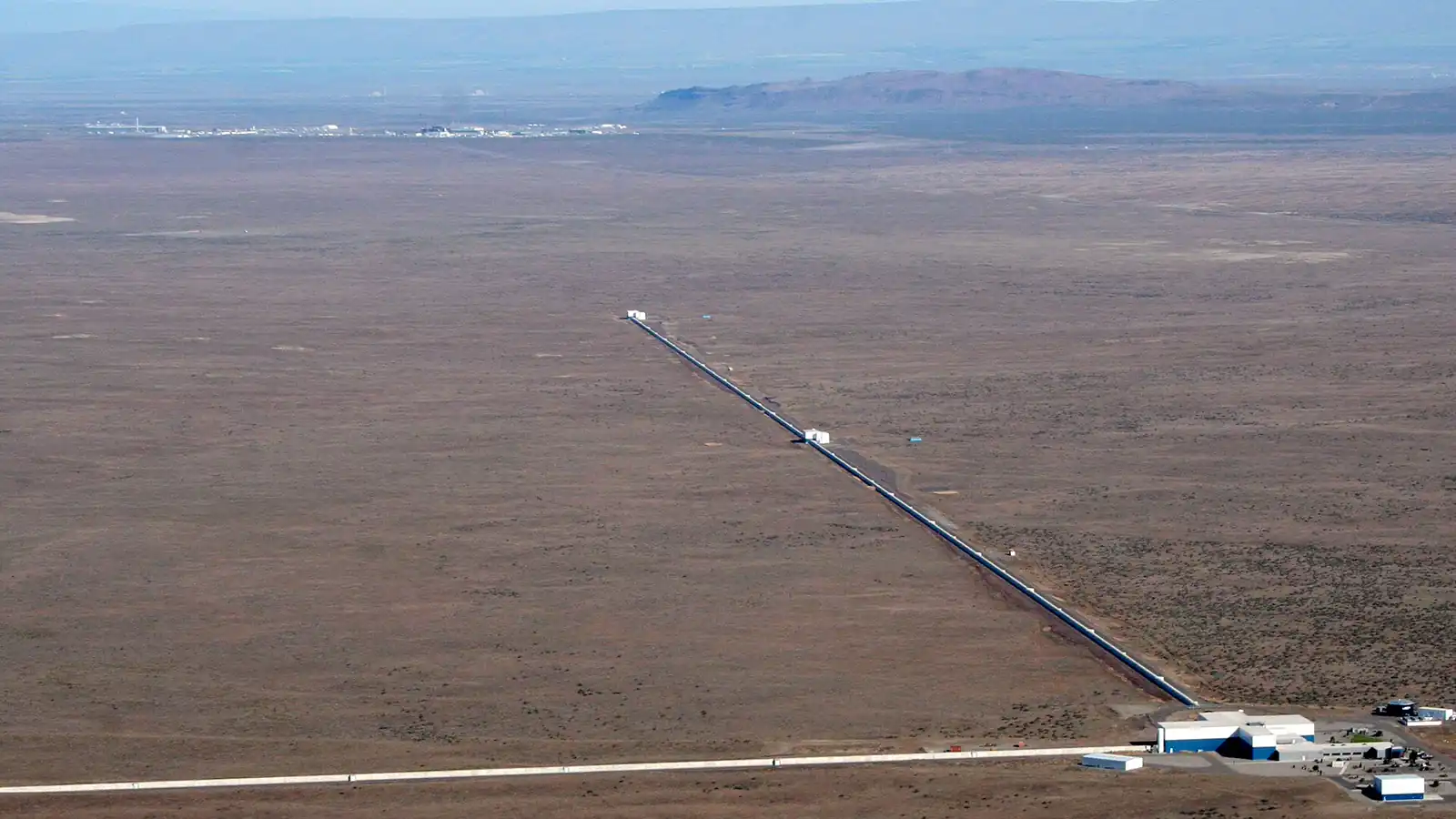
LIGO uses two perpendicular vacuum arms, each four kilometres long. A laser beam is divided and sent down both arms, reflected by suspended mirrors and recombined. If the paths are unchanged in the relevant way, the returning light largely cancels at the detector. A passing gravitational wave stretches one arm while compressing the other, then reverses the pattern. That differential change alters the interference. The mirrors do not behave like marks painted on a rigid ruler; the instrument measures how light travel changes between carefully isolated test masses. The geometry makes it sensitive to one polarization pattern while also rejecting many common disturbances.
The change is almost impossibly small
Scientists describe a wave by strain: the change in length divided by the original length. Astrophysical strains at Earth can be around one part in 10²¹. Over four kilometres, that corresponds to a displacement of roughly 10⁻¹⁸ metres. No single component simply “measures” that distance with a tiny ruler. The whole observatory is designed to convert a coherent differential motion into an optical signal while reducing noise. Long arms increase the physical path change, and optical cavities bounce light many times to increase interaction. Stable lasers, high-quality mirrors, vacuum systems and feedback controls work together as one measurement chain.
Two observatories separate sky from ground
The United States has LIGO detectors in Hanford, Washington, and Livingston, Louisiana. A real wave should appear in both with a delay no greater than the light-travel time between sites and with amplitudes consistent with their orientations. Local disturbances generally do not reproduce the same waveform at both locations. Virgo in Italy, KAGRA in Japan and other detectors add baselines and orientations. A network improves confidence, sky localization and polarization information. The instruments are not identical ears hearing a simple sound; each has an antenna pattern, meaning sensitivity varies with direction and wave orientation.
Mirrors must behave as free test masses
Each main mirror hangs from a multi-stage suspension. At frequencies of interest, the suspension helps isolate it from ground vibration so it can respond approximately as a free mass. Active systems also sense and counter seismic motion. The sites are selected and engineered carefully, yet trucks, wind, ocean waves and earthquakes still leave signatures. Thermal motion in coatings and suspensions contributes noise, as does quantum uncertainty in light. Engineers cannot remove physics; they shape the instrument so different noise sources are reduced in the band where cosmic signals are expected.
Vacuum protects the laser path
Air molecules would scatter light and changes in air pressure would alter the optical path, so LIGO’s beam tubes maintain one of the world’s largest ultra-high-vacuum systems. The tubes must remain straight, clean and stable across kilometres. Mirrors are housed in vacuum chambers, and contamination control protects their surfaces. The giant infrastructure can make detection seem like a matter of scale alone, but small details are equally important. A coating defect, electrical coupling or stray reflection can introduce noise. Commissioning is the repeated work of finding such couplings, changing hardware or controls and demonstrating that sensitivity truly improved.
A signal is found inside noise
Compact-binary searches use waveform models predicted by relativity. Analysts compare these templates with calibrated detector data through matched filtering, looking for the characteristic evolution expected from systems with different masses and spins. Other searches are less model-dependent and seek coherent bursts, continuous waves or a stochastic background. Candidate significance is estimated against the rate at which noise could produce similar events. Teams study auxiliary sensors and data-quality flags to identify disturbances. A visible curve matching a model is compelling only after calibration, background estimation and checks that the feature was not produced by the instrument.
The first direct detection
GW150914 reached Earth on 14 September 2015 and was announced in 2016. Its waveform matched the merger of two stellar-mass black holes and the ringdown of the remnant. The event provided the first direct detection of gravitational waves and the first observation of a binary black-hole merger. It also tested general relativity in a previously inaccessible strong-field regime. The discovery did not rest on one dramatic plot. It relied on two detectors, detailed instrument investigations, independent analysis pipelines, waveform modelling and statistical evaluation. Its importance came from both the source and the opening of an entirely new observational method.
Inspiral is a precision clock
During the early detectable stage, two compact objects orbit many times while losing energy. The frequency rises as separation falls. The rate of that rise strongly constrains a combination called the chirp mass, often measured more precisely than the individual masses. Spin can modify the phasing, especially when aligned or misaligned with the orbit. The signal also carries distance information through amplitude, though orientation creates degeneracies. Because phase accumulates across many cycles, even small deviations between theory and data can matter. Accurate waveforms combine post-Newtonian calculations, numerical relativity and effective models calibrated across parameter space.
Merger requires numerical relativity
Near merger, gravity is strong and motion is highly relativistic. Computers solve Einstein’s equations numerically to predict the waveform. After two black holes combine, the distorted remnant settles by emitting a damped ringdown whose frequencies depend mainly on its mass and spin. Comparing inspiral, merger and ringdown tests whether one consistent remnant explains the event. Weak signals limit how sharply each stage can be isolated, so claims depend on signal quality and analysis choices. Future louder detections could resolve multiple ringdown modes and test the black-hole description with greater precision.
Neutron stars add matter to the experiment
Unlike black holes, neutron stars contain matter whose behaviour at extreme density remains uncertain. Tidal forces can deform them late in an inspiral, leaving subtle changes in the waveform related to internal stiffness. A merger may produce a heavier neutron star, a black hole and ejected material. In 2017, GW170817 was also observed across the electromagnetic spectrum, linking a gravitational-wave signal to a short gamma-ray burst and a kilonova. Combining messengers provided information about element formation, jet physics, gravity and cosmic expansion. It showed why gravitational astronomy becomes especially powerful when telescopes and particle detectors participate.
How detectors locate an event
Arrival-time differences constrain a source to regions on the sky. Relative amplitude and phase add information, as do the detectors’ antenna patterns. With only two similarly oriented instruments, the region can be broad; a larger international network can narrow it dramatically. Rapid alerts allow telescopes to search for light, but most black-hole mergers are not expected to shine. Localization is probabilistic, displayed as a sky map rather than a single pin. Distance uncertainty adds a three-dimensional volume containing many possible galaxies. Better sensitivity and more operating detectors reduce that search region and increase the chance of identifying a counterpart.
Calibration turns voltage into strain
The recorded output begins as an electrical signal in control and readout systems. Researchers must determine how that output corresponds to differential arm length across frequency and time. Calibration uses known forces, including precisely controlled radiation pressure from auxiliary lasers. Uncertainty in amplitude and phase is carried into astrophysical inference. The detector’s sensitivity also changes as alignment and environmental conditions evolve. Calibration teams track those changes and create data products suitable for analysis. Without this work, an apparent difference between observation and a waveform model could reflect the instrument rather than the universe.
Noise can imitate pieces of a chirp
Transient glitches arise from many sources: scattered light, control instabilities, electrical problems, weather or processes not immediately understood. Machine-learning classifiers and citizen-science projects help group glitch shapes, while physical investigations trace them to hardware or environment. Analysts may exclude contaminated times or model a glitch alongside a signal. The goal is not to create perfectly quiet data—a real detector never provides that—but to understand when noise can bias a result. Public data releases and documented methods allow researchers outside collaborations to reproduce analyses and develop new searches.
What catalogs teach that one event cannot
A growing population reveals the distribution of black-hole and neutron-star masses, spins and merger rates. Unexpected mass ranges can challenge assumptions about stellar evolution. Spin orientations may preserve clues about whether binaries formed from isolated stars or through encounters in dense environments. Selection effects are essential: detectors more easily find massive or favourably oriented systems over greater distances. Population studies model this uneven sensitivity rather than treating detections as a simple census. Catalogs can also search collectively for weak departures from relativity that no single event could establish.
Gravitational waves measure distance differently
A compact-binary waveform can act as a “standard siren.” General relativity connects the evolving signal with intrinsic source parameters, while observed amplitude provides luminosity distance, subject to orientation uncertainty. If a redshift is obtained from an identified host or statistical galaxy information, the event can contribute to measurements of cosmic expansion. The method has different systematics from traditional distance ladders. Present constraints are comparatively broad, but larger samples and better localization can improve them. Standard sirens illustrate how a phenomenon first pursued as a test of relativity becomes a tool for cosmology.
Listening is a metaphor with limits
Scientists often convert waveforms into audio because their frequencies can fall within human hearing after suitable processing. The rising chirp becomes intuitive, but LIGO does not use microphones and space is not carrying ordinary sound to Earth. The detector measures strain in spacetime. Sonification is a representation, useful for pattern recognition and public explanation, not the raw physical medium. Similarly, saying that black holes “collide” is shorthand for a dynamical spacetime process without solid surfaces. Good metaphors provide an entry point, but the measurement remains optical, mathematical and carefully calibrated.
A new spectrum is still opening
Ground-based detectors are sensitive to a particular frequency range. Pulsar-timing arrays probe far lower frequencies by monitoring stable cosmic clocks, while planned space interferometers such as LISA will target millihertz waves from massive black-hole systems and compact galactic binaries. Cosmic microwave background experiments seek possible signatures at still earlier times and lower effective frequencies. These methods do not simply duplicate LIGO at different sizes; they observe different sources and eras. Gravitational-wave astronomy is becoming a spectrum, much as electromagnetic astronomy expanded from visible light to radio, infrared, ultraviolet, X-rays and gamma rays.
What the wave really tells us
A detection is not a photograph of two objects. It is a time series whose shape is compared with physical models. From it, researchers infer probable masses, spins, distance, orientation and source type, with correlations and uncertainty. Multiple detectors, environmental monitors, calibration and statistical background tests establish confidence. The achievement is remarkable precisely because the signal is so indirect and small. Kilometre-scale machines on Earth can reconstruct the final seconds of systems far beyond the Milky Way because relativity specifies how motion writes information into spacetime—and because experimentalists learned how to keep the local world quiet enough to read it.
Observing runs are not continuous
Detectors alternate between observing and periods of commissioning, maintenance and improvement. Even during a run, an instrument may be temporarily offline or operating with reduced sensitivity. Scientists report duty cycle and analyse the amount of spacetime volume effectively surveyed, not just calendar duration. A quiet stretch with no detection can still constrain event rates if sensitivity was known. Conversely, a month of noisy data does not equal a month at design reach. Catalog construction therefore includes careful bookkeeping about when each detector was ready and how far it could have detected different systems.
Public alerts trade speed for revision
Low-latency pipelines can distribute candidate notices within minutes, giving astronomers time to search for fading counterparts. Early estimates of significance, sky position and source type are preliminary. Calibration updates or human review may revise or retract an alert. That is expected in a system designed for speed, not evidence of failure. Formal catalog results undergo deeper analysis and describe selection criteria. Readers should distinguish a public candidate from a peer-reviewed detection. The alert network is valuable because some light signals vanish quickly, but scientific confidence accumulates through later checks, comparison and transparent documentation.
Future sensitivity changes the questions
Incremental reductions in noise increase the distance an observatory can reach; because accessible volume grows rapidly with range, modest sensitivity gains can produce many more detections. Next-generation ground observatories propose longer arms and improved low-frequency performance, potentially observing mergers earlier and with higher signal-to-noise. They could trace black-hole populations across cosmic history and measure neutron-star physics more sharply. Those ambitions depend on funding, engineering, site selection and international cooperation. The progression from the first event to population astronomy shows that gravitational-wave science is not one completed discovery but an expanding measurement programme.
Null results also contain information
A search that finds no credible signal can still set an upper limit on how often a source occurs or how strong a background could be. Continuous-wave searches, for example, examine data for nearly periodic signals from asymmetric rotating neutron stars. Burst searches test many possible transient shapes. Interpreting a null result requires quantified sensitivity and simulated signal recovery, not merely an empty candidate list. As instruments improve, those limits exclude models or guide future observing strategies. Gravitational-wave astronomy advances through detections, population statistics and carefully measured absences.
Sources and further reading
- LIGO Scientific Collaboration, Gravitational Waves Explained
- Abbott et al., Observation of Gravitational Waves from a Binary Black Hole Merger
- Abbott et al., Multi-messenger observations of a binary neutron star merger
- Gravitational Wave Open Science Center
- LIGO Laboratory, How LIGO Works
- Einstein Telescope, Gravitational-wave detector principles
How Barnakle selects and verifies sources · Corrections and updates
Keep exploring.
One remarkable idea at a time—nature, science, history and beyond.
Sources and further reading
Barnakle uses credible primary and authoritative sources wherever possible.
- LIGO Scientific Collaboration, Gravitational Waves Explained
- https://www.ligo.org/science/Publication-GW150914/
- Abbott et al., Observation of Gravitational Waves from a Binary Black Hole Merger
- https://doi.org/10.1103/PhysRevLett.116.061102
- Abbott et al., Multi-messenger observations of a binary neutron star merger
- https://doi.org/10.3847/2041-8213/aa91c9
- Gravitational Wave Open Science Center
- https://gwosc.org/
- LIGO Laboratory, How LIGO Works
- https://www.ligo.caltech.edu/page/what-is-interferometer
- Einstein Telescope, Gravitational-wave detector principles
- https://www.et-gw.eu/
Last reviewed September 21, 2026.

Barnakle Editorial Team
A member of the Barnakle editorial team, exploring remarkable ideas with clarity, curiosity and care.
More from this author →