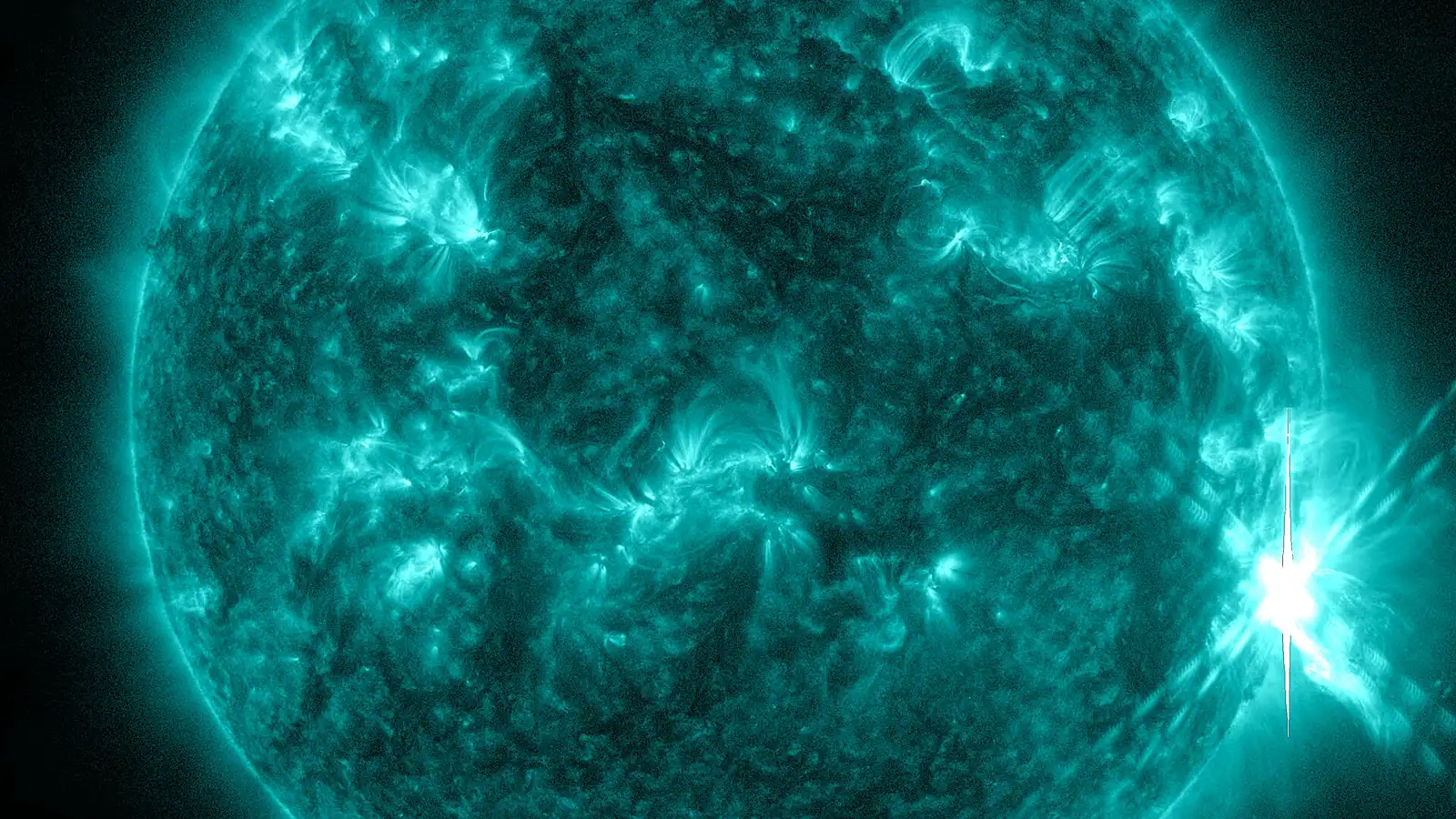
A solar storm is not one uniform blast that reaches every technology at the same time. Solar flares release electromagnetic radiation. Eruptions can also send plasma and magnetic fields into space, while energetic particles create another set of effects. Their interactions with Earth produce different kinds of space weather.
Separating these mechanisms explains why radio, satellites and power networks can respond differently during the same broad period of solar activity.
Flare radiation changes the upper atmosphere
A flare's enhanced radiation reaches Earth at the speed of light. On the sunlit side, it can increase ionisation in parts of the atmosphere and interfere with high-frequency radio propagation.
NOAA's guidance on HF communication describes how changes in the lower ionosphere can absorb signals that would otherwise support long-distance links. This is not the same process as a magnetic disturbance inducing current in a power line.
Energetic particles create additional hazards
Solar energetic particles can affect spacecraft electronics and alter the polar ionosphere. Their arrival and intensity depend on how the particles were accelerated and on magnetic connections through interplanetary space.
A solar radiation storm is therefore classified separately from a radio blackout or a geomagnetic storm. The categories describe related but distinct phenomena rather than three names for one measurement.
A magnetic disturbance can couple into infrastructure
When interplanetary conditions disturb Earth's magnetic environment, changing magnetic fields can create electric fields in the ground. Long conductors, including parts of transmission networks, can pick up the resulting geomagnetically induced currents.
The consequences depend on geology, network configuration and equipment, not merely on whether an aurora is visible overhead. Operators monitor conditions because a low-frequency disturbance can affect systems designed for a different pattern of electrical operation.
Satellites encounter a changing environment
Spacecraft can face particle effects, charging and changes in the upper atmosphere. Heating of that atmosphere can increase drag on low-orbiting satellites. Navigation and communication signals may also be disturbed as they pass through an altered ionosphere.
These mechanisms have different timescales and affect different orbits or services. An intense event at the Sun does not guarantee identical disruption at every satellite or on every receiver.
Forecasts combine observations and uncertainty
Observations of solar activity help identify potential eruptions, while measurements nearer Earth refine estimates of arriving conditions. The orientation of an eruption's magnetic field can be important to how strongly it interacts with the magnetosphere.
Forecasts are consequently updated as information improves. They support protective decisions but do not supply a guaranteed schedule of outages. Understanding the separate physical routes is more useful than treating every solar headline as evidence that all electronics on Earth are about to fail.
Explore a related question
What Causes the Northern Lights?
Sources and further reading
Keep exploring.
One remarkable idea at a time—nature, science, history and beyond.
Last updated October 27, 2026.

Barnakle Editorial Team
Barnakle Editorial Team is the collective byline used for Barnakle’s editorial articles. The contributor profile explains the team identity and links to the publication’s editorial policies.
More from the editorial team →