Tiny muscles pull hair follicles upright during cold, fear and powerful emotion
The short answer
Cold air, a frightening sound and a moving piece of music can produce the same skin pattern. These triggers converge on autonomic pathways that prepare the body for thermoregulation or arousal. The response is involuntary and can begin before a person consciously labels the feeling.
Tiny muscles attach to follicles
Each arrector pili is a small band of smooth muscle connecting a hair follicle to the upper skin. Contraction rotates the follicle and pulls the surface inward around it.
Sympathetic nerves trigger contraction
Piloerection belongs to the autonomic nervous system. Norepinephrine released by sympathetic fibres activates smooth muscle without a deliberate command.
Cold is a classic stimulus
Temperature sensors and brain thermoregulatory centres recruit several responses, including vessel constriction, shivering and piloerection. Their strength depends on exposure and individual physiology.
Fur makes the reflex useful
Raised fur increases the thickness of an insulating air layer. The same geometry can make a threatened animal look larger to a rival or predator.
Human hair changes the outcome
Humans retain follicles and muscles but have much less dense body hair than many mammals. Raising it adds little insulation, though it may still slightly alter heat exchange.
Fear recruits arousal circuits
Threat processing activates sympathetic responses such as faster heart rate, sweating and piloerection. Goosebumps are one possible component rather than a universal fear meter.
Music can trigger aesthetic chills
Unexpected harmony, anticipation, memory and emotional peaks can activate reward and autonomic networks. Piloerection is measurable during some—but not all—reported chills.
The scalp can respond too
Goosebumps are easiest to see on arms and legs, but piloerection can occur wherever suitable follicles and muscles remain, including the scalp.
The bumps are not the hairs themselves
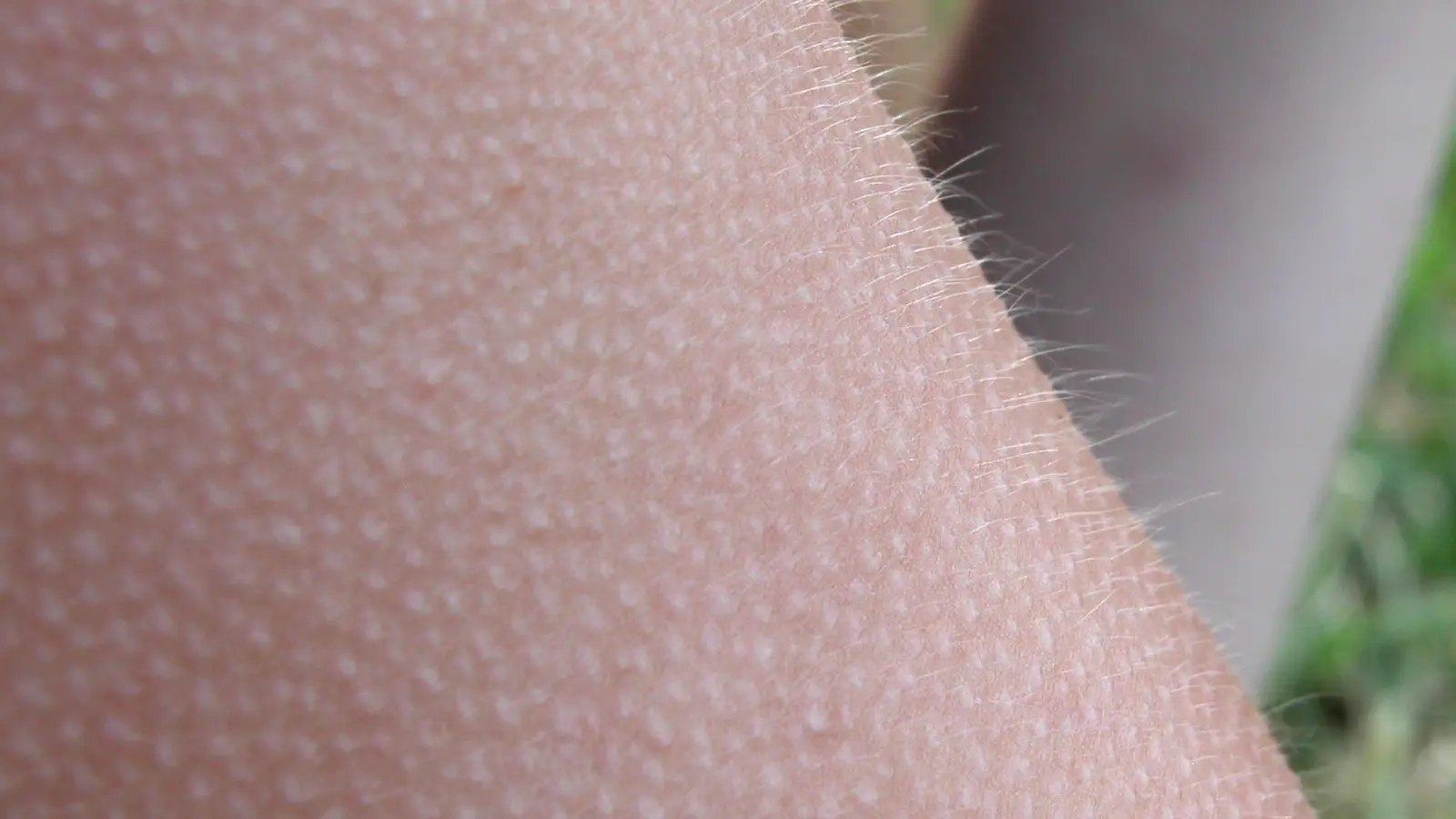
The raised texture comes from skin deformation around contracted follicles. Hairs may stand more upright at the centre of each bump.
Response patterns vary
Temperature, hormones, emotion, attention, medication and neurological state influence the threshold. Some people notice the reaction far more often than others.
Persistent one-sided piloerection is unusual
Rare neurological events can produce localized or episodic goosebumps. A new recurrent pattern with other symptoms warrants clinical assessment.
Hair follicles form a biological unit
Arrector pili muscles connect with follicles, nerves, glands and stem-cell niches. Research suggests this unit participates in more than the visible cold reflex.
Common misconceptions
Goosebumps do not mean someone is definitely frightened, cold or telling the truth. Strong music and memory can trigger them, while intense emotion may occur without them. The response is not useless simply because human hair is sparse; it reflects conserved autonomic circuitry and follicle biology.
How scientists know
Researchers record skin temperature, conductance, piloerection images and autonomic signals during cold exposure or emotional stimuli. Microscopy maps the follicle-muscle unit, animal studies trace sympathetic nerves and clinical observations reveal how neurological conditions alter the reflex.
Why are they called goosebumps?
The dimpled skin resembles the surface of a plucked goose.
Can you create them voluntarily?
A small minority report voluntary control, but most piloerection is involuntary.
Why does music cause chills?
Anticipation, surprise and reward networks can recruit autonomic arousal, including piloerection.
Do goosebumps warm humans?
They add little insulation compared with dense fur; shivering and blood-flow changes matter more.
When should they concern me?
Seek advice for recurrent localized episodes with confusion, weakness, pain or other new neurological symptoms.
Key takeaways
- Arrector pili muscles raise hair follicles.
- Sympathetic nerves control the reflex.
- Fur improves insulation and apparent size in other mammals.
- Cold, fear and aesthetic emotion can all trigger it.
Continue exploring
Sources and further reading
Keep exploring.
One remarkable idea at a time—nature, science, history and beyond.
Last updated October 27, 2026.

Barnakle Editorial Team
Barnakle Editorial Team is the collective byline used for Barnakle’s editorial articles. The contributor profile explains the team identity and links to the publication’s editorial policies.
More from the editorial team →