Moisture, heat and agitation let scaled fibres migrate and lock together in a denser felted structure
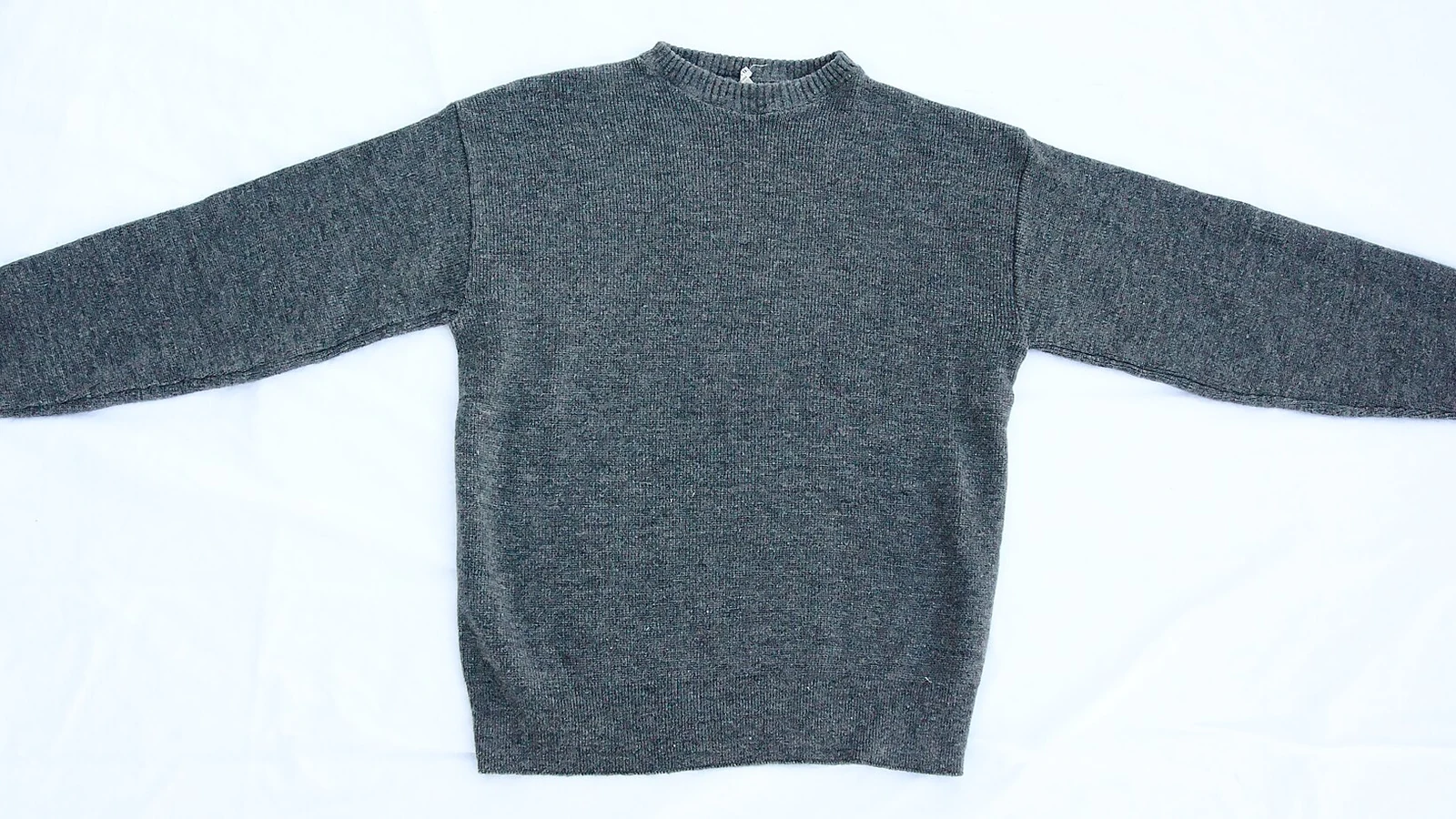
A wool sweater that emerges smaller and denser has not simply lost length from every fibre. In severe felting, the fibres have migrated through one another and become tangled into a new structure. The garment may contain much the same material, yet its original knitted organization is harder to see. That is a different problem from ordinary relaxation shrinkage.
A scaled fibre behaves differently in each direction
Like hair, wool contains protein chains organized into complex internal structures. Chemical bonds and moisture influence stiffness and swelling, while the fibre’s crimp helps yarn trap air and recover from gentle deformation.
Overlapping cells point from root toward tip, creating a directional texture. Friction is generally greater when neighbouring fibres move against the scale direction than when they slide with it.
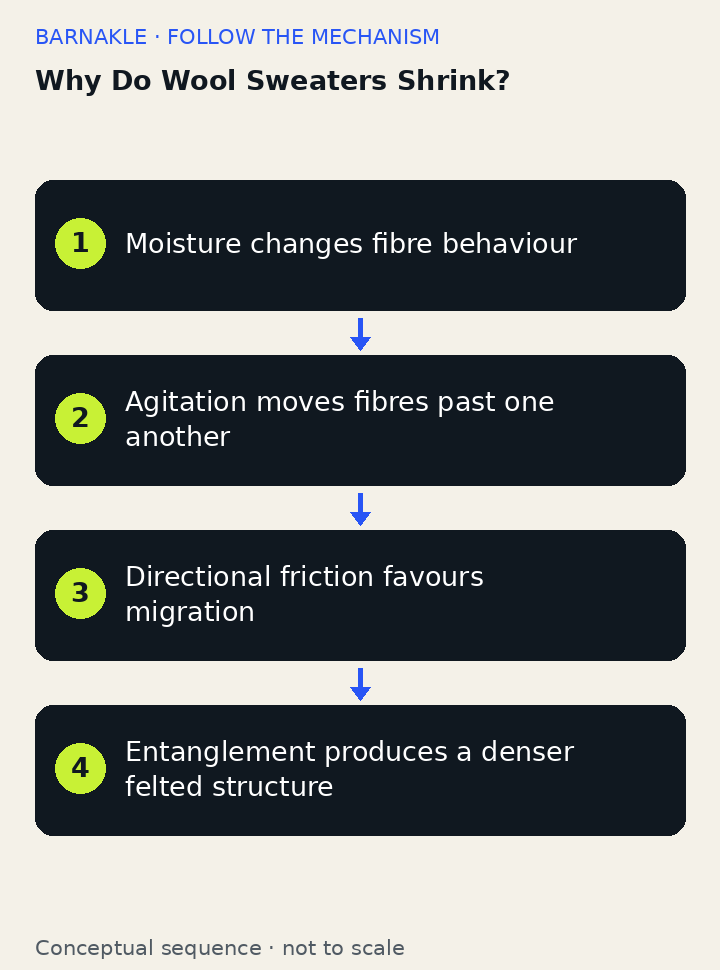
The cuticle scales are not tiny hooks that perform the entire process on their own. They contribute to friction that depends on direction. Repeated movements through wet fabric then produce unequal forward and backward sliding, helping fibres migrate and become entangled. The complete mechanism involves fibre surface, motion and the fabric structure together.
Sources: [1]
Washing supplies the conditions for migration
Moisture penetrates wool and plasticizes parts of the fibre, allowing swelling and easier relative motion within yarns. Water alone may relax manufacturing stresses, but severe felting usually needs additional agitation and favourable temperature or chemistry.
Tumblers, wash drums and rubbing repeatedly bend and compress the fabric. Directional friction means a fibre does not retrace exactly the same path, so it gradually migrates and becomes more entangled with its neighbours.
Warmth increases molecular motion and can strengthen detergent action, but there is no single magic temperature at which all wool suddenly shrinks. Time, agitation, moisture, pH, yarn and prior treatment interact.
Heat is one influence within a set of interacting conditions. Moisture, agitation, time and chemistry also matter. That is why a single supposedly safe temperature cannot explain every result. Two garments described as wool may differ in yarn, construction, blend and surface treatment, so the same wash does not necessarily give the same dimensional change.
Sources: [1]
Felting changes fabric structure, not just dimensions
As fibres lock, knitted loops draw closer, pores shrink and thickness can increase. Measurements in length and width fall even though the material has not vanished; the same fibre mass occupies a more compact area.
A new knit can relax when manufacturing tension is released, producing modest dimensional change. Felting is more permanent because fibres have migrated and interlocked, often distorting stitch definition and handle.
Relaxation releases some of the tensions introduced during manufacture. Felting instead rearranges and entangles fibres more extensively. Both can make a garment smaller, but their reversibility is different. That distinction is more useful than a general promise that stretching a wet sweater will restore whatever happened inside the wash.
Sources: [1]
Shrink-resistant treatment changes the surface behaviour
Treatments may remove or blunt scales or coat fibres with a thin polymer so they slide with less directional friction. This can improve machine washability, though care instructions still depend on the garment and treatment.
Cool or lukewarm water, approved detergent, minimal rubbing and flat drying reduce fibre migration and distortion. The garment label remains the best guide because blends, dyes, finishes and construction vary.
Superwash describes shrink-resist processing rather than a single universal recipe or unlimited permission to use any cycle. Treatments change the scale-related behaviour through surface modification or coatings. The care label still applies to the complete garment, including its construction and other components, rather than to one fibre property in isolation.
How testing separates relaxation from felting
Imagine drawing two lines on a loose knitted sample and then comparing their distance after washing. A smaller distance establishes dimensional change, but not its cause. Looking at stitch definition, thickness and fibre entanglement helps separate relaxation from felting. Textile testing combines those observations instead of treating one shrunken measurement as a complete diagnosis.
Relaxation, felting and shrink-resist treatment
| Term or component | What it means here |
|---|---|
| Relaxation shrinkage | Manufacturing tensions are partly released. |
| Felting | Fibres migrate and entangle into a denser structure. |
| Shrink-resist treatment | Changes fibre-surface behaviour; the care label still applies. |
Hot water is not the whole explanation
Wool does not shrink simply because individual fibres melt shorter in hot water. Heat can contribute, but mechanical agitation and directional friction are central to felting. Cold water is not an absolute guarantee if the garment is rubbed aggressively, and stretching a felted sweater rarely restores its original loop geometry.
How fibre movement and shrinkage are measured
Textile scientists measure fibre diameter, scale morphology, friction in opposite directions, fabric area, thickness and strength before and after standardized wash cycles. Microscopy shows entanglement, while controlled laundering separates effects of temperature, detergent, pH and agitation.
Wool shrinkage questions
Can a shrunken sweater be fully restored?
Gentle reshaping may recover some relaxation shrinkage, but strongly felted fibre entanglement is usually irreversible.
Why does felt have no visible knit stitches?
Extensive fibre migration and interlocking obscure the original yarn and loop structure.
Should wool hang to dry?
Wet wool can stretch under its own weight, so many garments are reshaped and dried flat according to their labels.
Felting changes the fabric structure
Wool felting is a structural transformation powered by repeated fibre movement under suitable wet conditions. The narrow focus here complements Barnakle's broader guide to clothes shrinkage: a wool sweater's severe change is best understood through directional friction and entanglement, not through one general rule about hot water.
Continue exploring
Sources and further reading
Keep exploring.
One remarkable idea at a time—nature, science, history and beyond.
Last updated November 6, 2026.

Barnakle Editorial Team
Barnakle Editorial Team is the collective byline used for Barnakle’s editorial articles. The contributor profile explains the team identity and links to the publication’s editorial policies.
More from the editorial team →