A thin chemical surface layer changes the appearance of copper
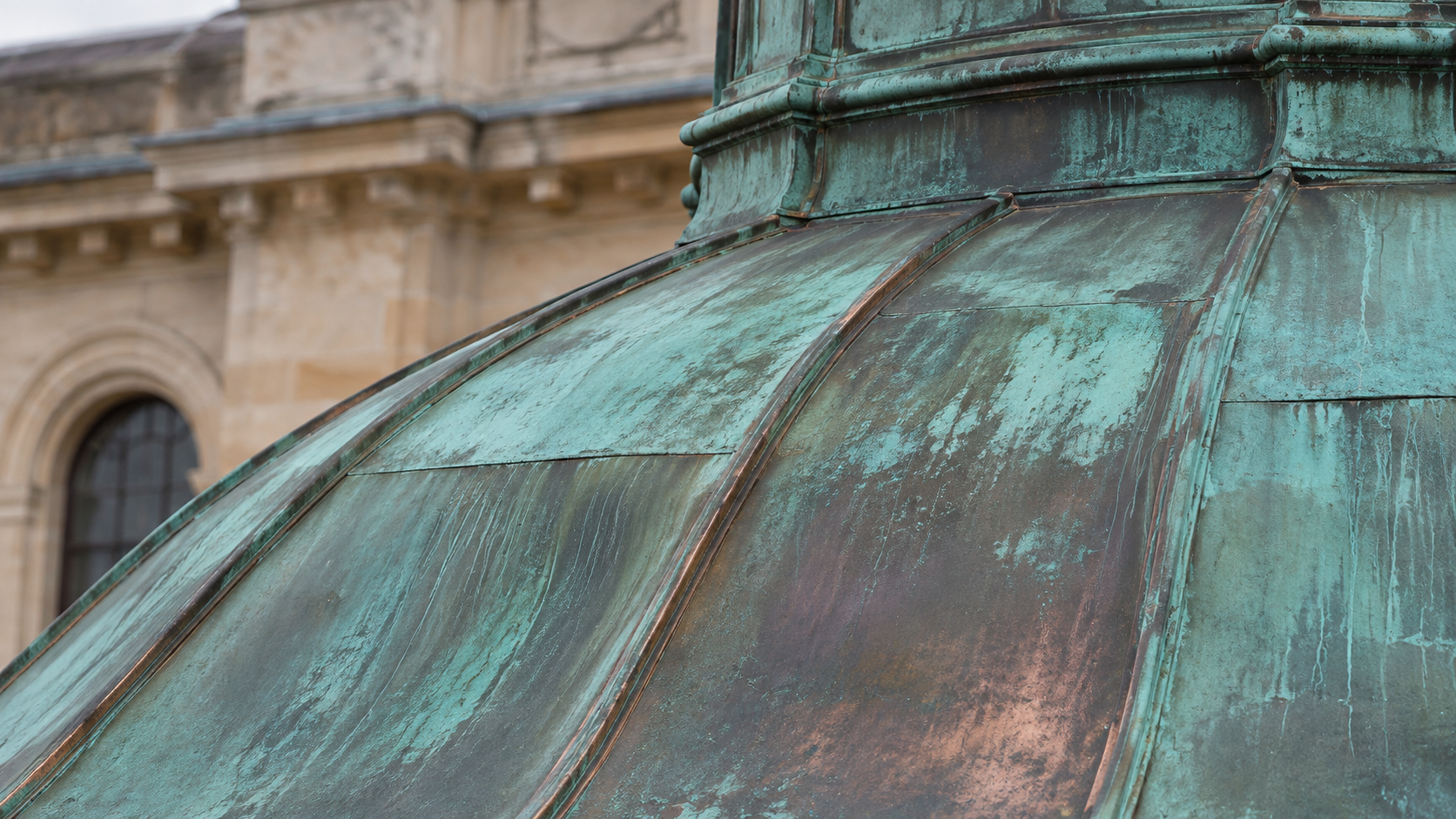
Fresh copper and an old green roof can look like entirely different materials. Yet the roof may still contain copper metal beneath a much thinner chemically changed surface. The colour tells a story about what the metal has encountered.
The explanation is more interesting than “copper rusts green”. As with iron corrosion, oxidation is a chemical change, but the resulting materials differ. Oxidation begins a sequence, environmental chemicals influence the products, and the resulting surface can behave differently from one object to another.
Follow the mechanism
- Copper is exposed to oxygen, moisture and other environmental substances.
- Reactions form corrosion products at the surface.
- Further weathering can create a layered blue-green patina.
- The surface condition and environment determine whether the layer remains stable.
The colour belongs to new compounds at the surface
Copper metal is not simply changing its colour without a chemical change. Corrosion reactions form compounds containing copper and other elements. Their optical properties differ from those of the underlying metal.
The National Park Service describes the Statue of Liberty’s green exterior as a naturally formed patina on its copper skin. That is a familiar example of a surface layer changing the appearance of a much larger object.
A useful comparison is a coating with a chemically formed origin. The analogy should not be pushed into calling the layer ordinary paint: its products arise through reactions involving the substrate and surroundings. Nor does a green exterior mean that the entire thickness of copper has become the same green material.
Sources: [1]
Oxidation starts the story but does not name every product
Copper can develop darker surface products before a green patina becomes prominent. The subsequent chemistry depends on substances present in the environment and the way moisture reaches the surface.
The Copper Development Association identifies basic copper sulfate as an important colouring component in many natural patinas, with carbonate and chloride salts also possible in varying concentrations. Coastal exposure can make chloride chemistry particularly relevant.
This is why one tidy equation cannot describe every green copper surface. Naming oxidation is useful, but it does not identify all the reacting substances or the final mixture. An accurate account leaves room for environmental differences instead of assigning one compound to every roof, statue and coin.
Sources: [2]
Moisture and exposure change the reaction environment
Water at a surface can help substances move and participate in electrochemical reactions. Wetting, drying, airborne deposits and local shelter therefore affect what develops. The same building can expose adjacent pieces of metal differently.
One surface may receive direct rain, another may be sheltered beneath a ledge, and a seam may retain deposits differently from an open panel. These are reasons to expect variation, not evidence that every patch has a separate manufacturing origin.
Research on atmospheric copper patination describes chemically and structurally complex layers, with environment-dependent products. A colour photograph is only the starting observation. It does not supply the composition, thickness or reaction rate of a particular patch.
Sources: [3]
| Part or idea | What it does | Common misunderstanding |
|---|---|---|
| Stable adherent patina | A coherent surface layer can remain relatively stable. | Every green layer is loose contamination. |
| Powdery active corrosion | New loose or erupting products can indicate continuing deterioration. | Green always means a protective layer. |
| Artificial patination | A deliberately treated surface can resemble natural weathering. | Colour proves how old an object is. |
| Copper-alloy surface | Alloy and treatment history affect the products. | Every green metal object is pure copper. |
Why a patina can help protect underlying metal
A coherent surface layer can limit the ease with which the environment continues to attack the metal beneath it. The protective effect belongs to the layer’s condition and the exposure, rather than to the word “green” alone.
The Copper Development Association describes the valued protective coating on weathered architectural copper. It also notes that achieving a particular patina depends on climate and application conditions. A desired colour and a well-adhering layer are not identical engineering requirements.
Imagine a barrier with gaps compared with a continuous one. Both may look similar from a distance while providing different routes for substances to pass. That conceptual comparison explains why appearance alone is insufficient to establish protection.
Sources: [2]
Stable patina and active corrosion should not be confused
The Canadian Conservation Institute distinguishes stable copper-alloy surfaces from active corrosion. Stable layers are often coherent and adherent. Rapidly developing light-green powder or loose deposits can instead indicate a damaging active process.
Its guidance describes chloride-related “bronze disease” as one important problem in archaeological copper alloys. The term is a conservation description, not a literal infection of the metal. It should not be used to diagnose every green mark seen in a photograph.
For a valued object, condition and history matter alongside colour. A conservation professional may need to examine the material and its environment. This article explains the distinction; it is not a recipe for stripping, treating or stabilising an artefact.
Sources: [4]
Why there is no universal timetable
A copper surface does not become fully green after a fixed number of rainy days. The Copper Development Association notes that natural patina development can take years, vary between environments and fail to produce the familiar appearance in some climates.
The Statue of Liberty is an example with a documented history, not a stopwatch for every copper object. Its exposure and scale differ from a sheltered domestic fitting or a coated roof panel. Transferring one landmark’s timeline to all copper would erase those differences.
This makes “how old is it?” an unreliable question to answer from hue alone. Colour can be influenced by alloy, prior cleaning, coatings, local exposure or deliberate treatment as well as elapsed time.
Artificial finishes can resemble natural weathering
Architectural and artistic treatments can deliberately produce patinated appearances. Their use means that a green surface is not proof of decades outdoors. A manufacturer or conservator may have a record of how an object was finished.
The Canadian Conservation Institute’s metal-care guidance discusses both naturally formed patinas and changes linked with contaminants or treatment residues. Similar visible colours can therefore arise from different histories and materials.
The useful habit is to separate observation from explanation. “There is a green layer along the seam” is an observation. “This exact mineral formed naturally over thirty years” adds a chemical identification, an origin and a date that need independent evidence.
Sources: [5]
Reading a roof without guessing its chemistry
On a safely visible outdoor copper surface, note whether the colour is even or patchy, whether sheltered areas differ from rain-exposed ones, and whether the layer appears coherent at the distance available. Record the setting and the date if you are comparing photographs over time.
Do not climb onto a roof or scrape a valued object to make the observation more dramatic. The visible pattern can be appreciated without disturbing the material. Physical removal may erase information about its history as well as change its appearance.
What the observation cannot do is identify each compound or prove that deterioration has stopped. Those are material questions requiring a suitable examination. A good explanation states where visual evidence ends rather than turning every attractive green surface into a chemical certificate.
Questions readers ask
Is green copper the same as iron rust?
Both involve corrosion, but they involve different metals and products. “Patina” is the more useful term for the familiar weathered copper surface.
Does copper turn green immediately?
Usually the familiar weathered appearance develops through a sequence influenced by exposure. There is no universal timetable for every object.
Is all green patina protective?
No. A stable adherent layer and loose active corrosion can have different implications. Colour alone does not establish the condition.
Is the Statue of Liberty painted green?
Its familiar green exterior is a naturally developed patina on copper, as described by the National Park Service.
Can a green finish be artificial?
Yes. Deliberate patination treatments exist, so appearance alone does not prove an object’s age or weathering history.
The surface records an interaction with the environment
Copper’s changing appearance is a consequence of chemistry at an interface. The underlying metal, moisture and surrounding substances jointly influence the compounds that form.
The most useful answer therefore has two parts: why the new products look different, and what sort of layer they make. A green patina can be a valued, stable architectural finish, while a different green corrosion product can signal a problem. Understanding the material requires more than naming its colour.
Continue exploring
Sources and further reading
- US National Park Service — Statue of Liberty FAQs: why the Statue is green
- Copper Development Association — Working With Copper: Green Patina Finishes
- The chemistry of copper patination
- Canadian Conservation Institute — Recognizing Active Corrosion
- Canadian Conservation Institute — Caring for Metal Objects
Keep exploring.
One remarkable idea at a time—nature, science, history and beyond.
Last updated November 6, 2026.

Barnakle Editorial Team
Barnakle Editorial Team is the collective byline used for Barnakle’s editorial articles. The contributor profile explains the team identity and links to the publication’s editorial policies.
More from the editorial team →