Fields, torque and timed switching create useful rotation
A fan blade, a drill chuck and an electric car’s driven wheels all depend on controlled motion. Their motors may differ enormously in size and construction, but each must turn an electrical input into a mechanical output that can do work.
The revealing question is not only why a magnet can exert a force. It is how a machine arranges those forces so that a shaft keeps turning. A fixed magnetic attraction can pull something into alignment and then stop. A motor needs an ongoing sequence.
Follow the mechanism
- Electrical input establishes currents and magnetic fields.
- Their interaction produces torque on a moving part.
- The field or current pattern changes as the rotor turns.
- The shaft transfers mechanical power to a load.
Meet the stator and rotor
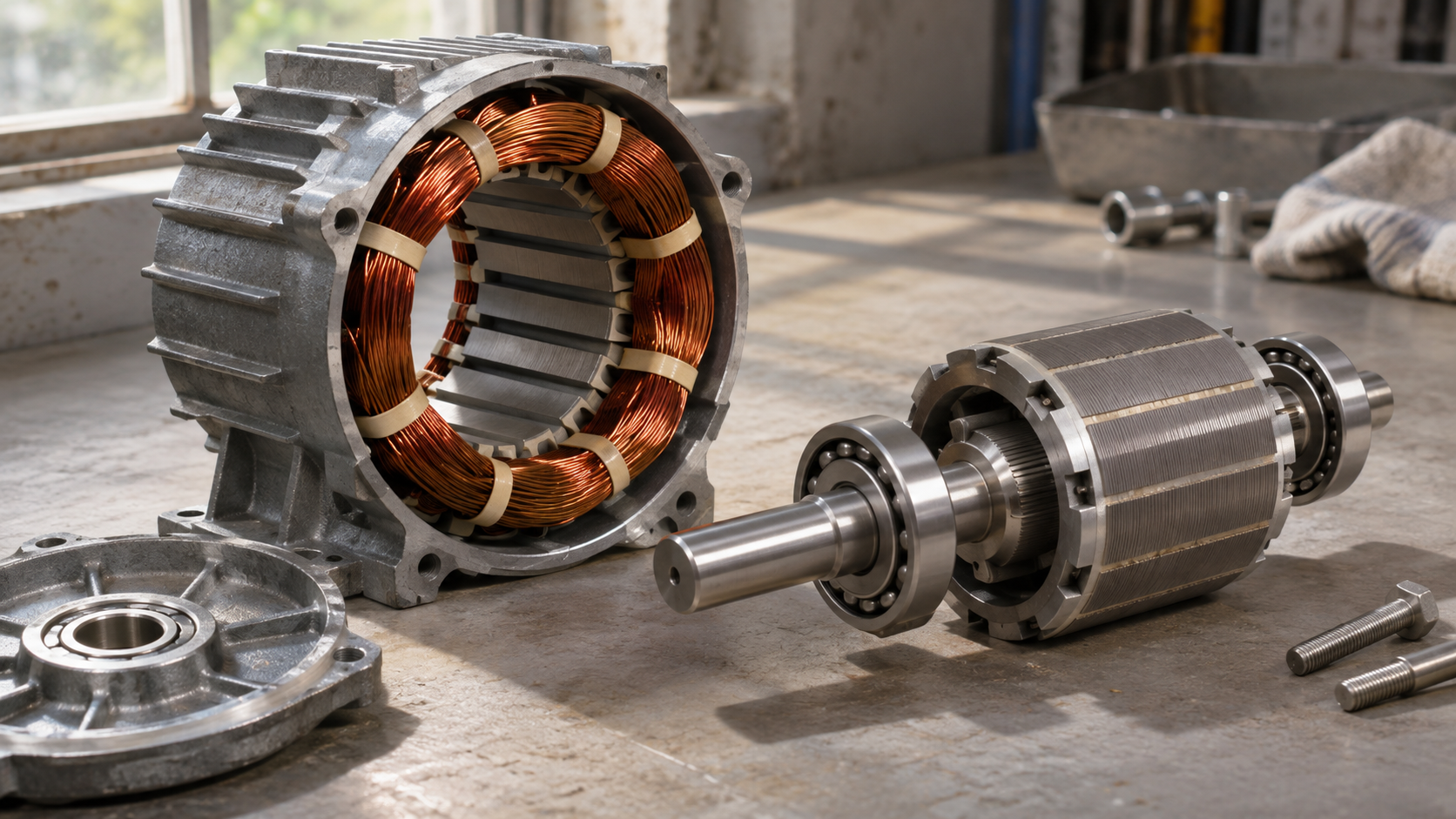
In a rotating motor, the stator is the stationary assembly and the rotor is the assembly that turns. A shaft transfers the rotor’s motion to the load. Bearings support the moving assembly and help keep the intended clearances.
These names describe roles, not a single construction. A rotor may carry permanent magnets, windings or conductive bars, depending on the design. The stator’s arrangement also changes between motor families. It is therefore safer to identify which motor is being explained before assigning magnets or coils to a particular part.
A useful reading habit is to label what stays still, what rotates and where the electrical input enters. That simple map prevents a diagram of one small brushed motor from becoming an accidental description of every motor in a house or factory.
Why magnetic forces can make a coil turn
A current-carrying conductor in a magnetic field can experience a force. In the deliberately simple coreless-coil example described by Nidec, forces on opposite sides of the coil form a turning effect. That turning effect is torque.
The example gives an accessible starting point, but a real iron-cored motor has a more complicated field distribution. Nidec explicitly distinguishes its coreless teaching model from the detailed explanation of a slotted iron-core machine. A schoolroom sketch is useful when its scope is stated.
To picture torque, compare pushing a door close to its hinge with pushing farther from it. Force and its position relative to the rotation axis matter together. A motor arranges electromagnetic forces to produce the required turning effect; the useful output is not merely the presence of a strong magnet.
Why the current pattern has to change
If one magnetic arrangement simply draws a rotor toward an aligned position, the turning effect will not remain favourable throughout a full revolution. The motor needs an appropriate sequence of current or field changes.
In a brushed DC motor, brushes contact a commutator attached to the rotor. As the rotor turns, those contacts switch which windings receive current. In a brushless permanent-magnet motor, a drive circuit performs the switching electronically instead. Oriental Motor describes a design in which rotor-position sensors guide that sequence.
The important common idea is timing. Switching is coordinated with the rotor’s position so that the magnetic interaction continues to produce useful torque. This does not mean that all motors use physical brushes or that every electronic controller uses the same sensing arrangement.
| Part or idea | What it does | Common misunderstanding |
|---|---|---|
| Brushed DC | A rotating commutator and brushes switch current through windings. | Every DC-powered motor has brushes. |
| Brushless permanent-magnet | Electronic drive circuitry sequences the stator currents. | Removing brushes removes the need for switching. |
| Induction | A changing stator field induces rotor currents that interact with the field. | Every rotor needs permanent magnets. |
Induction motors do not need permanent magnets in the rotor
In a common squirrel-cage induction motor, conductive rotor bars are joined into a cage-like electrical structure. A rotating magnetic field from the stator induces currents in that structure. Those currents interact with the field to produce torque.
In normal motoring operation the rotor turns more slowly than the stator’s rotating field. This relative motion, called slip, is part of how the rotor currents are induced. Saying that the rotor simply matches the field exactly would erase an essential feature of the explanation.
Nidec also distinguishes multi-phase supplies from single-phase arrangements that need a way to establish the required field behaviour. The details matter: “plugged into household electricity” does not specify every winding, starting method or control system inside a motor.
Torque, speed and power answer different questions
Torque is a turning effect. Rotational speed tells you how rapidly the shaft turns. Mechanical power combines the two: for steady rotation, power equals torque multiplied by angular speed.
Consider an imaginary shaft producing 2 newton-metres at 600 revolutions per minute. That speed is ten revolutions per second, or about 62.8 radians per second. Multiplying gives approximately 126 watts of mechanical output. These are invented teaching values, not a motor rating.
The calculation shows why a high torque number alone does not tell you the output power. A shaft holding a load stationary can exert torque while delivering no rotational mechanical power at that instant. Conversely, a fast shaft can have modest torque. A useful comparison needs the operating point, rather than one impressive-looking number.
Electrical input also exceeds useful mechanical output because some energy becomes losses, including heating and friction. A motor converts energy; its magnetic parts do not supply an unlimited extra source of power.
Why a turning motor also generates a voltage
Nidec’s DC-motor explanation describes a generated voltage that increases with rotational speed. In normal motoring operation this back electromotive force opposes the applied voltage. It helps explain why a simple DC motor’s current changes as its speed changes.
This is also a link between motors and generators: the same electromagnetic system can convert energy in either direction under suitable conditions. A drive system that recovers energy must have a path and controls for that energy; spinning an arbitrary motor does not automatically recharge any connected battery safely.
The distinction between physical capability and complete system design is useful throughout engineering. A component may exhibit a reversible effect, while the surrounding electronics decide how, when and whether the effect is used.
Sources: [7]
The controller is part of the working explanation
The US Department of Energy’s electric-vehicle component guide separates the traction motor from the power electronics controller. The controller manages electrical energy delivery to control torque and speed. Treating a motor as though it is connected directly to an unchanging battery misses that role.
The same distinction helps make sense of a variable-speed fan or a precisely positioned mechanism. The rotating machine supplies motion; a control system determines how that motion responds to a command and load. The exact implementation varies.
This article explains the energy conversion. It is not an instruction to rewire a mains-powered appliance or bypass its controller. To understand a real product, use its manufacturer’s documentation to identify the motor family and the intended operating system.
Sources: [8]
Questions readers ask
Does every motor contain permanent magnets?
No. A squirrel-cage induction motor is an important counterexample: rotor currents are induced, and their interaction with the field produces torque.
Why does a motor need switching?
The magnetic arrangement must remain suitable as the rotor turns. Different motor types achieve that through commutation, an electronic drive or an alternating-field arrangement.
Are torque and power the same?
No. Torque describes a turning effect. Rotational mechanical power depends on both torque and angular speed.
Can a motor act as a generator?
Many motor designs can convert mechanical input into electrical output. Useful energy recovery still requires appropriate circuitry, controls and a compatible destination for the energy.
Does brushless mean maintenance-free?
It means the motor does not use brushes for commutation. Bearings, electronics and the rest of the machine still have operating requirements.
Continuous motion comes from a coordinated sequence
The central achievement is controlled repetition. Electrical currents establish magnetic interactions, those interactions produce torque, and the motor’s construction or controller keeps the sequence working as the shaft moves.
Once that sequence is visible, a motor becomes easier to understand than the phrase “magnets make it spin” suggests. The magnets or fields supply the interaction; the arrangement and timing turn it into useful motion.
Continue exploring
Sources and further reading
- Nidec — What Is a Motor?
- Nidec — Reviewing the Principle of DC Motor Rotation
- Nidec — Basics Rotation Principles
- Oriental Motor — Brushless Motor Structure and Rotation Principles
- Nidec — Rotation Principle of Induction Motor
- Nidec — AC Motor
- Nidec — Rotating Speed of DC Motor and Counter-electromotive Force
- US Department of Energy — How Do All-Electric Cars Work?
Keep exploring.
One remarkable idea at a time—nature, science, history and beyond.
Last updated November 6, 2026.

Barnakle Editorial Team
Barnakle Editorial Team is the collective byline used for Barnakle’s editorial articles. The contributor profile explains the team identity and links to the publication’s editorial policies.
More from the editorial team →