A falling maple fruit does not need an engine. Its descent supplies the energy that keeps the wing turning.
Quick answer
Maple fruits called samaras combine a concentrated seed-bearing mass with a light wing. As a samara falls, its shape, mass distribution and interaction with air can produce autorotation. The turning wing generates aerodynamic forces that slow descent, including lift associated with a leading-edge vortex. More time in the air gives wind a greater opportunity to carry it away.
A maple tree releases a tiny object that initially seems destined for a quick drop. Instead, it turns, settles into a spinning descent and drifts sideways. Its single wing sweeps a circle, making the fruit look remarkably like a one-bladed helicopter.
The resemblance is useful, provided we keep one difference clear: no motor drives the maple’s rotor. The fruit is falling through air. Its structure turns that descent into a stable pattern of rotation and aerodynamic resistance.
The “helicopter” is a winged fruit
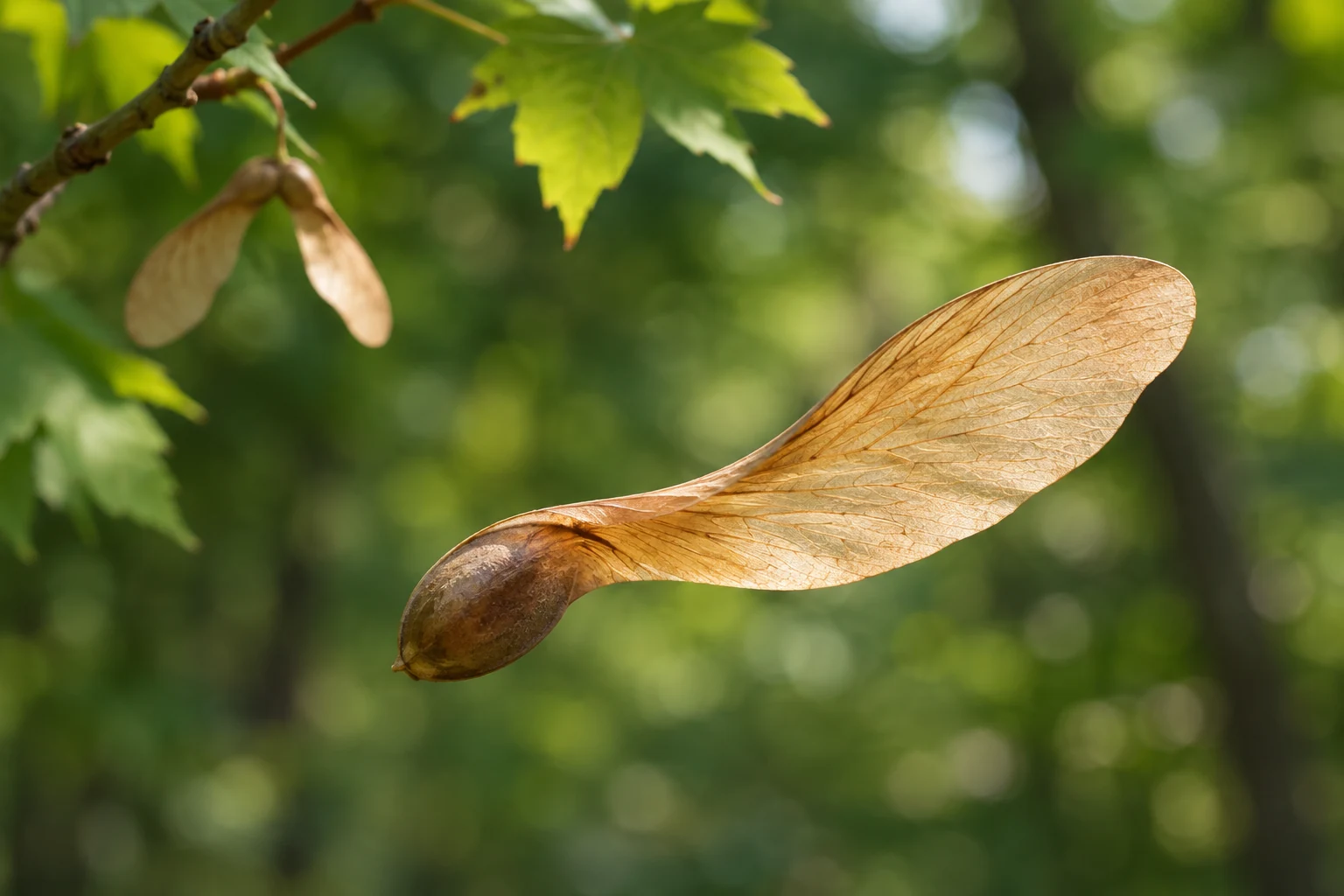
The familiar object is a samara, a fruit with a wing and a seed enclosed in its thicker region. Michigan’s Department of Natural Resources uses “helicopter” as the common description while distinguishing the fruit from the seed inside. Maples commonly produce paired units, which can separate for dispersal. [1]
That distinction is more than botanical vocabulary. A complete description must include both the reproductive cargo and the shape that carries it. Examining only the seed would miss the large, lightweight aerodynamic surface.
Maple species also differ in fruit dimensions and release patterns. The USDA Forest Service describes the papery wings of sugar maple as structures that assist wind dispersal. A photograph of one samara should not be treated as the exact shape or size of every maple fruit. [6]
What autorotation means
Autorotation is rotation sustained through interaction with the surrounding airflow rather than an onboard motor. The descending samara encounters air moving relative to its wing. Aerodynamic forces, the object’s shape and its mass distribution interact to produce the spinning motion.
Gravity is still the energy source for a fall through otherwise still air. As the fruit loses height, gravitational potential energy becomes motion of the fruit and surrounding air, with energy eventually dissipated. Spinning is not evidence of a hidden energy supply.
It helps to separate three motions: downward movement, rotation of the wing and sideways transport by wind. They happen together, but each describes a different aspect of the trajectory. A samara can rotate in relatively still air even when it is not drifting far across the ground.
Why the heavy end and light wing matter
A samara does not distribute its mass evenly like a uniform paper rectangle. Much of the mass lies in the seed-bearing region, while the wing extends outward. This geometry affects the centre of mass, the aerodynamic forces and how the object turns.
A 2024 experimental study examined how samara shape, mass and wing area relate to descending speed and rotation. It describes a coupled system: changing one feature does not necessarily change the flight in the simple way that an isolated-variable slogan might suggest. [5]
Consider two imaginary objects with equal total mass but different distributions: one concentrates mass near an end, while the other spreads it evenly. They need not rotate or orient the same way under the same air forces. Total mass alone cannot specify the dynamics.
The first moments are more complicated than steady spinning
Cornell researchers used high-speed imaging to reconstruct the transition from release to a stable helical motion. Their account distinguishes an initial tumble, a change in orientation and the development of steady gyration. They also investigated seeds with much of the wing removed. [4]
That matters because describing the finished motion does not automatically explain how it begins. A photograph of a steadily rotating samara is one stage of the event, not the whole trajectory.
The transition depends on the arrangement of forces and the changing orientation as the object moves. Calling the wing a propeller is a visual shortcut, but it can hide the difference between starting from rest and maintaining an already established autorotation.
How the rotating wing slows the fall
A wing moving relative to air produces a pressure distribution and deflects the surrounding flow. In a samara, the spinning wing can generate a force with an upward component that opposes the weight. The result is a slower descent than would occur if the fruit offered little aerodynamic resistance.
In 2009, researchers identified a stable leading-edge vortex associated with the high lift of autorotating seeds. This is a rotating region of air near the front edge of the wing, not a large tornado trailing across the sky. Measurements on models and real specimens supported the finding. [2]
The word “lift” can be confusing because the fruit may still move downward. A force can oppose a motion without reversing it. A parachute also slows a descent; it does not need to make its load climb to provide a useful aerodynamic effect.
Why researchers used model seeds in oil
The Caltech account describes enlarged seed models moving through mineral oil, with flow conditions selected to represent the relevant behaviour around real seeds in air. Illuminated tracer particles made the surrounding motion measurable. Wind-tunnel tests with real seeds provided a further comparison. [3]
This method may sound strange until we separate material identity from physical similarity. A model does not have to use the same fluid if size, speed and fluid properties are selected to reproduce the important flow relationships.
The model also makes an invisible process accessible. A normal video shows the fruit turning; flow measurements reveal what the air is doing near the wing. That additional evidence helps connect a plausible story about lift to a testable mechanism.
Does a damaged wing stop it spinning?
Not always. Cornell’s work showed that some substantially reduced wings could still enter gyrating motion. The 2024 study likewise found autorotation robust to considerable changes in mass and wing area under its tested conditions. Neither result means that any amount or kind of damage leaves flight unchanged. [4] [5]
That is a useful distinction between robustness and perfection. A structure can keep performing its basic function while its speed, orientation or dispersal performance changes. “Still spins” and “flies exactly like before” are different claims.
Why slower descent helps dispersal
Horizontal wind has more time to carry an object that remains aloft longer. For an idealized example, a steady wind of one metre per second carries an object two metres during a two-second fall and four metres during a four-second fall. This arithmetic illustrates the opportunity provided by extra time; it is not a field prediction for a real seed.
Actual journeys depend on release height, turbulence, surrounding branches, terrain and changing winds. Some fruits land close to the parent; others travel farther. A wing improves the opportunity for transport rather than guaranteeing a particular distance or a suitable place to grow.
How this differs from a dandelion parachute
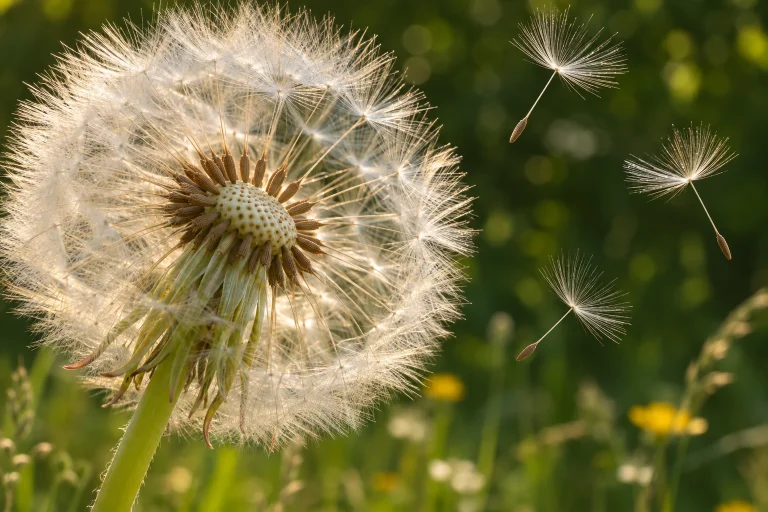
A maple samara has a solid wing and a characteristic rotating descent. A dandelion uses a porous bristly crown to increase resistance as it falls. Both prolong time in the air, but they do so with different shapes and flow patterns. They should not be treated as the same aerodynamic device. [7]
The maple’s leading-edge vortex is also different from the separated vortex ring described around a dandelion pappus. “Vortex” is a general term for rotating fluid, not one universal mechanism that makes all plant dispersal structures work identically.
Frequently asked questions
Does a maple seed need wind to begin spinning?
It needs air interaction, but not necessarily a strong sideways breeze. Falling creates relative airflow even when the surrounding air is fairly still.
Is the wing alive and actively steering?
The spinning descent is passive mechanics. The samara’s structure responds to forces without an onboard motor, nervous system or chosen destination.
Does more spinning always mean a farther journey?
No. Rotation rate alone does not determine where a fruit lands. Descending speed, release height and surrounding airflow also matter.
Why does this interest engineers?
A passive structure that slows descent can inform designs for small unpowered flyers. Researchers still have to account for differences in size, payload, materials and operating conditions before borrowing the idea. [3]
Keep exploring
Sources and further reading
- Michigan Department of Natural Resources — Sugar maple and its samaras
- Lentink and colleagues (2009) — Leading-edge vortices elevate lift of autorotating plant seeds (paper, PDF)
- Caltech — Maple seeds and animals exploit the same trick to fly
- Cornell Wang Research Group — Falling maple seeds and the transition to helical motion
- Research paper (2024) — Maple samara flight is robust to morphological perturbation
- USDA Forest Service — Sugar maple silvics
- Cummins and colleagues (2018) — Dandelion flight, accepted manuscript (PDF)
Reference review: November 9, 2026.
Keep exploring.
One remarkable idea at a time—nature, science, history and beyond.
Last updated November 10, 2026.

Barnakle Editorial Team
Barnakle Editorial Team is the collective byline used for Barnakle’s editorial articles. The contributor profile explains the team identity and links to the publication’s editorial policies.
More from the editorial team →