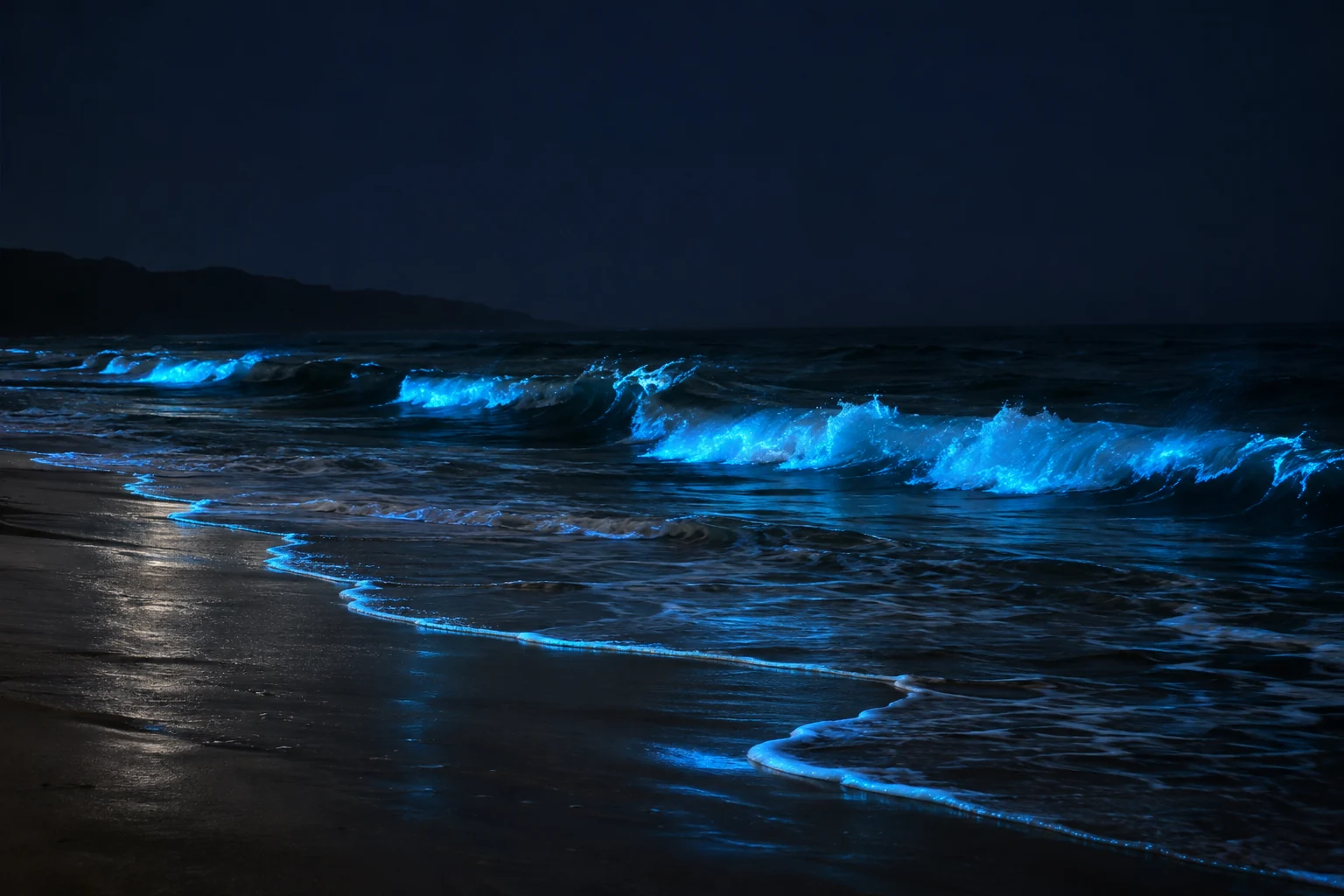
The surf is not storing moonlight. Millions of microscopic organisms can flash when water movement disturbs them.
Quick answer
Some ocean waves glow because they contain bioluminescent organisms, often dinoflagellates. Mechanical stress associated with breaking waves can trigger brief flashes produced by cellular chemical reactions. Many flashes together make the surf appear blue or blue-green. Not every plankton bloom glows, and a glow alone does not identify the organism responsible.
In daylight, the sea may look unremarkable or carry a rusty tint. After dark, a breaking crest suddenly traces a brilliant blue line across the beach. The light follows motion: a wave collapses, the water sparkles, and darkness returns between the next bursts.
The effect is called bioluminescence—light produced through chemistry in living systems. It connects an event you can see from shore with processes happening inside cells far too small to resolve individually with the naked eye.
What is making the light?
Dinoflagellates are an important source of flow-triggered coastal bioluminescence. Some species can occur in large concentrations, so the combined flashes become visible as glowing waves or disturbed patches of water. A single bright-looking stretch of surf is therefore a collective display rather than one enormous luminous organism. [1]
Other marine organisms also produce light, including various animals and bacteria. The explanation for a particular display depends on what is present. A glowing ocean photograph cannot, by itself, establish a species identification. [5]
Think of seeing a city’s lights from far away. The combined pattern is easy to see even when individual sources are too small to distinguish. The ocean differs because many of its tiny sources flash in response to a shared physical disturbance.
How a cell turns chemistry into light
Bioluminescent reactions release chemical energy as light. In dinoflagellates, the light-producing system includes luciferin and the enzyme luciferase. Scripps describes blue-green emission from this chemistry, with light production stimulated by sufficient mechanical force. [3]
The glow is not evidence that the water has become hot enough to shine. A red-hot metal emits light because of its temperature; a bioluminescent cell uses a different energy pathway. The visible result can be bright without requiring the surrounding seawater to glow thermally.
Nor does the wave create energy from nothing. The organism has a biochemical supply that supports the reaction. Mechanical disturbance is the trigger, while the light-producing chemistry supplies the immediate source of the emitted photons.
Why a breaking wave switches the display on
As a wave breaks, the flow subjects cells to mechanical stresses. The Latz Laboratory describes how sufficient disturbance can trigger a flash and how cellular regulation includes a drop in pH associated with proton movement. The regulation is complex; the familiar blue glow is the visible endpoint of several linked steps. [1]
It is useful to distinguish a signal from an energy source. Pressing a doorbell button signals a powered circuit; the finger does not supply all the energy used by the chime. Similarly, the force on the cell helps initiate a biochemical response rather than serving as a tiny electrical generator.
This also explains why the glow often outlines turbulent features. Cells distributed through the water do not necessarily emit continuously and equally. Where and when they receive a strong enough stimulus helps shape the luminous pattern.
Why the light usually looks blue
Marine bioluminescence often lies in the blue to blue-green range, wavelengths that travel effectively through seawater. It is not universally blue: marine organisms produce a range of colours. The chemistry of the particular light-emitting system determines the emitted spectrum. [4]
Water then changes how light reaches an observer, and viewing conditions change what is easy to detect. Source colour, transmission and human perception are related parts of the experience, but they are not the same thing.
In a photograph, camera settings and processing add another layer. A striking blue image may depict a real event while emphasizing it differently from a person’s immediate view. An exposure records accumulated light, whereas your moment-to-moment experience is continually changing.
Is this the same as fluorescence?
No. Fluorescence involves absorbing incoming light and re-emitting some of that energy at another wavelength. Bioluminescence generates light through a chemical reaction. Phosphorescent materials can continue emitting after illumination stops, which is another mechanism again. [4]
A blacklight poster needs suitable illumination to fluoresce. A chemically glowing cell does not need a beam of moonlight aimed at it at the instant of its flash. These distinctions explain why a completely dark shoreline can still contain visible living light.
Why a red tide can produce a blue night
The daytime colour of a bloom and its nighttime emission arise differently. Scripps explains that pigments in concentrated cells can colour water reddish-brown, while light-producing organisms flash blue when disturbed at night. Many red tides do not produce bioluminescence. [2]
One often-studied Southern California organism appears in older literature as Lingulodinium polyedra; Scripps’ current FAQ uses Lingulaulax polyedra. Scientific names can change while older research remains valuable, so matching the naming context matters when following the references. [2]
It is therefore a mistake to treat “red tide” as a single species or a guarantee of a blue display. Colour describes an observation, not a complete biological diagnosis of the water.
Why some seemingly similar plankton do not glow
Scripps researchers investigated why local West Coast specimens of an organism associated elsewhere with bioluminescence did not emit light. The result is a reminder that appearance and a familiar organism name do not establish the same light-producing behaviour in every population. [3]
That lesson extends beyond this particular phenomenon. If the feature being explained is a biochemical capability, researchers need evidence of that capability. A photograph of the organism or the water does not replace measurements of light production.
What purpose might the flashes serve?
Laboratory observations support defensive roles for some dinoflagellate flashes, including startling grazers and disrupting feeding. Another proposed effect is attracting a larger predator toward the attacker. These are ecological explanations to test in particular systems, rather than evidence that every glowing organism uses light for the same purpose. [1]
Across marine life, bioluminescence can also participate in finding food, communication and concealment. Similar-looking light can serve different functions in different organisms. The chemistry tells us how a flash happens; experiments and field observations help explain what it does for the organism. [5]
How scientists use the glow to study moving water
Researchers can connect cell responses with models of turbulent flow. A 2024 Scripps-led study used numerical simulations to quantify bioluminescent intensity in breaking waves, linking a visible display to underlying physical processes. Such work can help interpret observations rather than treating every luminous patch as a direct cell count. [6]
One bright wave might reflect more organisms, stronger stimulation, viewing geometry or a combination of factors. A useful measurement model separates those possibilities. Beauty and scientific information coexist in the same short-lived flash.
Frequently asked questions
Does every beach have glowing waves?
No. The right light-producing organisms and conditions must be present, and visibility varies. A previous display at a location does not guarantee another on a particular night. [2]
Is the sand itself glowing?
In the wave phenomenon described here, organisms in or carried by the water produce the light. A blue reflection on wet sand does not mean the sand grains are generating it.
Does glowing water mean a bloom is harmless?
The light alone does not establish a bloom’s identity or effects. Identifying the organisms and assessing local water conditions are separate questions from explaining the glow. [2]
Do the cells shine all the time?
Not necessarily. Dinoflagellate displays commonly involve brief, mechanically triggered flashes, with biological regulation affecting when and how cells respond. [1]
Keep exploring
Sources and further reading
- Scripps Latz Laboratory — Dinoflagellate bioluminescence
- Scripps — Red tides and bioluminescence off California
- Scripps — Why some West Coast bioluminescent plankton do not shine
- NOAA Ocean Exploration — How living organisms produce light
- Woods Hole Oceanographic Institution — How bioluminescence works
- UC San Diego — Simulating bioluminescent light intensity in breaking waves
Reference review: November 9, 2026.
Keep exploring.
One remarkable idea at a time—nature, science, history and beyond.
Last updated November 10, 2026.

Barnakle Editorial Team
Barnakle Editorial Team is the collective byline used for Barnakle’s editorial articles. The contributor profile explains the team identity and links to the publication’s editorial policies.
More from the editorial team →