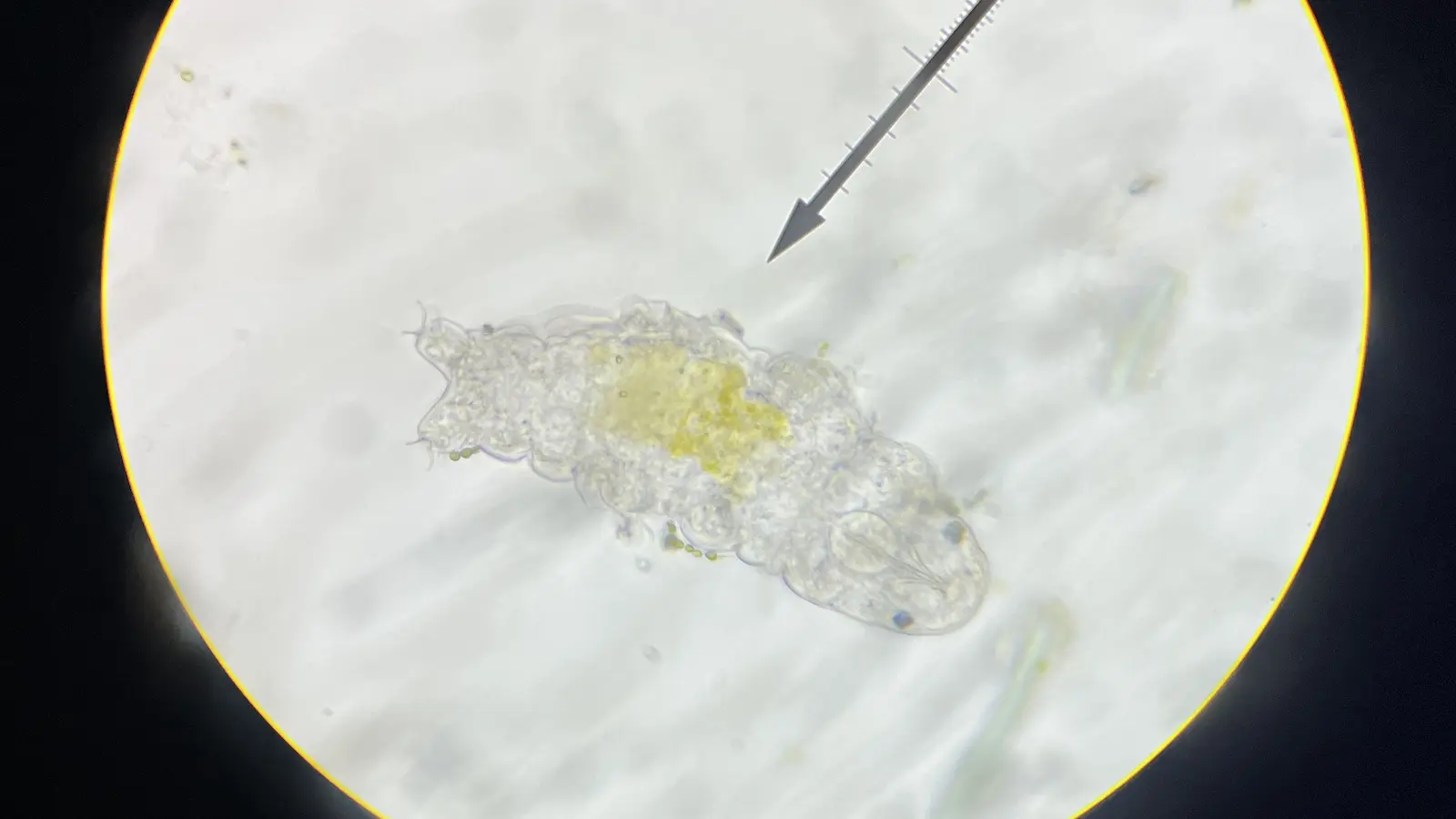
Tardigrades are tiny animals with remarkable stress tolerance, but they are not indestructible. Their survival depends on the species, life stage, condition of the animal and the nature and duration of the stress. An experiment on a dried tardigrade does not describe an actively feeding animal under the same conditions.
One of their most studied abilities is anhydrobiosis: surviving extensive water loss in a state from which activity can resume after rehydration.
The tun is a survival state
During drying, many tardigrades contract into a compact form called a tun. Activity is greatly reduced as water becomes scarce. The challenge is to keep cellular structures and molecules capable of functioning again when water returns.
Drying can damage proteins and membranes and disrupt the organisation of a cell. Simply losing water is therefore not enough. Protective mechanisms must act during the transition as well as in the dried state.
Disordered proteins can become protective materials
Research on tardigrade-specific intrinsically disordered proteins, including CAHS proteins, links them to desiccation tolerance. Experiments have tested their roles in the animals and their ability to protect other biological systems.
Some findings support glass-like states that limit damaging molecular movements. Other experiments show reversible filament networks or gels under dehydration-like stress. These descriptions concern different physical behaviours and experimental conditions; they should not be collapsed into a claim that every tardigrade turns into a literal piece of glass.
A protective gel does not simply keep all the water in
A study of CAHS D found that it influenced how water behaved without retaining more water than comparison systems. That result is useful because it distinguishes a plausible mechanism from a convenient story.
The protective role of a protein can involve stabilising structures rather than acting as an internal water bottle. Several mechanisms may contribute, and findings about a purified protein do not by themselves explain the whole animal.
DNA protection is another question
Radiation tolerance involves additional mechanisms. A study identifying the tardigrade protein Dsup found reduced radiation-related DNA damage in experimental cultured human cells expressing it. That result concerns a defined cellular experiment, not a demonstrated way to make people radiation-proof. It also cannot alone explain every species’ tolerance to every stress.
Space survival had specific experimental conditions
A low-Earth-orbit experiment exposed dried tardigrades to space conditions. Some survived, with outcomes differing between vacuum exposure and exposure that also included solar radiation. The animals were not living normally, eating and reproducing in open space.
The result demonstrated an exceptional capacity to recover after a defined exposure. It did not show indefinite survival in every space environment or remove the damaging effects of radiation.
Recovery is the meaningful test
Researchers assess survival after rehydration rather than judging success from the continued presence of a dried body. They may examine movement, longer-term function or reproduction, depending on the study.
Tardigrades illustrate how evolution can protect biological systems during extreme interruptions to ordinary life. Their scientific value comes from understanding those mechanisms and their boundaries, not from adding ever more dramatic claims to a list of conditions supposedly incapable of harming them.
Explore a related question
Why Do Some Animals Hibernate?
Sources and further reading
Keep exploring.
One remarkable idea at a time—nature, science, history and beyond.
Last updated October 27, 2026.

Barnakle Editorial Team
Barnakle Editorial Team is the collective byline used for Barnakle’s editorial articles. The contributor profile explains the team identity and links to the publication’s editorial policies.
More from the editorial team →