A document on a hard drive is neither a miniature page nor a row of tiny printed numbers. It is information represented by controlled magnetic patterns on rotating disks.
How do hard drives store data? A magnetic hard disk drive writes patterns of magnetization into a coating on spinning platters. A moving head writes the patterns and senses them during reading; electronics translate the signals into digital information. The magnetic state can remain when the power is off, making the storage nonvolatile. [1]
The important material is on the surface
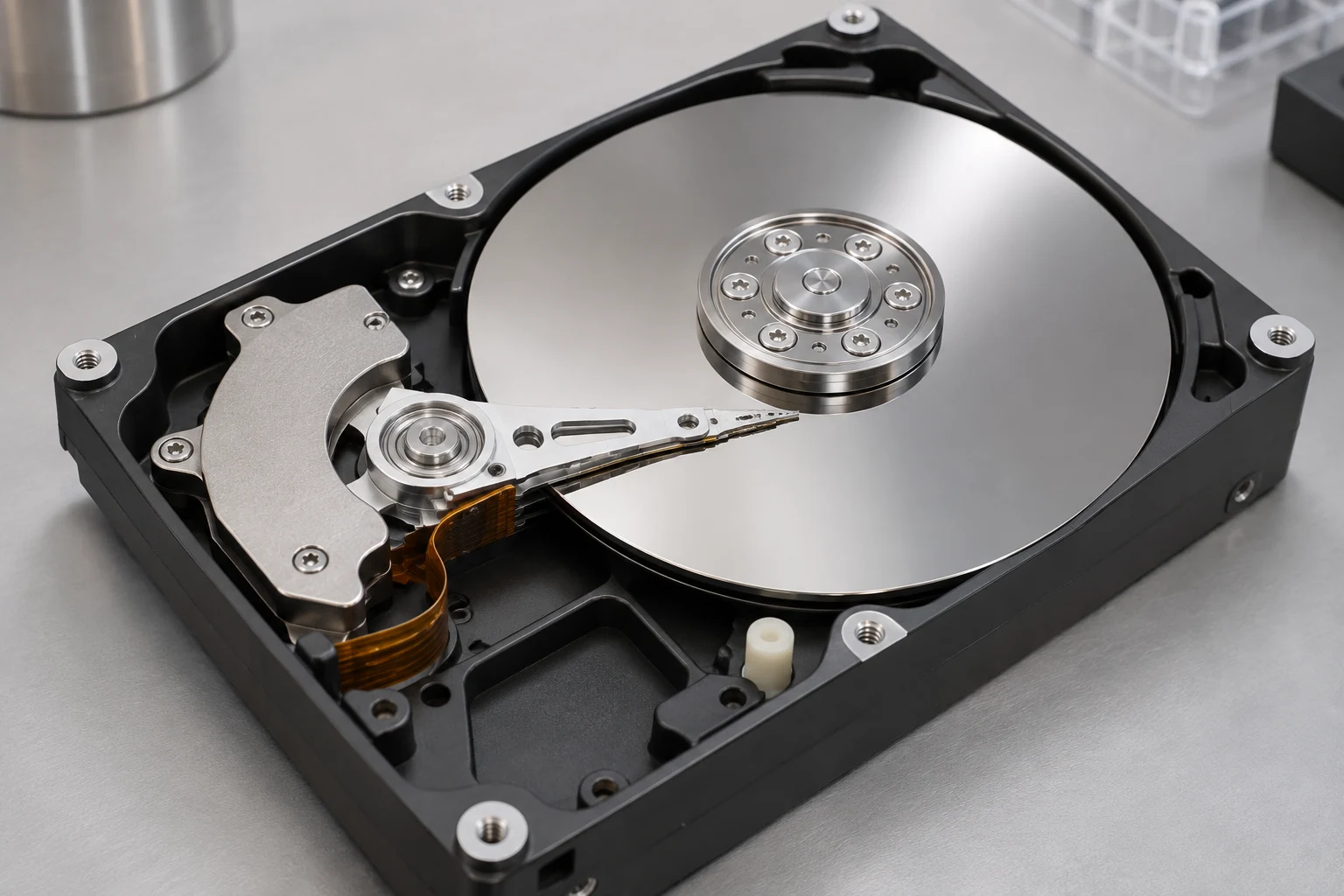
The shiny disk inside a hard drive is called a platter. A rigid substrate provides its shape, while a very thin magnetic recording layer supplies the medium in which information is stored. Confusing the supporting disk with its recording layer is like confusing a notebook’s cover with the marks on its pages: both belong to the object, but they perform different jobs.
The Canadian Conservation Institute describes hard disks as rigid disks carrying thin magnetic recording films. This places them in the broader family of magnetic media, even though their physical construction and reading mechanisms differ from those of flexible tapes. A file depends on a physical recording material rather than existing independently of the device. [6]
A drive can contain more than one platter and use multiple recording surfaces. What appears from above to be a single disk may therefore be part of a stack. The amount of information stored is not determined simply by how large the visible metal housing looks.
What does a magnetic pattern mean?
Digital systems represent information using bits. Writing those bits to a hard drive involves encoding them as patterns in a magnetic material. It is tempting to imagine a separate microscopic bar magnet for each printed zero or one, but that is only a rough analogy. Real recording uses engineered magnetic media and carefully interpreted signals.
Yale’s teaching resource describes the magnetic materials and recording arrangements underlying this process. The direction of magnetization and the transitions between recorded regions matter to recovering information. A magnetic grain, a recorded bit and an electrical signal are related concepts, but they are not interchangeable names for the same thing. [4]
A stored photograph is consequently not a photograph-shaped patch on the platter. Its encoded data forms part of the drive’s addressable storage. The association between those bytes and a familiar image is made by the computer’s software. The platter supplies the persistent physical patterns from which the information can be recovered.
Two kinds of motion locate the data
The spindle motor rotates the platters. A separate actuator moves the head assembly across their surfaces. Rotation brings different positions around a circular path beneath a head; actuator movement selects different positions across the disk’s radius. Those two motions let the drive reach many storage locations with a small head assembly.
Western Digital’s explanation describes these rotating platters, movable heads and magnetic recording process. The head does not search visually for a filename. The drive’s electronics position and control the mechanism so that the required recorded region can pass beneath the relevant head. [2]
Tracks provide a useful way to picture that arrangement: many recording paths lie at different distances from the centre. These paths are not grooves carrying a stylus, as on a vinyl record. They describe an organized magnetic recording surface. The distinction matters because the head’s job is to interact with magnetic fields, not follow a mechanically engraved soundtrack.
Writing and reading are different operations
Writing requires a magnetic field capable of changing the recording medium’s magnetization in a controlled way. Reading requires detecting the magnetic pattern that is already present. A modern recording head assembly incorporates extremely small structures for these jobs rather than a single general-purpose needle.
TDK describes thin-film magnetic heads and magnetoresistive reading technology. In magnetoresistive sensing, a magnetic field influences the electrical behaviour of the sensor. The read signal can therefore be recovered without scraping off the coating or removing a little piece of data. TDK’s account also shows why the head assembly is a carefully engineered component, not simply a miniature version of an ordinary household magnet. [3]
The head operates extremely close to the recording surface. Its position and spacing are part of the device’s design. An illustration showing an opened drive can reveal the broad arrangement of the components, but it cannot show the actual operating gap at the scale of the whole device. Nor does that illustrative view represent normal operation with the cover removed.
Why the data survives a power cut
The motor needs power to spin, and the electronics need power to read or write. The recorded magnetic pattern does not require the spindle to keep turning merely to remain recorded. That separates holding information from accessing it. When an unpowered hard drive is sitting still, it can retain information even though it cannot deliver that information to a computer.
Stanford’s introductory explanation identifies this persistent magnetic storage as nonvolatile. The word describes retention without a continuing power supply; it does not promise that a device is indestructible or that its contents will remain readable forever. The physical medium and the mechanism needed to retrieve its contents both matter. [1]
This also explains why the magnetism is not “used up” by ordinary reading. Reading senses a recorded state. It is a different operation from intentionally changing that state during writing. The need for power during access should not be mistaken for a need to continuously replenish each stored bit.
Why a spinning drive sometimes has to wait
Access includes physical positioning. The actuator may need to move, and the desired region may need to rotate into place. Even a fast-spinning disk has a finite revolution time. As a purely arithmetic example, a hypothetical speed of 7,200 revolutions per minute equals 120 revolutions per second, or about 8.3 milliseconds per turn.
If a desired position were equally likely to be anywhere around that circle, its average rotational wait alone would be roughly half a turn, about 4.2 milliseconds. This example isolates one geometric contribution; it is not a benchmark or a complete prediction of a drive’s response. Head movement, electronics, workload and other operations also affect access.
The distinction between moving to information and transferring a stream of information helps explain why a drive’s behaviour can vary with the task. A single capacity number says how much it can hold, not how quickly every possible request will be completed.
Why making smaller bits is difficult
Greater recording density means fitting more recoverable information into a given area. The difficulty is not just drawing smaller marks. The magnetic regions must remain sufficiently stable, the head must write selectively, and the read signal must remain distinguishable. Yale’s discussion connects recording materials and thermal effects to the limits and trade-offs involved in storing ever-smaller magnetic patterns. [4]
The device is therefore a meeting point of materials science, precision mechanics and signal detection. A platter that looks perfectly smooth to the eye can carry an enormous amount of deliberately structured information in a coating that the eye cannot resolve.
How a hard drive differs from an SSD
An SSD provides persistent storage by a different route. Seagate distinguishes magnetic hard drives from solid-state drives using flash memory. Flash retains information through electrical charge-storage structures, and an SSD does not need a platter rotating beneath a movable head to reach its data. Both are storage devices, but their underlying mechanisms are different. [5]
That distinction is separate from file compression. Compression changes the representation of information so that fewer bits may be needed. A magnetic drive supplies one physical way to retain the resulting bits. Understanding the medium and understanding the file format answer different questions.
Frequently asked questions
Are the zeros and ones engraved into the disk?
No. The drive records magnetic patterns in its recording layer and recovers them as electrical signals. Visible scratches are not the intended recording method. [2]
Does the head normally rub against the platter?
No. The operating arrangement keeps the head extremely close to the recording surface while avoiding normal rubbing contact. It is a magnetic sensing and writing system, not a record player. [3]
Does nonvolatile mean permanent?
No. It means the information can remain without continuous electrical power. Physical media and the equipment needed to read them still have limitations. [6]
Is every computer drive magnetic?
No. The term “drive” also appears in solid-state storage. An SSD’s flash memory retains information through a different physical mechanism. [5]
Keep exploring
Sources and further reading
- Stanford University, Nick Parlante — How a hard drive works
- Western Digital — How hard drives work
- TDK — Magnetic heads and hard disk recording
- Yale University — Hard drives: methods and materials
- Seagate — Hard drives and solid-state drives
- Canadian Conservation Institute — Caring for audio, video and data recording media
Reference review: November 10, 2026.
Keep exploring.
One remarkable idea at a time—nature, science, history and beyond.
Last updated November 12, 2026.

Barnakle Editorial Team
Barnakle Editorial Team is the collective byline used for Barnakle’s editorial articles. The contributor profile explains the team identity and links to the publication’s editorial policies.
More from the editorial team →