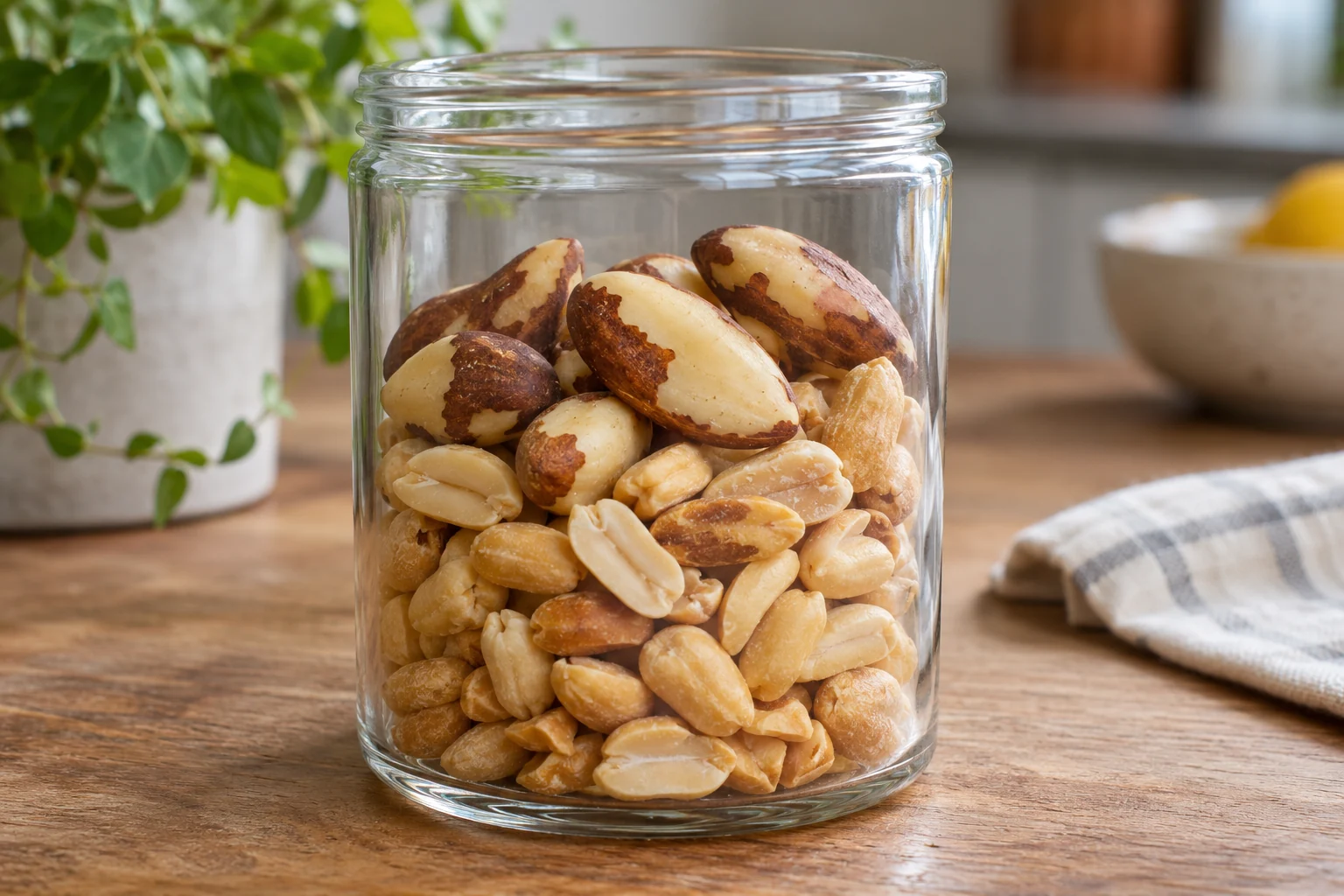
Open a shaken container of mixed nuts and some of the largest pieces may be at the surface. The phenomenon is called the Brazil-nut effect, and it shows why granular mixtures do not behave like simple liquids.
Why do Brazil nuts rise to the top? Shaking or shearing can reorganise a granular mixture so that larger pieces move upward relative to smaller ones. Local rearrangements, circulating motion, particle shape and other conditions can all contribute. It is not a universal rule that the heaviest item rises, nor does one mechanism explain every container and shaking pattern. [3]
A granular mixture is a collection of contacts and gaps
Each nut or grain is a separate solid object. A pile contains spaces as well as material, and movement changes the network of contacts supporting it. Rearranging that network can create opportunities for some pieces to change position more readily than others.
That is different from treating the mixture as a uniform liquid and asking which object should float. A Brazil nut’s motion depends on interactions with surrounding particles, boundaries and any air between the grains. Its size, density and orientation cannot always be reduced to one simple buoyancy comparison.
The visible surface also hides most of the action. Seeing a large nut on top after shaking does not tell you which path it followed or what happened to the smaller pieces around it.
Early models showed how local geometry can sort sizes
Rosato and colleagues studied size segregation using a computational approach in 1987. Their model reproduced a large particle rising among smaller ones and identified a local geometric route to separation. The result could occur even when the large particle was denser than the others. [1]
Local rearrangement provides an intuitive starting point. When agitation opens temporary spaces, small and large objects do not have identical options for settling into the new arrangement. Repetition can bias the outcome rather than producing a perfectly mixed collection.
The original paper distinguishes its mechanism from the simplest image of tiny grains merely sifting through permanent holes. That is a useful caution: a familiar gap-filling analogy can introduce the topic without capturing every contact and motion in a real granular bed.
Sometimes the whole pile circulates
In a 1993 experiment, Knight, Jaeger and Nagel investigated a large glass bead in a vibrating cylindrical column of smaller particles. The material rose in the centre and descended through a thin region near the walls. A sufficiently large bead could be carried upward but fail to enter the narrow downward flow.
In that geometry, the authors attributed size separation to convection rather than local rearrangements alone. A large particle became trapped near the top because the circulation could not carry it back down through the same route used by smaller particles. [2]
The word convection here describes circulation of the granular material. It does not mean the experiment required boiling liquid. Container shape and the way the particles interact with its walls can help determine the flow pattern.
Real nuts are not identical spheres
Many models use spheres because their geometry is easier to control. Brazil nuts are elongated and irregular. Rotating such a piece changes its horizontal footprint and the spaces available to neighbours. Shape therefore creates possibilities that a spherical model cannot represent in the same way.
Gajjar and colleagues used time-resolved X-ray tomography to examine actual nuts inside a sheared mixture. They observed Brazil nuts changing orientation as they rose. A more upright orientation reduced the projected horizontal area and allowed smaller peanuts to move around them. However, becoming upright was not by itself sufficient for every large nut to rise. [3]
That last qualification is important. An observed association can be part of a mechanism without serving as a complete prediction. The surrounding configuration still matters.
Why three-dimensional imaging was useful
A camera looking through a clear container mostly records its surface. X-ray CT can reconstruct positions inside an opaque mixture, providing a view of changes that ordinary observation misses. The Manchester team used sequences of reconstructions to follow the sorting process through time.
The university’s account highlights orientation as a crucial part of the upward movement seen in that experiment. It also explains why the work matters to industries trying to keep mixtures uniform: shaking and handling can change the composition delivered from different parts of a container. [4]
A jar of nuts is an accessible example, but it is not the only practical setting. Whenever separate solid pieces differ in size and shape, movement can potentially reorganise the mix. Determining whether it does so requires attention to the particular materials and handling process.
Density and air can change the result
Particle size is prominent in the phenomenon’s name, but it does not act alone. Möbius and colleagues investigated the role of particle density and interstitial air in granular size separation. Their results showed that both needed to be considered in explaining the behaviour of their mixtures. [5]
Air between grains is not always mechanically irrelevant. As a bed moves, gas flow and pressure differences can interact with the particles. Likewise, two large particles of similar size but different density need not follow identical paths under a given forcing.
This is one reason demonstrations can disagree. Changing the particle population or the experimental atmosphere can change the dominant effects. The phrase Brazil-nut effect groups related sorting outcomes; it does not specify all the conditions needed to obtain one.
Can the large particles end up at the bottom?
Yes. A reverse Brazil-nut effect is possible under suitable conditions. Hong, Quinn and Luding developed a theoretical account of a crossover between large particles rising and the reverse outcome, comparing its predictions with molecular-dynamics simulations. [6]
The existence of a reverse outcome is not a contradiction. It tells us that the direction of segregation depends on competing influences. “Large pieces rise” is an observation to explain within a defined system, not a law overriding every other property of the mixture.
A useful scientific explanation therefore states the setup as well as the result: which particles, which container, which motion and which environmental conditions. Without that information, two apparently conflicting demonstrations may not be testing the same case.
Why shaking is not the same as mixing
We often associate motion with disorder, but movement can also repeatedly favour particular arrangements. If large and small pieces have systematically different routes through a changing bed, continued agitation can make the distribution less uniform.
The practical lesson is to separate the action from the outcome. “Shaken” describes what was done to a mixture; “well mixed” describes its resulting distribution. One does not guarantee the other. Experiments, models and internal imaging help establish which mechanisms link the two in a particular case.
Frequently asked questions
Do the heaviest nuts always rise?
No. Weight alone is not a sufficient explanation. Size, density, shape, airflow and the movement of the bed can all matter.
Is the effect just small pieces falling through gaps?
That is one useful starting idea, but circulation and other mechanisms can dominate in particular experiments.
Did the X-ray study prove every nut must stand upright?
No. Orientation was important in the studied mixture, and an upright orientation was not sufficient by itself to guarantee rising.
Can shaking make a mixture less uniform?
Yes. Size segregation is an example of motion producing separation rather than uniform mixing.
Keep exploring
Sources and further reading
- Rosato and colleagues (1987) — Why the Brazil nuts are on top; research abstract
- Knight, Jaeger and Nagel (1993) — The convection connection; research abstract
- Gajjar and colleagues (2021) — Size segregation captured by time-resolved 3D imaging
- University of Manchester — Researchers explain the X-ray nut-mixture study
- Möbius and colleagues (2001) — Size separation of granular particles; research abstract
- Hong, Quinn and Luding (2001) — Reverse Brazil nut problem; research abstract
Reference review: November 11, 2026.
Keep exploring.
One remarkable idea at a time—nature, science, history and beyond.
Last updated November 12, 2026.

Barnakle Editorial Team
Barnakle Editorial Team is the collective byline used for Barnakle’s editorial articles. The contributor profile explains the team identity and links to the publication’s editorial policies.
More from the editorial team →