Cacti have spines that help protect their stems from hungry animals and can alter the light, airflow and moisture around the plant. The familiar needles are modified leaves, rather than small branches. Their benefits depend on the species and its environment: a sparse set of long spines and a dense woolly covering do not affect a cactus in exactly the same way. [1, 2]
The green, water-storing body often does the photosynthetic work that broad leaves perform in other plants. Spines belong to that larger arrangement of stem, surface, roots and growth habits. Understanding the arrangement gives a fuller answer than imagining each spine as a miniature weapon with only one purpose.
Are cactus spines really leaves?
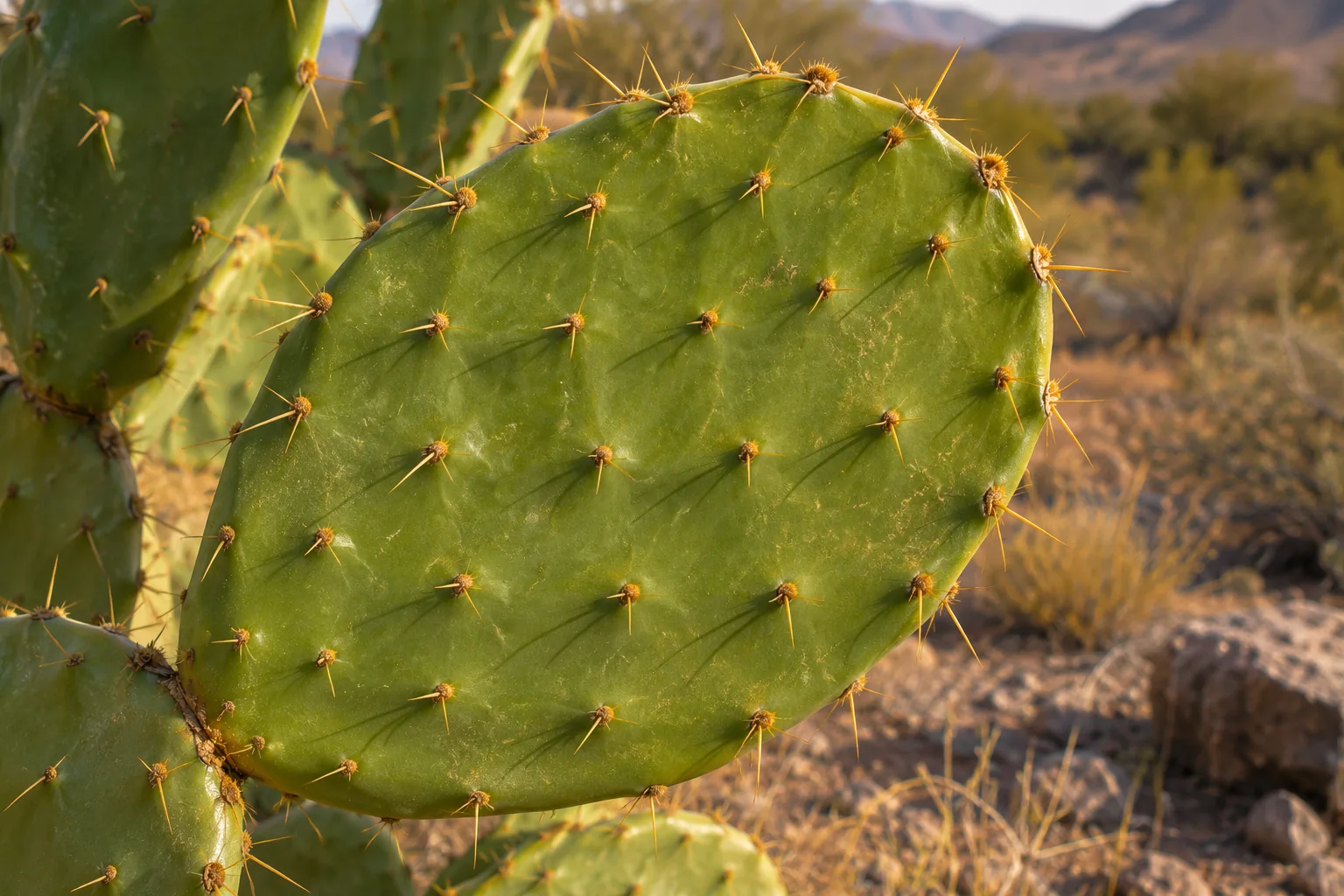
In many familiar desert cacti, spines represent highly modified leaves. They arise from specialized sites called areoles, often visible as small clusters or cushions on the stem. A prickly pear’s broad green pad is itself a flattened stem, not a huge leaf covered in thorns. The University of Michigan’s botanical exhibit makes this anatomical distinction explicit. [1, 8]
Everyday language often calls sharp plant structures “thorns,” but botanists distinguish structures by their origin. Calling a cactus spine a modified leaf describes its developmental identity; it does not mean an individual mature green leaf shrivels into a needle whenever the weather becomes dry.
Areoles also help organize the cactus surface. Instead of needles emerging randomly from anywhere, they grow in characteristic groups. Their spacing, number and appearance vary among species, contributing to the different silhouettes of a prickly pear, a barrel cactus and a tall columnar cactus. [1, 2]
Why defending a stem matters
A succulent stem contains living tissue and stored water. Eating that stem can damage both the cactus’s reserves and the surface responsible for photosynthesis. A covering of sharp structures makes access more difficult for at least some herbivores. The Fish & Wildlife Service identifies defense against animals as one of the major functions of cactus spines. [2]
This is a deterrent, not an impenetrable barrier. Canyonlands National Park notes that rodents still gnaw cactus pads and other mammals eat the fruits. Different animals approach a plant in different ways, and a defense that reduces damage does not have to prevent every bite to have a biological effect. [3]
Imagine a soft object protected by a set of projecting rods. The rods change which surfaces can be approached directly and where force can be applied. That simple geometric analogy helps explain physical obstruction without assuming that all spine shapes evolved for exactly the same feeding threat.
Can a thin spine make useful shade?
A single narrow shadow is small, but many spines can intercept a meaningful share of incoming light. Dense coverings can reduce the radiation reaching a photosynthetic stem. Their effect depends on spacing, orientation, sun angle and the shape of the stem beneath them. [4, 5]
Researchers have examined these relationships rather than assuming that more spines must always be better. Work on Mojave Desert Opuntia species compared plants with different degrees of spinescence, alongside measurements of light interception, stem temperature and photosynthetic behavior. It treats the covering as a physical and physiological feature that can be measured. [4]
Shade also creates a trade-off. Blocking intense radiation may protect tissue in some circumstances, while blocking useful light can reduce the energy available for photosynthesis. A plant’s covering is not a perfectly transparent sunscreen that excludes only unwanted energy.
Why temperature effects are not one fixed number
A cactus exchanges energy with sunlight, the sky, nearby ground and moving air. Spine shade is one part of that energy balance. A field study of saguaros found that surface temperatures varied with season, height on the plant, sun exposure and the position of ridges and furrows. Some differences associated with spiny ridges were significant but small. [6]
That result is a useful boundary on sweeping claims. It would be misleading to assign every cactus a universal temperature reduction simply because it has needles. A measurement depends on which species, which surface, what time and which weather conditions were compared.
Earlier experimental and modeling work also examined how removing spines changed intercepted light and growth-related measures. Its findings underline that the consequences of a covering involve both thermal conditions and access to photosynthetically active radiation. [5]
How spines fit into water conservation
Replacing broad leaves with reduced structures helps change how much exposed, actively exchanging leaf surface a desert cactus maintains. Its fleshy stem, waxy exterior and root system contribute to the overall water strategy. Some coverings can also disrupt airflow near the stem and provide shade. [1, 3]
Many desert cacti use CAM photosynthesis, taking in carbon dioxide mainly at night and storing it chemically for later use. Opening gas-exchange pores during cooler conditions can reduce water loss compared with keeping them open through the hottest part of the day. That biochemical schedule is separate from the spine’s physical role. [3]
The distinction matters because spines do not independently solve every water problem. A plant still needs water uptake, storage, gas exchange and living cells capable of functioning through dry periods. Its shape and physiology work together.
Can cactus spines collect fog?
Some can help. A study of Opuntia microdasys examined a system of conical spines and hair-like structures that collected and transported tiny water droplets under experimental fog conditions. Differences along the spine surface helped direct droplets toward its base. [7]
This is evidence about a particular structure and set of conditions, not proof that every cactus obtains most of its water from fog. Liquid droplets in fog, vapor condensation and rainfall are different starting conditions. The presence of a needle alone does not establish a plant’s annual water budget.
The study is interesting precisely because a surface can do more than passively get wet. Shape and microscopic texture can influence where small droplets move. Another plant-surface solution appears in why lotus leaves repel water and stay clean.
What are the tiny fuzzy clusters on prickly pears?
Some cacti, including prickly pears and chollas, carry small barbed structures called glochids as well as more obvious spines. These can look like soft fuzz from a distance. Big Bend’s description distinguishes these fine structures from the larger needles in the clusters. [1]
That difference is another reason to look at the whole covering rather than counting only the longest spines. A surface that seems almost unarmed in a photograph can still have numerous tiny structures that affect contact with it.
Questions about cactus spines
Does a prickly pear pad count as a leaf?
No. The familiar green pad is a modified stem. Its larger spines and glochids are highly modified leaves. [8]
Are spines only for defense?
No. Depending on the species and conditions, they can also affect shade, temperature, airflow or droplet collection. [2, 4, 6, 7]
Would removing every spine necessarily improve growth?
There is no universal answer. More light can be useful, but the plant would also lose other functions of its covering. Experiments on a few species cannot become a rule for all cacti. [4, 5]
Where is most of the visible water storage?
In the fleshy body rather than the needles. For another view of plant water movement, read how trees lift water without a pump. Cactus spines make more sense when seen as one component of a complete plant.
Sources and further reading
Sources checked November 15, 2026. Abstracts and research syntheses are identified below where used; restricted full texts are not represented as fully reviewed.
- National Park Service, Big Bend — Cacti
- U.S. Fish & Wildlife Service — Get to Know Your Cacti
- National Park Service, Canyonlands — Cacti / Desert Succulents
- Loik (2008) — The effect of cactus spines on light interception and Photosystem II for three sympatric species of Opuntia from the Mojave Desert — research abstract
- Nobel (1983) — Spine influences on PAR interception, stem temperature, and nocturnal acid accumulation by cacti — research abstract
- Drezner (2011) — Cactus surface temperatures are impacted by seasonality, spines and height on plant — research abstract
- Ju and colleagues (2012) — A multi-structural and multi-functional integrated fog collection system in cactus
- University of Michigan Botanical Gardens — Leaves Under the Lens, cactus areoles and modified leaves
Keep exploring.
One remarkable idea at a time—nature, science, history and beyond.
Last updated November 16, 2026.

Barnakle Editorial Team
Barnakle Editorial Team is the collective byline used for Barnakle’s editorial articles. The contributor profile explains the team identity and links to the publication’s editorial policies.
More from the editorial team →