Lichens can grow on bare rock because they do not depend on roots drawing food from soil. A lichen combines a fungus with a photosynthetic partner, usually a green alga or a cyanobacterium. With light and suitable moisture, that partner supplies carbon-rich products of photosynthesis to the association. [1]
The rock offers a place to live, with a particular texture and chemistry. It is not the lichen's equivalent of a sandwich. Explaining how a colorful crust survives there requires following several different resources: carbon, water, mineral nutrients and a surface on which new growth can establish.
What exactly is a lichen?
A lichen's visible body is called a thallus. Fungal tissue forms much of its structure and houses the photosynthetic cells. “Fungus plus alga” is a useful introduction, although lichen associations can include cyanobacteria and additional partners; their biology is more varied than a universal two-member formula suggests. [1]
Lichens are distinct from mosses. A moss is a small plant, while a lichen is an association organized around a fungus. They may share a boulder and look similarly small from a distance, but the resemblance does not make them the same kind of organism. [6]
This distinction also changes the starting question. A rootless patch on stone is not necessarily a tiny seedling missing its soil. It can be a different way of organizing life, with a photosynthetic partner embedded within a fungal body.
Where does a rock-dwelling lichen get water?
Lichens draw water from their surroundings. Their water content can rise when conditions are wet and fall as their environment dries. Unlike a vascular plant with roots and an internal water-management system, a lichen's activity is closely coupled to the moisture available around its thallus. [2]
A dry thallus can become physiologically inactive. Rehydration allows activity to resume, but water does not immediately translate into extra growth. Respiration initially uses stored carbohydrates, and photosynthesis needs enough suitable time to replace that expenditure before there is a net surplus. [2]
That is why “it got wet” and “it grew” are different observations. A lichen may survive a dry interval and then become active again without gaining much new material during a short wet spell. Its carbon budget depends on the duration and quality of the opportunity. [2]
Can dew sustain a lichen in a dry place?
In some arid habitats, morning dew provides an opportunity to rehydrate and photosynthesize before heat and drying bring another inactive period. The opportunity depends on local conditions and the lichen involved. A desert can contain useful pulses of moisture even when its surface looks dry for much of the day. [3]
Crevices, sheltered positions and spaces among boulders can reduce exposure to drying wind and intense sun. A protected patch may remain usable for longer than an exposed surface only a short distance away. Lichens do not manufacture water; their position affects how effectively they can use what arrives. [3]
Dryness tolerance should not be confused with unlimited tolerance of all conditions. The Australian National Botanic Gardens notes that dry thalli of many arid-area species can withstand temperatures that would damage them when wet. Hydration changes the organism's physiological state, as well as its access to water. [3]
Why is one side of a boulder covered and another bare?
For a lichen, a few centimeters can separate different habitats. Rock and adjacent soil differ in texture, chemistry, heating and water behavior. Even a single boulder creates contrasts through its shape, shading and exposure. Those differences affect which species can establish and remain active. [4]
Water can also run off a rock and collect near its base, making the neighboring ground unlike soil farther away. On some sites, that extra supply creates a richer local community. A patchwork of lichens therefore need not mean the whole rock was equally suitable and colonized at random. [4]
Imagine two incoming fragments landing on the same boulder: one in a sheltered rough spot, the other on a surface that rapidly dries. Their distance apart may be small to a walker while their available growing time differs considerably. This is an illustrative comparison, rather than a rule predicting every patch.
How does a new lichen arrive on bare stone?
Some lichens disperse small structures that contain both fungal and photosynthetic components. Soredia and isidia are important examples. A fragment can also carry pieces of an existing association to a new site. Establishment still requires an appropriate landing place and conditions that permit growth. [7]
These packages solve an important problem: a fungus arriving alone does not automatically arrive with the photosynthetic partner it needs. Transporting both together gives a new thallus a different starting point from that of a solitary fungal spore. It does not guarantee survival on whatever surface receives it. [7]
Lichen reproduction also includes a sexual route involving the fungal partner. Spores produced by that fungus can disperse, but a developing lichen must establish an appropriate association with a photobiont. Saying that a lichen produces spores is convenient shorthand; it should not imply that every spore contains a complete miniature partnership. [5]
Why are some lichens flat crusts?
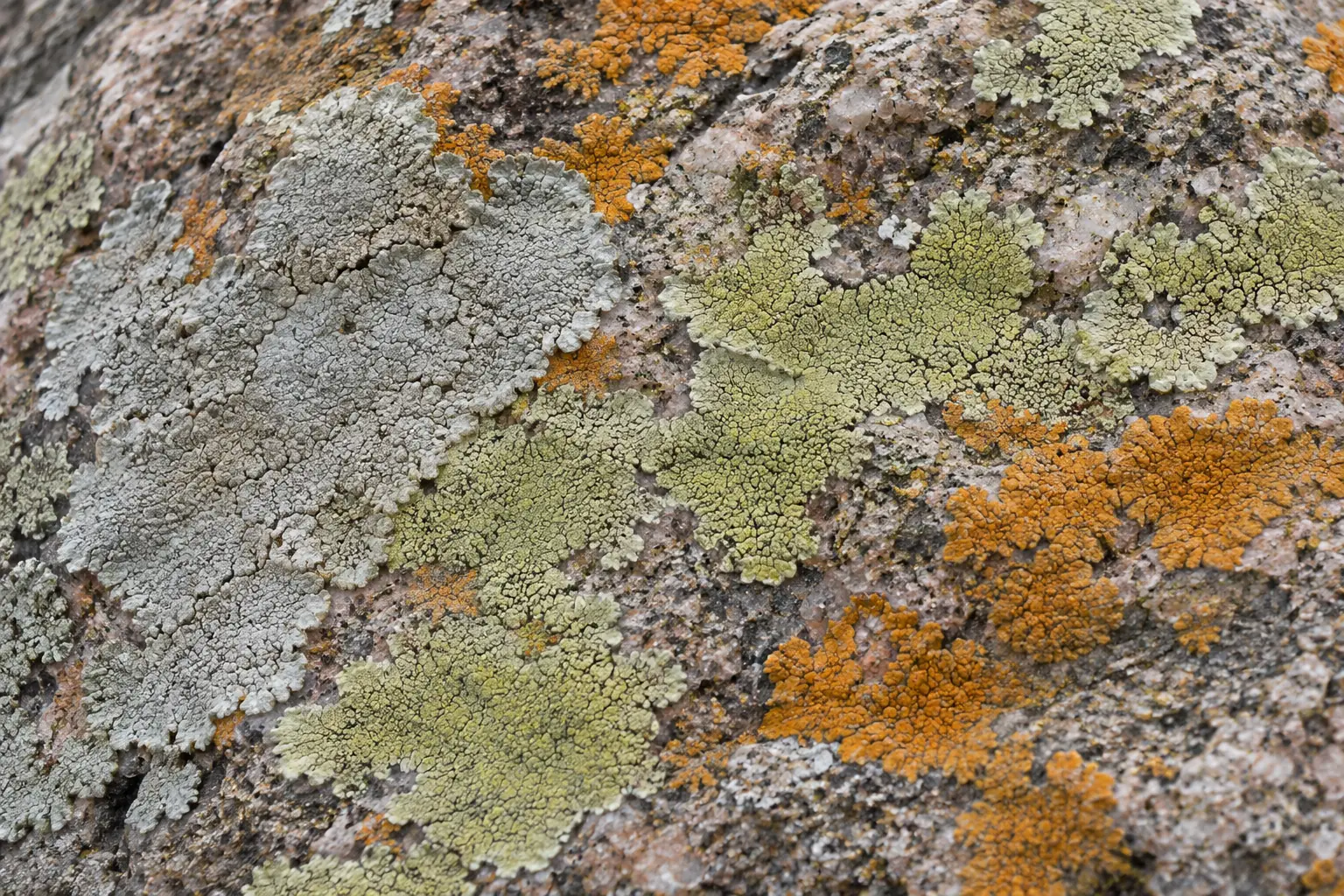
Lichens have several growth forms. Crustose lichens sit closely against their substrate, foliose forms have more leaf-like lobes, and fruticose forms can be shrubby or branching. The form is part of how a lichen occupies space, though shape alone is not enough to identify every species. [1]
Flat patches on rock can therefore be established lichen bodies rather than stains waiting to turn into leafy plants. Their close attachment makes the boundary between living cover and mineral surface visually subtle. A hand lens often reveals structures that a casual glance misses. [6]
Do lichens break rock down into soil?
Some lichens contribute to weathering. Their interactions with rock, including the action of acids, can help alter the surface. Over time, weathered mineral material and organic remains can contribute to conditions in which other organisms establish. This is one reason lichens are described as pioneer colonizers. [6]
That description needs limits. Not every species grows on every rock, and the presence of lichen does not prove a rapid or uniform rate of soil production. Weathering and ecological succession involve site conditions and other organisms too. A colorful patch is evidence of life on a surface, not a complete timetable for a future forest.
The useful distinction is between obtaining carbon and changing a substrate. Photosynthesis supplies organic carbon to the association; interaction with minerals is another part of its ecology. Calling the lichen a rock-eater obscures both processes.
Why does lichen growth seem so slow?
Growth occurs within a restricted window: the thallus needs suitable hydration, light and other conditions, while metabolism also consumes resources. Long dry intervals and repeated short starts can leave relatively little opportunity for net production. Persistence through a difficult season is not the same achievement as expanding rapidly. [2, 3]
A lichen-covered boulder brings those processes together. Partners obtain carbon, the thallus takes up environmental water, propagules establish where conditions permit, and growth accumulates over time. Bare rock lacks soil, but it does not necessarily lack every resource a lichen needs.
Keep exploring
Lichens reveal one side of fungal life. Explore two others through mushroom reproduction and the chemistry behind luminous fungi.
Sources and further reading
Lichen explanations checked November 16, 2026, against Australian National Botanic Gardens accounts and National Park Service material. The illustration depicts an unlabelled community, not a species identification.
- Australian National Botanic Gardens — What is a lichen?
- Australian National Botanic Gardens — Hydration & photosynthesis
- Australian National Botanic Gardens — Lichens in arid areas
- Australian National Botanic Gardens — Microhabitats
- Australian National Botanic Gardens — Reproduction and dispersal
- U.S. National Park Service, Rocky Mountain National Park — Lichens
- British Lichen Society — Lichen life cycle
Keep exploring.
One remarkable idea at a time—nature, science, history and beyond.
Last updated November 16, 2026.

Barnakle Editorial Team
Barnakle Editorial Team is the collective byline used for Barnakle’s editorial articles. The contributor profile explains the team identity and links to the publication’s editorial policies.
More from the editorial team →