
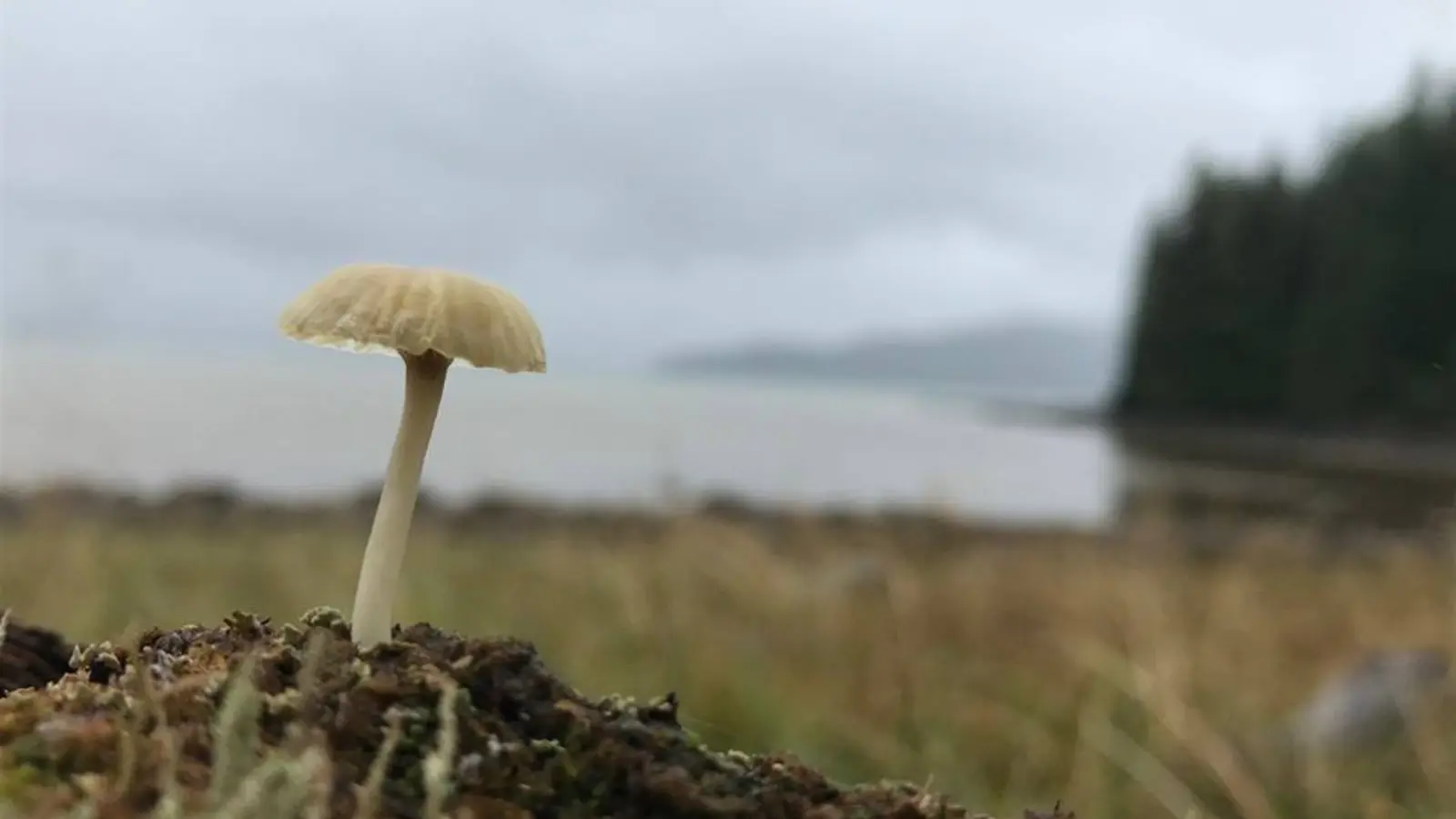
Fruit bodies release microscopic spores while the larger fungal organism grows as hidden threads
The short answer
A mushroom is usually the spore-producing fruit body of a much larger fungus. Specialized cells on gills, pores or other surfaces make microscopic spores, which are released into air, water or onto animals. A spore that reaches suitable conditions can germinate into hyphae. Compatible hyphae may fuse, forming a mycelium capable of producing new mushrooms.
The cap visible above soil or wood is only a temporary reproductive structure. Most of the organism persists as mycelium: a branching network of hyphae that explores its substrate, digests material externally and absorbs nutrients. Reproduction links this hidden network with an enormous dispersal system.
The mushroom is a fruit body
Many fungi build mushrooms only when moisture, temperature, nutrition and development align. The structure elevates or exposes spore-producing tissue.
Understanding The mushroom is a fruit body means separating the immediate mechanism from the conditions that change its strength, timing or visibility. Researchers measure those variables independently, compare natural examples and test whether the explanation predicts new observations. That turns a plausible story into an evidence-based account.
The evidence comes from methods that fail in different ways. Direct observation establishes what occurs, instruments quantify structure or timing, experiments isolate candidate causes and models test whether known physical or biological rules reproduce the pattern. Agreement among methods is stronger than repetition of one memorable example.
Context also matters. Scale, composition, temperature, geometry, environment and measurement limits can change an outcome without overturning the underlying process. Accurate reporting preserves this variation, states uncertainty and avoids turning a useful explanation into a universal rule.
A practical explanation should identify what would change the observation. Following that question reveals the limits of present evidence and the next measurement needed.
This mechanism connects a reader-level question with a broader scientific principle. Following matter, energy or information through each stage shows where the explanation is established, where natural variation enters and why a superficially similar event may have another cause.
Scientists also test alternatives rather than stopping at the first plausible account. A strong explanation predicts several linked observations, survives controlled comparison and specifies where it should fail. That approach keeps a clear answer accurate without hiding complexity.
Spores are not seeds
A fungal spore is usually a single cell or small group without a plant embryo or food-rich seed. It is adapted for dispersal and dormancy.
Understanding Spores are not seeds means separating the immediate mechanism from the conditions that change its strength, timing or visibility. Researchers measure those variables independently, compare natural examples and test whether the explanation predicts new observations. That turns a plausible story into an evidence-based account.
The evidence comes from methods that fail in different ways. Direct observation establishes what occurs, instruments quantify structure or timing, experiments isolate candidate causes and models test whether known physical or biological rules reproduce the pattern. Agreement among methods is stronger than repetition of one memorable example.
Context also matters. Scale, composition, temperature, geometry, environment and measurement limits can change an outcome without overturning the underlying process. Accurate reporting preserves this variation, states uncertainty and avoids turning a useful explanation into a universal rule.
A practical explanation should identify what would change the observation. Following that question reveals the limits of present evidence and the next measurement needed.
This mechanism connects a reader-level question with a broader scientific principle. Following matter, energy or information through each stage shows where the explanation is established, where natural variation enters and why a superficially similar event may have another cause.
Scientists also test alternatives rather than stopping at the first plausible account. A strong explanation predicts several linked observations, survives controlled comparison and specifies where it should fail. That approach keeps a clear answer accurate without hiding complexity.
Gills multiply surface area
Thin plates beneath many caps pack a large hymenial surface into a small space. Other species use pores, teeth, folds or enclosed sacs.
Understanding Gills multiply surface area means separating the immediate mechanism from the conditions that change its strength, timing or visibility. Researchers measure those variables independently, compare natural examples and test whether the explanation predicts new observations. That turns a plausible story into an evidence-based account.
The evidence comes from methods that fail in different ways. Direct observation establishes what occurs, instruments quantify structure or timing, experiments isolate candidate causes and models test whether known physical or biological rules reproduce the pattern. Agreement among methods is stronger than repetition of one memorable example.
Context also matters. Scale, composition, temperature, geometry, environment and measurement limits can change an outcome without overturning the underlying process. Accurate reporting preserves this variation, states uncertainty and avoids turning a useful explanation into a universal rule.
A practical explanation should identify what would change the observation. Following that question reveals the limits of present evidence and the next measurement needed.
This mechanism connects a reader-level question with a broader scientific principle. Following matter, energy or information through each stage shows where the explanation is established, where natural variation enters and why a superficially similar event may have another cause.
Scientists also test alternatives rather than stopping at the first plausible account. A strong explanation predicts several linked observations, survives controlled comparison and specifies where it should fail. That approach keeps a clear answer accurate without hiding complexity.
Meiosis creates sexual spores
In basidiomycete mushrooms, nuclei ultimately fuse and undergo meiosis in club-shaped basidia, producing genetically varied basidiospores.
Understanding Meiosis creates sexual spores means separating the immediate mechanism from the conditions that change its strength, timing or visibility. Researchers measure those variables independently, compare natural examples and test whether the explanation predicts new observations. That turns a plausible story into an evidence-based account.
The evidence comes from methods that fail in different ways. Direct observation establishes what occurs, instruments quantify structure or timing, experiments isolate candidate causes and models test whether known physical or biological rules reproduce the pattern. Agreement among methods is stronger than repetition of one memorable example.
Context also matters. Scale, composition, temperature, geometry, environment and measurement limits can change an outcome without overturning the underlying process. Accurate reporting preserves this variation, states uncertainty and avoids turning a useful explanation into a universal rule.
A practical explanation should identify what would change the observation. Following that question reveals the limits of present evidence and the next measurement needed.
This mechanism connects a reader-level question with a broader scientific principle. Following matter, energy or information through each stage shows where the explanation is established, where natural variation enters and why a superficially similar event may have another cause.
Scientists also test alternatives rather than stopping at the first plausible account. A strong explanation predicts several linked observations, survives controlled comparison and specifies where it should fail. That approach keeps a clear answer accurate without hiding complexity.
Spores launch into moving air
Tiny changes in water condensation and surface tension can propel basidiospores away from gills. Air currents then carry them farther.
Understanding Spores launch into moving air means separating the immediate mechanism from the conditions that change its strength, timing or visibility. Researchers measure those variables independently, compare natural examples and test whether the explanation predicts new observations. That turns a plausible story into an evidence-based account.
The evidence comes from methods that fail in different ways. Direct observation establishes what occurs, instruments quantify structure or timing, experiments isolate candidate causes and models test whether known physical or biological rules reproduce the pattern. Agreement among methods is stronger than repetition of one memorable example.
Context also matters. Scale, composition, temperature, geometry, environment and measurement limits can change an outcome without overturning the underlying process. Accurate reporting preserves this variation, states uncertainty and avoids turning a useful explanation into a universal rule.
A practical explanation should identify what would change the observation. Following that question reveals the limits of present evidence and the next measurement needed.
This mechanism connects a reader-level question with a broader scientific principle. Following matter, energy or information through each stage shows where the explanation is established, where natural variation enters and why a superficially similar event may have another cause.
Scientists also test alternatives rather than stopping at the first plausible account. A strong explanation predicts several linked observations, survives controlled comparison and specifies where it should fail. That approach keeps a clear answer accurate without hiding complexity.
Germination produces hyphae
A suitable spore absorbs water and extends a microscopic filament. Repeated branching creates a mycelial network through soil, wood or another substrate.
Understanding Germination produces hyphae means separating the immediate mechanism from the conditions that change its strength, timing or visibility. Researchers measure those variables independently, compare natural examples and test whether the explanation predicts new observations. That turns a plausible story into an evidence-based account.
The evidence comes from methods that fail in different ways. Direct observation establishes what occurs, instruments quantify structure or timing, experiments isolate candidate causes and models test whether known physical or biological rules reproduce the pattern. Agreement among methods is stronger than repetition of one memorable example.
Context also matters. Scale, composition, temperature, geometry, environment and measurement limits can change an outcome without overturning the underlying process. Accurate reporting preserves this variation, states uncertainty and avoids turning a useful explanation into a universal rule.
A practical explanation should identify what would change the observation. Following that question reveals the limits of present evidence and the next measurement needed.
This mechanism connects a reader-level question with a broader scientific principle. Following matter, energy or information through each stage shows where the explanation is established, where natural variation enters and why a superficially similar event may have another cause.
Scientists also test alternatives rather than stopping at the first plausible account. A strong explanation predicts several linked observations, survives controlled comparison and specifies where it should fail. That approach keeps a clear answer accurate without hiding complexity.
Compatible hyphae can fuse
Many fungi have mating types rather than male and female individuals. Compatible cells exchange nuclei and establish the long-lived reproductive mycelium.
Understanding Compatible hyphae can fuse means separating the immediate mechanism from the conditions that change its strength, timing or visibility. Researchers measure those variables independently, compare natural examples and test whether the explanation predicts new observations. That turns a plausible story into an evidence-based account.
The evidence comes from methods that fail in different ways. Direct observation establishes what occurs, instruments quantify structure or timing, experiments isolate candidate causes and models test whether known physical or biological rules reproduce the pattern. Agreement among methods is stronger than repetition of one memorable example.
Context also matters. Scale, composition, temperature, geometry, environment and measurement limits can change an outcome without overturning the underlying process. Accurate reporting preserves this variation, states uncertainty and avoids turning a useful explanation into a universal rule.
A practical explanation should identify what would change the observation. Following that question reveals the limits of present evidence and the next measurement needed.
This mechanism connects a reader-level question with a broader scientific principle. Following matter, energy or information through each stage shows where the explanation is established, where natural variation enters and why a superficially similar event may have another cause.
Scientists also test alternatives rather than stopping at the first plausible account. A strong explanation predicts several linked observations, survives controlled comparison and specifies where it should fail. That approach keeps a clear answer accurate without hiding complexity.
Mycelium acquires resources
Fungi release enzymes outside their bodies and absorb small molecules. Some decompose dead material; others form partnerships or live as pathogens.
Understanding Mycelium acquires resources means separating the immediate mechanism from the conditions that change its strength, timing or visibility. Researchers measure those variables independently, compare natural examples and test whether the explanation predicts new observations. That turns a plausible story into an evidence-based account.
The evidence comes from methods that fail in different ways. Direct observation establishes what occurs, instruments quantify structure or timing, experiments isolate candidate causes and models test whether known physical or biological rules reproduce the pattern. Agreement among methods is stronger than repetition of one memorable example.
Context also matters. Scale, composition, temperature, geometry, environment and measurement limits can change an outcome without overturning the underlying process. Accurate reporting preserves this variation, states uncertainty and avoids turning a useful explanation into a universal rule.
A practical explanation should identify what would change the observation. Following that question reveals the limits of present evidence and the next measurement needed.
This mechanism connects a reader-level question with a broader scientific principle. Following matter, energy or information through each stage shows where the explanation is established, where natural variation enters and why a superficially similar event may have another cause.
Scientists also test alternatives rather than stopping at the first plausible account. A strong explanation predicts several linked observations, survives controlled comparison and specifies where it should fail. That approach keeps a clear answer accurate without hiding complexity.
Fungi also reproduce asexually
Fragments, budding cells, conidia and other spores can create descendants without meiosis. Life cycles vary widely across the fungal kingdom.
Understanding Fungi also reproduce asexually means separating the immediate mechanism from the conditions that change its strength, timing or visibility. Researchers measure those variables independently, compare natural examples and test whether the explanation predicts new observations. That turns a plausible story into an evidence-based account.
The evidence comes from methods that fail in different ways. Direct observation establishes what occurs, instruments quantify structure or timing, experiments isolate candidate causes and models test whether known physical or biological rules reproduce the pattern. Agreement among methods is stronger than repetition of one memorable example.
Context also matters. Scale, composition, temperature, geometry, environment and measurement limits can change an outcome without overturning the underlying process. Accurate reporting preserves this variation, states uncertainty and avoids turning a useful explanation into a universal rule.
A practical explanation should identify what would change the observation. Following that question reveals the limits of present evidence and the next measurement needed.
This mechanism connects a reader-level question with a broader scientific principle. Following matter, energy or information through each stage shows where the explanation is established, where natural variation enters and why a superficially similar event may have another cause.
Scientists also test alternatives rather than stopping at the first plausible account. A strong explanation predicts several linked observations, survives controlled comparison and specifies where it should fail. That approach keeps a clear answer accurate without hiding complexity.
Common misconceptions
The visible mushroom is not the entire fungus, and every spore does not grow into a new mushroom. Most land in unsuitable places or are eaten and damaged. Fungi are also not plants: they lack chlorophyll, digest food externally and belong to their own evolutionary kingdom.
Clear shorthand is valuable only when it preserves the causal chain. It becomes misleading when it substitutes a label for a mechanism, confuses association with cause or extends evidence beyond tested conditions.
How scientists know
Mycologists make spore prints, use microscopes to examine basidia and spores, culture hyphae, sequence DNA and track labelled nuclei. Environmental sampling and genomic methods reveal mycelia and species that rarely form obvious fruit bodies.
No single measurement carries the conclusion. Observations, experiments, theory and repeated records provide independent checks, while disagreement can reveal an uncontrolled variable or a question requiring a better test.
Frequently asked questions
How many spores can one mushroom release?
Large fruit bodies can release millions or billions, though output varies enormously.
Why are gills underneath?
They protect and expand the spore-producing surface while allowing spores to fall into air.
Can a mushroom grow from a fragment?
Mycelium can sometimes regrow from viable fragments, depending on species and conditions.
Are all spores airborne?
No. Water, insects, mammals and active mechanisms also disperse fungal spores.
Is picking a mushroom like killing a plant?
It removes a fruit body; much mycelium may remain, though trampling and overharvesting can still damage habitat.
Key takeaways
- Mushrooms are temporary reproductive structures.
- Gills and pores produce microscopic spores.
- Spores germinate into hyphae and mycelium.
- Fungal sexual and asexual cycles are diverse.
Continue exploring
Sources and further reading
Keep exploring.
One remarkable idea at a time—nature, science, history and beyond.
Sources and further reading
Barnakle uses credible primary and authoritative sources wherever possible.
- U.S. Forest Service — Fungi
- https://www.fs.usda.gov/wildflowers/beauty/mycology/whatisfungi.shtml
- University of Wisconsin — Mushroom life cycle
- https://botit.botany.wisc.edu/Resources/Botany/Fungi/Basidiomycota/Mushroom%20life%20cycle.html
- NCBI Bookshelf — Fungal biology
- https://www.ncbi.nlm.nih.gov/books/NBK559444/
- Royal Botanic Gardens Kew — State of the World’s Fungi
- https://www.kew.org/science/our-science/projects/state-of-the-worlds-fungi
Last reviewed October 7, 2026.

Barnakle Editorial Team
A member of the Barnakle editorial team, exploring remarkable ideas with clarity, curiosity and care.
More from this author →