A salt dome forms when buried salt moves upward from an older deposit, deforming the rock around it. Under sustained geological stress, salt can change shape and flow while remaining solid. Uneven loading, density contrasts and weaknesses in the overlying layers can all help direct that movement. [1, 2]
The resulting structure is called a diapir when the salt rises through surrounding strata. It may resemble a plug, pillar or broader mass rather than a perfectly rounded dome. Many remain underground, so a salt dome need not be a white hill visible at the surface. [6]
Where does the salt come from?
The story starts with salt deposited as saline water evaporates. Later sediment buries the deposit, and that sediment can eventually become rock. NASA's account of Melville Island describes this sequence as the starting point for the island's salt diapirs. [5]
The original deposit can extend far beyond the eventual dome. Geologists call the layer supplying a growing structure its source layer. Salt moves out of that layer toward the developing accumulation, so an upward-growing mass is part of a larger redistribution underground. [1]
This matters when imagining the process. A dome is not normally a new heap of salt crystallizing at its final height. Material deposited much earlier is changing its position and shape after burial. The ancient environment creates the raw material; the later basin history helps create the structure. [1, 5]
How can solid rock flow?
Flow does not always require melting. A material can accumulate deformation under stress over long periods. Buried salt is mechanically different from the comparatively brittle rocks that may cover it, allowing movement that would be difficult to infer from a small crystal held in the hand. [1]
The contrast is important: salt can redistribute while surrounding layers bend or break. Geological models therefore consider both the mobile salt and the resistance of its roof. Calling salt weak is a comparison of behavior under particular conditions, not a claim that overlying rock offers no obstacle. [2]
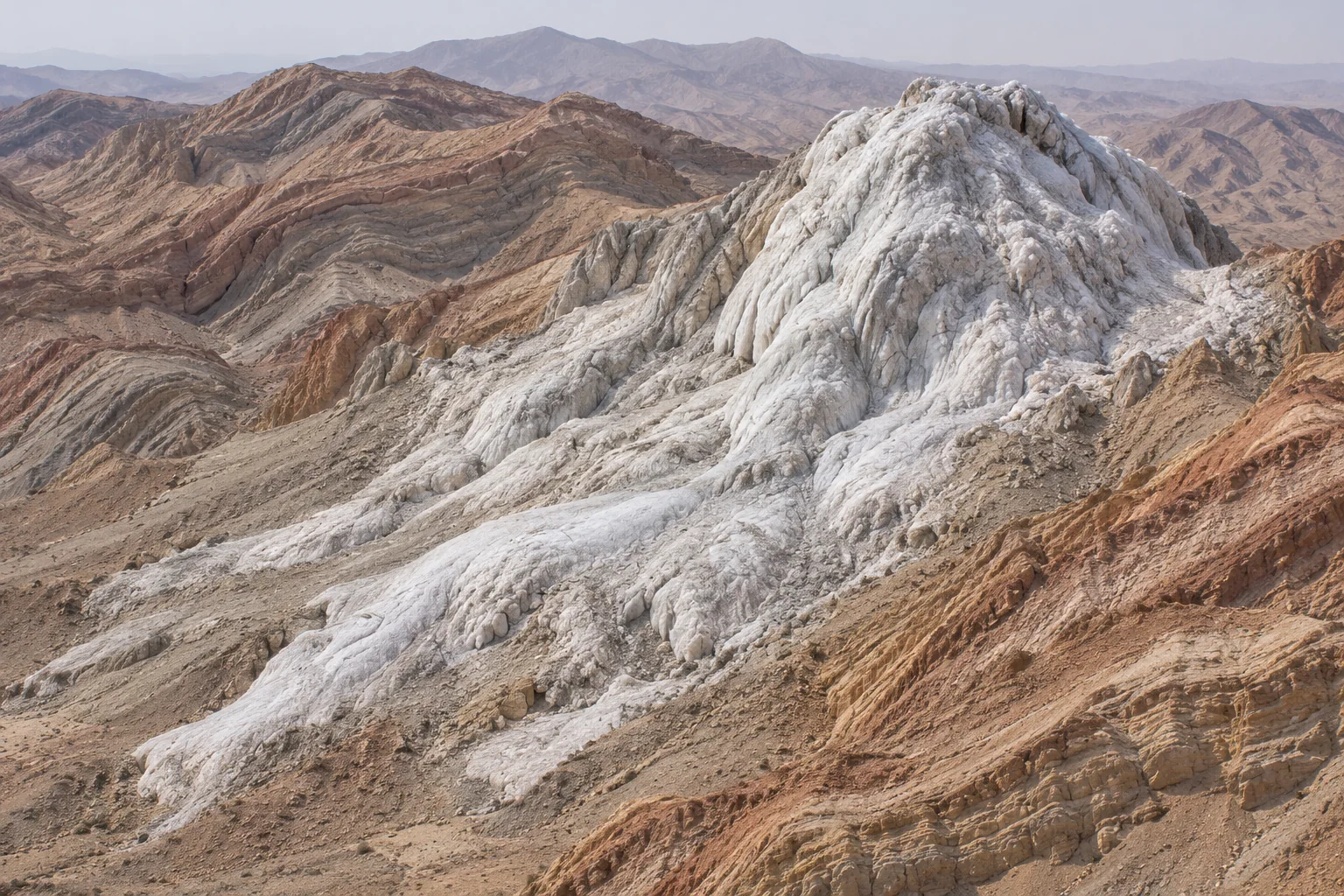
Nothing about this requires a volcanic magma chamber. NASA describes rising salt in Iran as a lower-density mass moving under the weight of rock above it. Its eventual exposure can produce a flowing salt glacier, but that name refers to the material's deformation rather than frozen water or molten lava. [4]
Does the salt rise because it is lighter?
A density contrast can contribute buoyancy. Where salt is less dense than the material overlying it, upward redistribution can lower the system's gravitational energy. SLB's geological glossary identifies relative buoyancy as a major part of the formation of salt domes and related structures. [6]
Density alone is not a complete explanation. The salt must also overcome or avoid the resistance of the overlying material. The University of Texas study of active diapirism identifies driving pressures from both density contrast and differential loading, balanced against roof weight and resistance to folding and faulting. [2]
Differential loading means the salt is not squeezed equally everywhere. A thicker pile of sediment in one area can create a different load from a thinner pile nearby. Salt can move from more heavily loaded regions toward a growing structure where conditions favor movement. [1]
Why do faults and stretching matter?
A thick, intact roof can hinder upward movement. Stretching and faulting can thin that cover and create room for salt to rise. Research summarized by the University of Texas distinguishes a reactive stage, in which salt responds to the opening and weakening of overburden, from more forceful active rise. [8]
Laboratory models help show how those relationships develop. The Applied Geodynamics Laboratory describes experiments using sand layers to represent brittle overburden and silicone to represent viscous salt. Experiments stopped at different stages were compared to reconstruct a sequence of structural change. [3]
These are scaled models, not claims that natural salt is silicone. Their value is in testing how movement in one part of a system relates to folding, faulting or subsidence elsewhere. They help researchers investigate mechanisms that cannot be watched directly through kilometers of rock. [3]
Must a diapir force its way upward forever?
No. Salt structures depend on their continuing supply and surroundings. A University of Texas research abstract describes how regional extension can first promote diapir growth and later contribute to subsidence when salt supply becomes restricted. A feature's history can include both rise and fall. [8]
In another growth mode, salt can remain near the depositional surface while new sediment accumulates beside it. This passive growth does not require continuously lifting an ever-thicker roof in the same way as active intrusion. The distinctions describe different relationships between salt movement and surrounding deposition. [3, 8]
Models of active diapirism also show that shape matters. The height and width of a diapir relative to its roof influence whether it can continue toward emergence. A small upward bulge is therefore not a guarantee that the salt will eventually break through to open air. [2]
What happens when salt reaches the surface?
At exposed examples, erosion can reveal the displaced surrounding layers. NASA's Zagros account describes uplifted tan and brown strata around a pale salt mass. If salt breaches the surface, it can spread away from the rising plug as a salt glacier. [4]
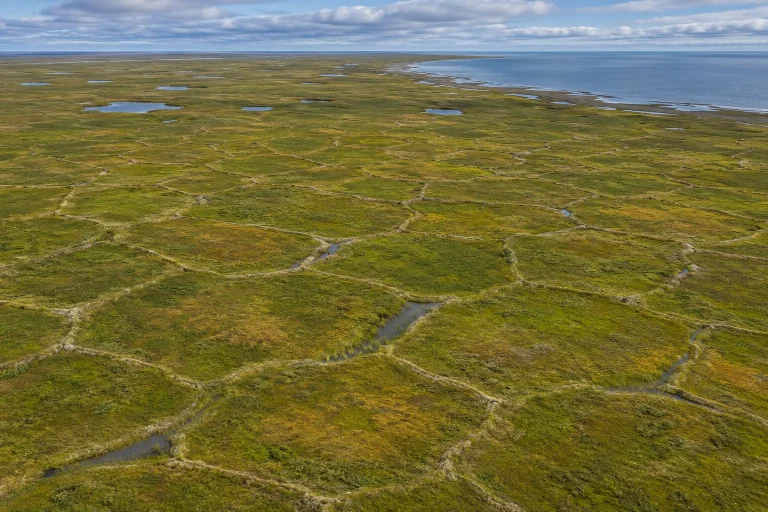
Other salt structures have different surface appearances. NASA identifies circular features on Canada's Melville Island as salt diapirs rather than impact craters, linking the source deposits to the Carboniferous history of the Sverdrup Basin. A round outline by itself does not reveal which geological process made it. [5]
Why do geologists study salt domes so closely?
Salt movement can bend adjacent strata and create structures capable of trapping hydrocarbons. The relatively impermeable salt can also contribute to sealing arrangements. That association explains why domes have long attracted attention in geological exploration, without meaning every salt dome contains a useful petroleum accumulation. [4, 6]
Their later behavior matters too. A Texas study documents subsidence and collapse associated with sulfur extraction at several domes, distinguishing gentle downwarping from brittle collapse. Those site-specific findings illustrate why natural growth, dissolution, extraction and surrounding geology need separate investigation rather than one universal story about a dome. [7]
Keep exploring
Put salt movement alongside the broader forces that reshape rock, then explore another way water and minerals alter underground landscapes.
Sources and further reading
Salt-dome formation checked November 17, 2026, against geological research summaries and institutional explanations. The Texas studies are cited as abstracts; neither the illustration nor a surface landform alone establishes a subsurface structure.
- University of Michigan — Geologic Structures and Deformation Regimes: salt structures
- Schultz-Ela, Jackson and Vendeville — Mechanics of Active Salt Diapirism (1994 abstract)
- University of Texas Applied Geodynamics Laboratory — Animations of Salt Diapirs, Part I
- NASA Earth Observatory — Salt Dome in the Zagros Mountains, Iran
- NASA Earth Observatory — Salt Domes on Melville Island
- SLB Energy Glossary — Salt dome
- Mullican — Subsidence and Collapse at Texas Salt Domes (1988 abstract)
- Jackson and Vendeville — The Rise and Fall of Diapirs During Thin-Skinned Extension (1992 abstract)
Keep exploring.
One remarkable idea at a time—nature, science, history and beyond.
Last updated November 20, 2026.

Barnakle Editorial Team
Barnakle Editorial Team is the collective byline used for Barnakle’s editorial articles. The contributor profile explains the team identity and links to the publication’s editorial policies.
More from the editorial team →