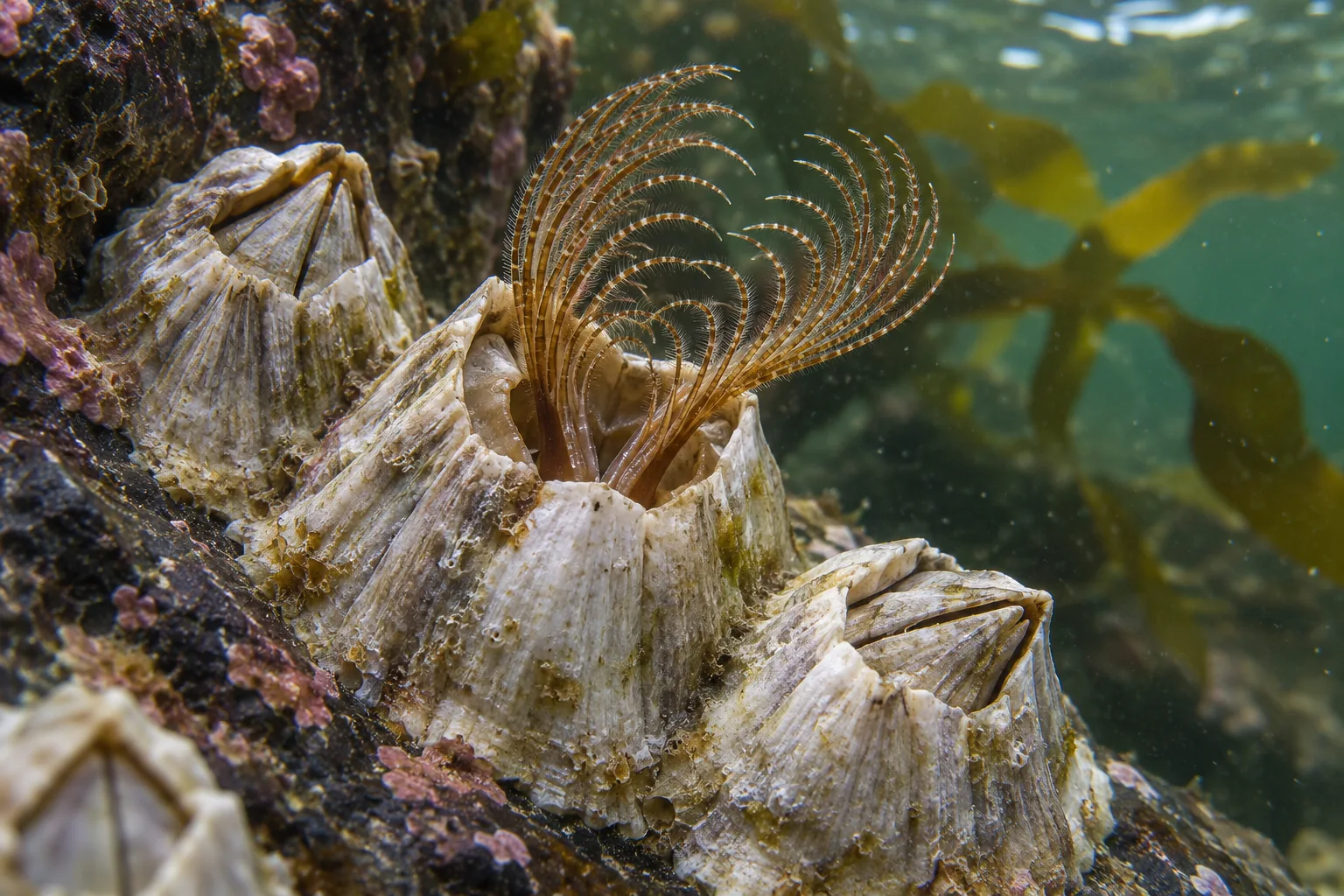
At low tide an acorn barnacle looks like a small, pale volcano with a lid. Submerge the same rock and a jointed fan may reach out of the opening, sweep through the water and fold back inside. The fan is made of modified legs called cirri. Adult acorn barnacles stay fastened to the rock, but those legs can intercept plankton and other suspended food, then deliver the catch toward the mouth. On a shell no bigger than a fingernail, the movement can be easier to spot than the animal making it. [1, 2]
A crustacean hidden inside a shell
The hard cone often earns barnacles a place beside limpets in a beachcomber’s mental catalogue. Their relatives include crabs and shrimp. Look inside the opening of a feeding animal and the kinship makes more sense. Its appendages have joints, and pairs of limbs perform different jobs. The plates around the body provide shelter while movable plates at the top control access to the water. A closed animal conceals nearly all of the features that identify it as a crustacean. [1, 2]
The change between tides explains why two visits to the same rock can give different impressions of what lives there. When the rock is uncovered, closing the opening helps an intertidal acorn barnacle retain moisture. Once water returns, the animal can expose its delicate limbs and resume feeding. The patch of shore sets a schedule for access to suspended food. A photograph of the rock at low tide records the neighbours that settled there, but it misses almost everything about the way they feed. [1]
Follow a particle from the current to the mouth
The visible fan has many fine bristles called setae. A long limb on its own would sweep past much of the material in the water. Multiple branches and bristles give small suspended particles many more opportunities to touch the feeding apparatus. Work on the bay barnacle Amphibalanus improvisus distinguishes the long rear cirri that form the collecting fan from the shorter front pairs involved in handling captured material. The particle still has a journey to make after it meets the fan. [2]
Picture the sequence from a plankton animal’s point of view. First the surrounding water must carry it within reach. Next it has to encounter a bristle or become enclosed as the limbs gather. Finally it must stay with the apparatus long enough to be transferred to the barnacle’s mouthparts. A particle that passes through a gap, swings around the outside of the fan or slips away during withdrawal has had a different fate, even though an observer might see the very same sweep of the legs. [2, 3]
One especially revealing experiment followed copepods, small crustaceans that can detect disturbances in the water and dart away. In observations of Balanus crenatus, many of the successful captures approached from the sides through regions where the water was relatively little disturbed. Copepods approaching from behind often escaped. The paths around the fan mattered as much as the position of its rim. A prey animal could be close enough to touch the barnacle and still get enough warning to avoid becoming a meal. [3]
When the water does some of the work
In quieter water an acorn barnacle can beat its cirri and create a feeding current of its own. Researchers have studied those movements by following small particles in water around the animal. By comparing successive particle positions they can distinguish water moving toward the opening from water leaving the region. Watching the cirri alone shows where the limbs go. Watching the surrounding particles reveals which water the limbs actually sample. [3, 4]
A stronger outside current offers another opportunity. Some acorn barnacles can extend the fan into the flow and let the passing water deliver particles to it. That still calls for movement to orient the limbs, collect the catch and take it inside. In wave-washed places the approach direction and speed of the water also change. An open fan held into a current and a repeatedly beating fan can both belong to a feeding animal. Counting beats alone would miss the difference between the two feeding modes. [2, 4]
Consider two identical fans exposed for one second. If the water at the first is nearly still, the barnacle needs some way of bringing fresh particles within reach. If water moves steadily past the second, many different parcels may cross its collecting area in that second. Doubling the current would double the volume crossing an imaginary fixed opening of the same size in uniform flow. A real barnacle is more complicated. Its flexible limbs change shape, and the fraction of passing particles actually captured can change too.
Even the length of the feeding legs can vary
Experiments on acorn barnacles have linked water movement during growth with differences in the length of the cirri. In the range of conditions addressed by this research, specimens in faster water commonly had shorter feeding appendages. Researchers have also explored where this flexibility reaches a limit on wave-exposed shores. A longer reach has a potential advantage in slow water, while a long structure held out in fast flow also presents a mechanical burden. The resulting shape records more than the identity of the species. [5]
That longer-term response is separate from what you can see in one feeding session. Closing the plates as water drains away takes no change in leg length. Turning the fan into a current changes how it is used on that tide. Differences that develop as the animal grows change what it has available to use. Seeing two barnacles a few centimetres apart in one still photograph cannot tell you the full history of either animal’s exposure to moving water.
How a stationary feeder found its rock
An adult’s address began with a mobile stage. Acorn barnacles develop as larvae in the water before a settling stage, the cyprid, explores a surface and attaches. The animal then changes into the juvenile form that resembles a small adult. The permanent attachment that looks so limiting on a dry rock makes more sense underwater. A favourable site can bring a stream of moving food past one spot again and again. [1]
In an aquarium close-up or a tide-pool video, follow just one opening through several cycles. Watch where the fan points, whether it pauses outside and where it folds out of sight. Those three observations reveal an animal gathering a meal, even though the rim of its shell never shifts against the rock.
Keep exploring
A sea sponge brings food-bearing water inside its body. A scallop can move its whole shell through the water. Compare two other ways of making a living on the seafloor.
Sources and further reading
Aquarium observations describe the life cycle. Anatomical work and feeding experiments explain how individual cirri and the water around them contribute to capture.
- Monterey Bay Aquarium — Acorn barnacle natural history
- Journal of Morphology — Functional morphology of cirri in the barnacle Amphibalanus improvisus
- Maar and colleagues — The fluid dynamics of barnacle feeding
- Stamhuis and colleagues — Particle image velocimetry and the feeding currents of small aquatic organisms
- Biological Bulletin — Limits to phenotypic plasticity and flow effects on barnacle feeding appendages
Keep exploring.
One remarkable idea at a time—nature, science, history and beyond.
Last updated November 18, 2026.

Barnakle Editorial Team
Barnakle Editorial Team is the collective byline used for Barnakle’s editorial articles. The contributor profile explains the team identity and links to the publication’s editorial policies.
More from the editorial team →