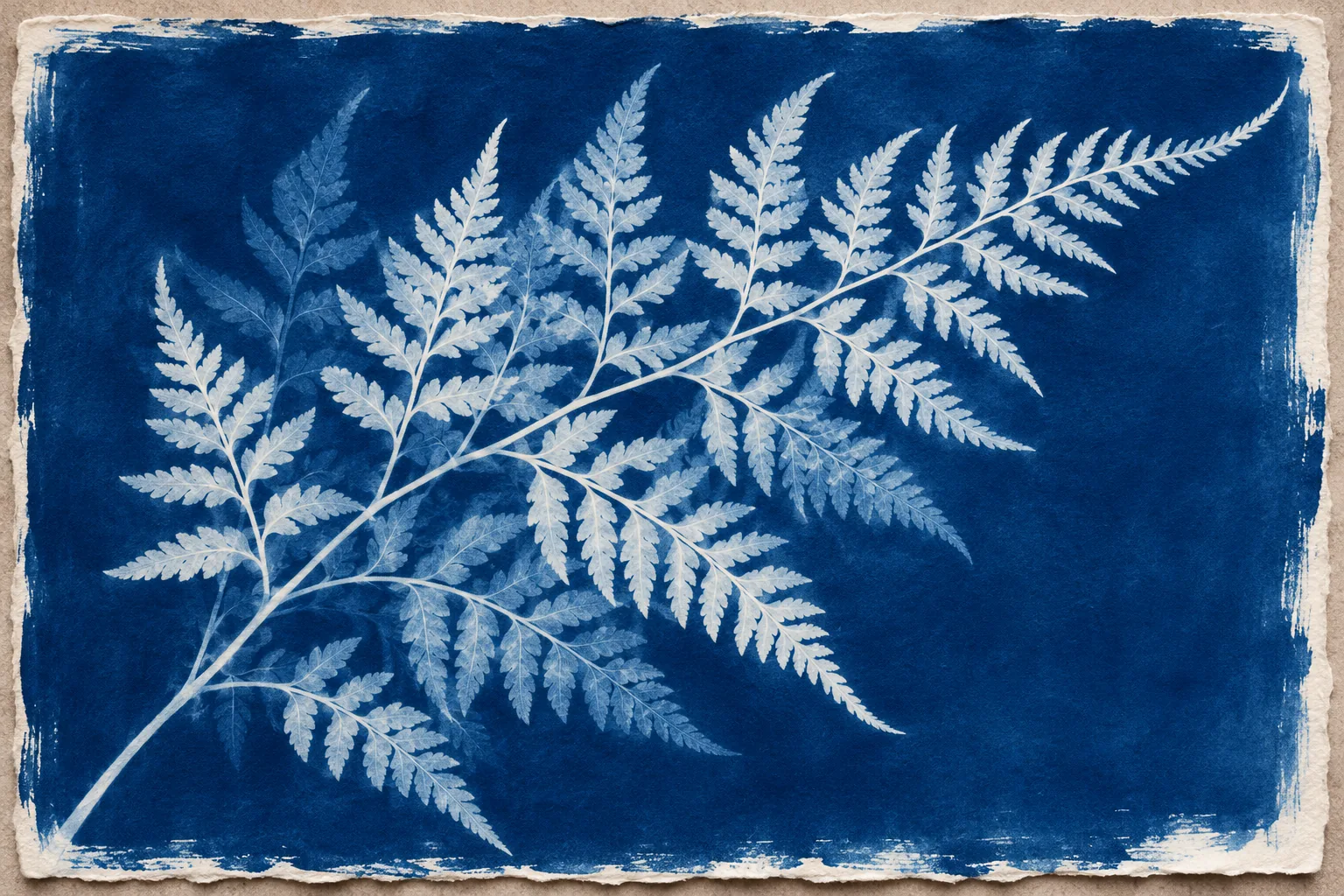
On a botanical cyanotype, the blue usually marks the places where the plant was absent. Light fell on an iron-based coating there and started a chemical change that produced Prussian blue. Under an opaque leaf, the paper received too little light for that blue to form. Washing carried away soluble material and revealed the pale shape. The finely divided branches of a fern can produce a remarkably detailed image without a lens, a camera or an artist tracing their outline. [1, 2]
The blue belongs to the print
Look closely at the edge of a traditional cyanotype. A brush mark outside the image may be just as blue as the background around the leaf. That patch is a clue to the origin of the colour. The paper was coated to make it sensitive to light. In the classic process the coating contains ferric ammonium citrate and potassium ferricyanide. Light changes the chemical state of some of the iron in the sensitized area. The subsequent reactions produce an insoluble blue iron compound in the sheet. [1, 3]
The original plant could have been green, red or brown. A viewer looking only at its finished silhouette cannot recover those colours. Instead, the sheet records how much of the relevant light reached each location. A thin part of a specimen can transmit some light, and a gap between two branches can admit it freely. A specimen with very little colour contrast to the human eye can therefore make a print with sharply different tones. Conversely, two strikingly different leaves can make almost identical outlines. [1, 2]
Contact changes the edge of the image
A print made by placing an object over a light-sensitive surface is called a photogram. There is no lens projecting a miniature image onto the sheet. The specimen itself intercepts the light. A flat frond in close contact can produce a pale shape close to its actual size. If a curled leaflet stands away from the sheet, light arriving from different directions can reach beneath its edge. There may be a gradual transition through blue in place of a crisp boundary. [2, 4]
You can reason through a complicated specimen without knowing anything more about the chemistry. Suppose two slender, opaque stems cross over each other. At the crossing they still only block the light once as far as the paper is concerned. The print can show an uninterrupted pale junction with little evidence of which stem lay on top. Two translucent parts might instead leave a paler overlap because together they blocked more light than either did alone. The record is wonderfully precise about some things and silent about others.
The same logic explains an apparent reversal along the edge of a fern. Pale teeth projecting from the silhouette can mark the tips of the leaflets. Fine blue lines cutting back into it can mark the open spaces between adjacent tips. Following the blue shapes as carefully as the white ones often reveals the structure more clearly than trying to read the whole frond as a single flat emblem.
Why washing is part of making the picture
After exposure, the sheet still holds soluble substances in the spaces that received little light. A water wash removes those materials. The insoluble image material remains, and oxidation helps bring out the characteristic deeper blue. That sequence matters because a freshly exposed sheet can look quite different from the washed, dried print. A partly changed coating and a finished pigment have different optical properties even where the exposure was exactly the same. [1, 3]
This is a different kind of image from blue ink covering the area around a white drawing. With a cyanotype, local exposure determines where the pigment develops. Consider an uncoated margin and an opaque shape laid on a coated part of the sheet. Both areas can look almost like bare paper in the finished print. In the margin there was never any sensitive coating. Under the shape there was a coating, but light was withheld and soluble material washed out. Similar-looking marks can record two quite different parts of the printer’s work. [1]
Why a botanist chose this process for seaweed
Anna Atkins began issuing Photographs of British Algae: Cyanotype Impressions in 1843. A seaweed specimen can have a branching structure so delicate that tracing every fork by hand is slow, and a tiny change in the drawing can alter its appearance. Atkins could arrange the specimen on a sensitized sheet and let the branching object define its own outline. Copies of the book contain actual photographic prints. The Natural History Museum and Kew both describe how she used the new process to document botanical material. [2, 4]
That apparent directness still involved judgment. Spread the branches apart and a reader can follow where they divide. Let them overlap and some of the same information disappears. Choose a thick specimen and much of its centre becomes a solid silhouette. Choose a fine one and light can describe a network of internal detail. The print preserved an arrangement made for the page. It could not, by itself, show how the specimen moved underwater or which side of a branch faced the light in its original habitat.
From a plant outline to a builder’s blueprint
The object controlling the exposure can also be a drawing on a translucent support. Dark ink lines block light while the surrounding sheet admits it. On traditional cyanotype paper the result is pale lines against a blue field. That reversal accounts for the distinctive appearance of an old engineering blueprint. Place a photographic negative against sensitized paper instead, and its transparent and dense areas can supply a much wider range of image tones. [1, 3, 5]
The next time you see a cyanotype, pick one small gap in the subject and follow it into the surrounding blue. That little mark tells you that light could reach the sheet there. Then look at the palest part of the subject and ask what might have shielded it. Read that way, a cyanotype is a map of the light that reached a particular sheet of paper during a particular exposure. Its blue can outlast the delicate specimen that shaped it.
Keep exploring
Explore how researchers identify historical pigments and how a photocopier uses a pattern of light to reproduce a page.
Sources and further reading
Museum collections document the photographic process and Atkins’s botanical work. The chemistry resource explains how the exposed coating becomes a blue image.
- Science and Media Museum — Introduction to the cyanotype process
- Natural History Museum, London — Anna Atkins’s cyanotypes and the first book of photographs
- Royal Society of Chemistry — Making and using blueprint paper
- Royal Botanic Gardens, Kew — Cyanotypes and the origins of photography
- The Museum of Modern Art — Cyanotype
Keep exploring.
One remarkable idea at a time—nature, science, history and beyond.
Last updated November 18, 2026.

Barnakle Editorial Team
Barnakle Editorial Team is the collective byline used for Barnakle’s editorial articles. The contributor profile explains the team identity and links to the publication’s editorial policies.
More from the editorial team →