A kaleidoscope can turn a single piece of red glass into a ring of red petals. There is still only one red piece at the end of the tube. Two angled mirrors give its light several different paths to your eye. You see the piece directly, see it once in either mirror, and see reflections of those reflections. If the mirrors enclose an angle that fits neatly around a circle, the different views meet to form a symmetrical design. Turning the instrument changes what sits between the mirrors while keeping the rule that repeats it. [1, 2]
The design begins in one small wedge
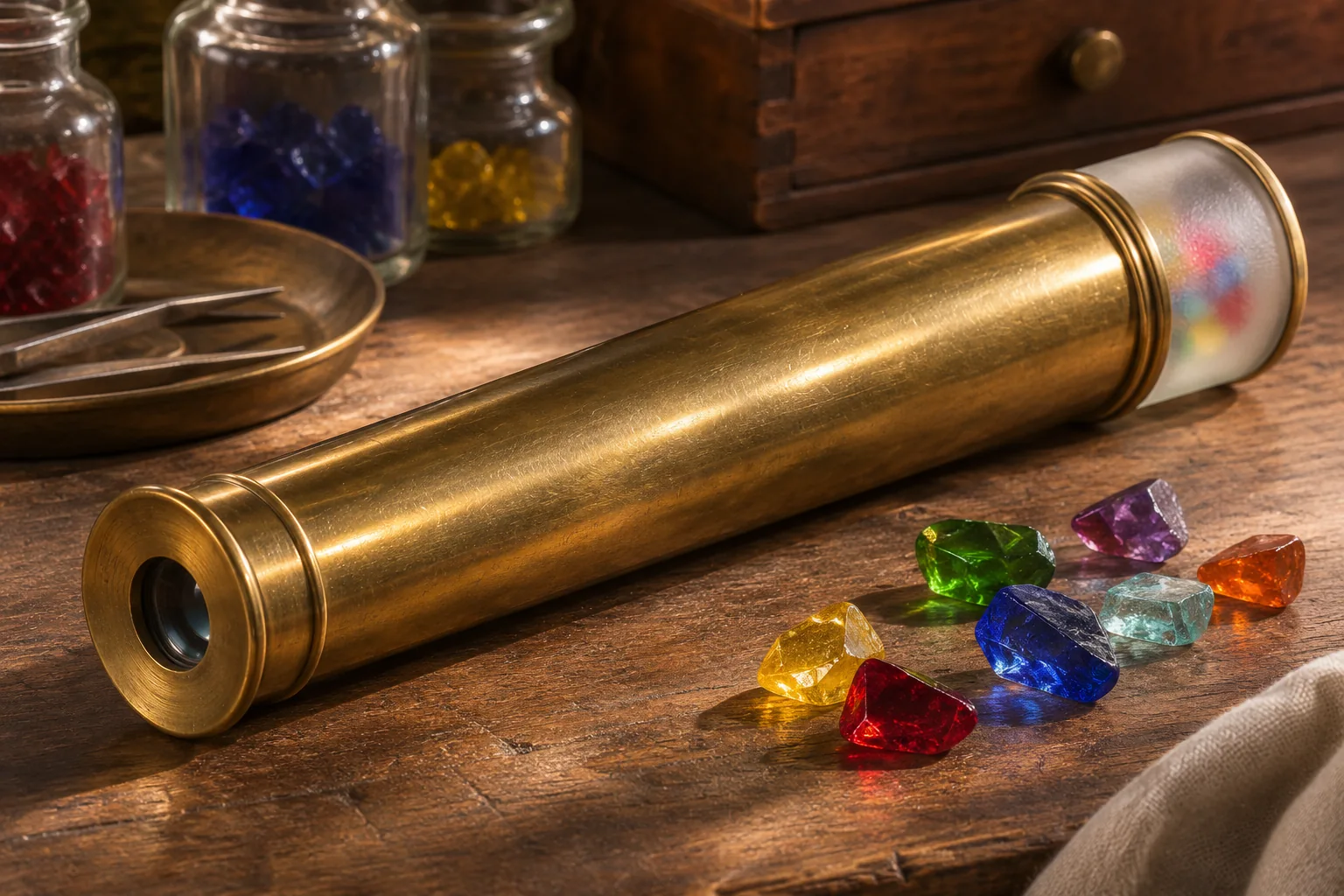
In a traditional object-cell kaleidoscope, the far end contains small pieces of coloured glass or other material. Light entering that end illuminates them. The eye looks along the mirrors from the opposite end. The real arrangement fills only a wedge of the picture. Each neighbouring wedge appears to hold another set of coloured pieces, but those apparent sets have no weight and take up no space in the object chamber. Moving one real piece can rearrange every one of its copies at once. [1, 3]
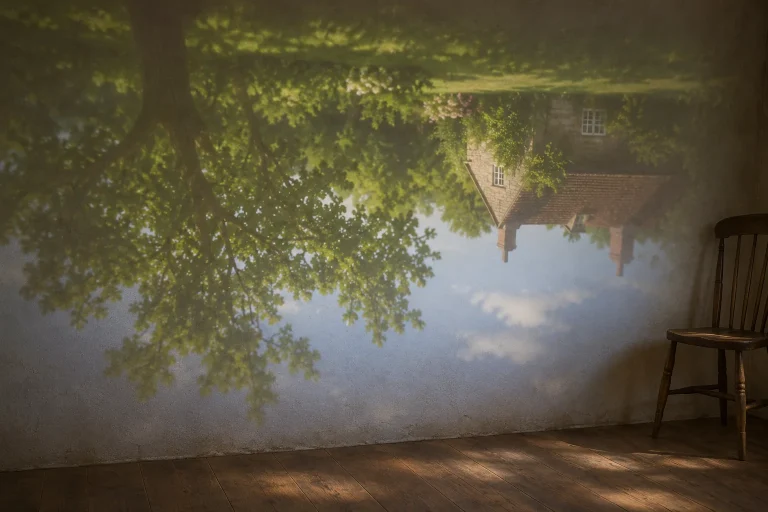
It helps to start with a single mirror and a dot. Light can travel from the dot to the mirror and then to your eye. Your visual system traces the final part of that path back in a straight line, placing the apparent dot behind the mirror. Now add a second mirror at an angle. Some light from the dot can reflect from both surfaces before reaching you. Its apparent starting point lies in yet another direction. The mirrors need only reflect the arriving light according to their actual positions to create a whole family of virtual images. [1, 2]
Why the mirror angle sets the pattern
Picture two mirrors that enclose an angle of 60 degrees. Treat the space between them as one slice of a round pie. Six such slices fill 360 degrees. In a suitable two-mirror instrument you see the original sector and five reflected sectors completing the circle. A 45-degree wedge instead fits eight times. The University of Wisconsin’s Ingersoll Physics Museum uses a 45-degree pair in its kaleidoscope exhibit, giving visitors a particularly clear example of that division of a full turn. [1, 2]
Counting sectors is easier if you choose a mark that lies well away from both edges. A bead sitting exactly on an edge may seem to merge with its image. A round spot placed near the centre of the view could be hard to distinguish from another spot. Neither case changes the geometry. A lopsided chip, such as a small red triangle with one chipped corner, makes the repeated sector boundaries much easier to follow.
There is a subtle point about which copies are truly identical. Across one mirror line, the chip and its image have opposite handedness. Across the next boundary, another reflection reverses it again. In the 60-degree example, compare sector one with sector three. Their orientations agree after a rotation of 120 degrees. Neighbouring sectors can look like two impressive petals yet point their chipped corners in opposite directions. Counting six visible slices does not necessarily mean an arbitrary design looks identical after every 60-degree turn. [2]
What changes when you turn the tube
A turn can make loose pieces in the cell slide under gravity, tumble over each other or settle into a new arrangement. The mirrors reproduce those changes throughout the field simultaneously. A blue fragment that uncovers a yellow one in one sector uncovers it everywhere you see the pair. That is why a small click or shift in the cell can make a much larger design seem to blossom all at once. The mirrors have not changed their angle in the process. [1, 3]
Imagine fixing every piece in place first. Turning the entire tube could rotate the whole pattern relative to the room, but the red chip would keep the same neighbours. Now imagine holding the mirrors steady while rotating just the cell. With loose pieces, both their orientation and their positions relative to the mirror edges can change. Looking for a pair of chips that separate or exchange neighbours is a way to tell a rearrangement from the mere rotation of an otherwise fixed image.
The cell does not even need to contain several colours. Clear and opaque pieces can make a pattern from bright and dark patches, and a single strongly coloured fragment can supply colour to every sector. The geometry repeats whatever light comes through the original wedge. It does not choose which colours go well together or create distinct colours for the individual copies. [1, 2]
Why different kaleidoscopes give different views
Two mirrors and a dark third side are a convenient way to frame one central rosette. Other instruments arrange three reflecting surfaces in a triangle. In a suitable three-mirror design, repeated images extend beyond the first cluster and fill the view with a tiled pattern. How closely the reflecting surfaces meet, their angle and what the eye can see through the opening all affect the result. The simple count for a two-mirror rosette cannot by itself describe every three-mirror field. [2]
The Science Museum Group preserves a nineteenth-century instrument identified as Brewster’s Patent Kaleidoscope. The Smithsonian also holds an example of this optical instrument. A look at the outside of a surviving tube offers a different puzzle from looking through it. The small physical opening has to deliver all the rays that seem to come from a much larger decorated field. The width of the object cell alone would give a poor estimate of how expansive the image appears to its viewer. [3, 4]
If you get a chance to look through one, try to identify the smallest wedge from which you could reconstruct the design. Find one distinctive fragment, trace its neighbours across a seam and see where its original orientation returns. After the next turn its neighbours may have changed completely. The angle at which its reflected copies meet will still be the signature of the mirrors inside.
Keep exploring
Explore what one mirror does to a reflected scene, then see how light passes through the glass used in the instrument.
Sources and further reading
- University of Wisconsin–Madison, Ingersoll Wonders of Physics Museum — Kaleidoscope
- Brewster Kaleidoscope Society — Angle analysis in kaleidoscopes
- Science Museum Group Collection — Brewster’s Patent Kaleidoscope
- Smithsonian National Museum of American History — Kaleidoscope
Keep exploring.
One remarkable idea at a time—nature, science, history and beyond.
Last updated November 19, 2026.

Barnakle Editorial Team
Barnakle Editorial Team is the collective byline used for Barnakle’s editorial articles. The contributor profile explains the team identity and links to the publication’s editorial policies.
More from the editorial team →