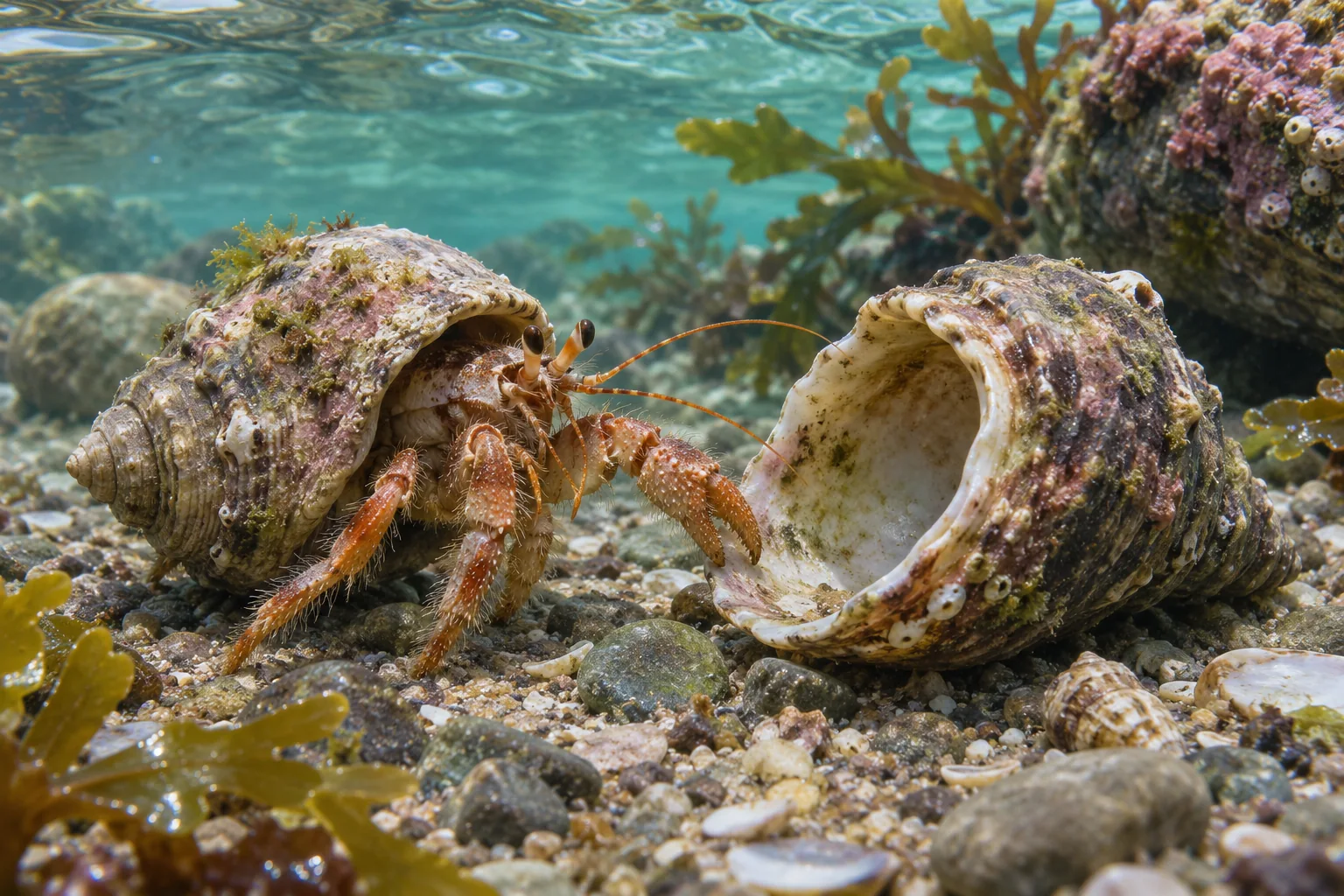
Two empty snail shells sit next to a hermit crab. One looks enormous and impressive from above. The other has a modest opening and sits comfortably upright. If you had to guess which one the crab would choose, there is a third shell you would want to see first. How well does the one it already occupies fit? In experiments, the condition of a crab’s current shelter changed how quickly and thoroughly it investigated the next one.[2]
A typical shell-carrying hermit crab has a hard front end and a more vulnerable curved abdomen. A discarded gastropod shell provides a spiral cavity into which that abdomen fits. The crab carries the shelter wherever it walks. A snail can add material to its own shell as it grows. The next size up for a hermit crab has to come from somewhere in its surroundings.[1]
Finding the next shell
An observer looking down into clear water can pick out a familiar spiral outline. Down among pebbles and seaweed, the animal has different clues. A shell-shaped object may be partly buried, occupied by a living snail or already moving around on another crab. There is a difference between detecting a promising object and finding a home that is actually available.
Researchers studying crabs on a natural rocky shore investigated the contributions of sight, chemical cues and the activity of other crabs. Their results showed that a shell’s appearance alone gave an incomplete account of what the animals recognized in the field. When visual and chemical shell cues were available together, the crabs were better able to use the opportunity. The bustle around a potential shell can also supply information to animals nearby.[5]
That gives a gathering of crabs more than one possible explanation. Several animals may be responding to the same cue. One may have noticed what others are doing. A crowd around a shell demonstrates interest in the site. Only by tracking individual animals before and after the encounter can an observer tell who found a shell, who merely looked and who eventually switched.
What can a crab learn before moving in?
Susan Neil and Robert Elwood offered common hermit crabs, Pagurus bernhardus, shells with the entrances blocked. At first it sounds like an odd experiment. The animals could never complete a move. That restriction let the researchers measure the decision to investigate separately from the outcome of getting inside. They could time an approach, record contact and compare the attention each crab gave an object.[2]
Animals already living in poor shells approached the alternatives sooner and explored them for longer. The quality of the offered shell mattered too. An undersized option generally received less investigation than a favourable one, even though both entrances were blocked. A crab could learn enough from its encounter with a shell to change its behaviour before it had ever occupied the interior.[2]
Picture two animals of similar size encountering the same vacancy in turn. The first already fits neatly into its shell. The second has long since outgrown its shelter. The value of spending another minute inspecting the opening is different for each one. A comparison that recorded only the dimensions of the offered shell would miss half of what the animals were responding to.
The biggest shell carries a cost
A shell has internal volume, weight and a balance point. Those properties often change together in nature. A large shell usually has more room and more material to carry. Two shells of the same outside length can also have different internal shapes. A scientist trying to explain a preference has to find a way to vary one property while keeping the others as similar as possible.[3]
A study of Pagurus pollicaris did that by comparing shells with added weight. Even with an increase of about a quarter, the crabs continued to occupy shells of similar size and volume in that experiment. Yet alterations that changed a shell’s centre of gravity or the angle of its axis could make it less attractive. The result helps explain why weighing a set of empty shells cannot by itself predict which will be occupied.[3]
Consider carrying a full shopping bag close to your side, then carrying it at the end of an outstretched arm. The mass stays the same, but the load turns your body differently. A shell presents a similar mechanical question on a much smaller scale. Where its weight sits relative to the walking legs matters as well as how much weight there is. Different crab and snail species offer different combinations of body shape and shell geometry.[1, 3]
How one vacancy can reach several crabs
A new shell can change the options for animals that could never fit inside it. Imagine a large crab moving into an empty shell. The shell it leaves fits a medium crab. After the medium crab moves, its old home fits a smaller neighbour. Three animals have switched, although only one additional shell entered the group. Biologists call this sequence a vacancy chain. The thing that passes from animal to animal is the opportunity to occupy an empty shelter.[4]
In work on the land hermit crab Coenobita clypeatus, researchers observed chains in different social settings. Some transfers occurred while several animals were gathered. A series can also unfold over time, as a shell abandoned by one animal is found later by another. The striking lineup seen in some descriptions is one form the process can take. The connection between successive vacancies is what defines the chain.[4]
What to look for in a tide pool
A crab approaching a shell, a crab inspecting it and a crab leaving in it are three different observations. Watch which shell moves away, how long the animal stays beside the opening and whether another crab later occupies the vacated shell. A short encounter can end with the original shell still firmly in use. That outcome is just as informative as a dramatic exchange.
It also pays to keep the species and setting in view. A marine experiment that isolates the weight of a shell answers a different question from a field study of several land crabs sharing a patch of habitat. Together they reveal why a shell can spend an afternoon untouched and then suddenly set several neighbours in motion. Its dimensions stayed the same. What changed was which animal found it and what that animal had to give up.
Keep exploring
For two other crustacean adaptations, see how a crab walks sideways and how a barnacle feeds from a fixed position.
Sources and further reading
- Smithsonian’s National Zoo — Striped hermit crab
- Neil and Elwood — Factors Influencing Shell Investigation in the Hermit Crab
- Conover — The importance of various shell characteristics to the shell-selection behavior of hermit crabs
- Society for Integrative and Comparative Biology — Vacancy chains in terrestrial hermit crabs
- Journal of Experimental Marine Biology and Ecology — Hermit crabs use vision, olfaction, and eavesdropping to detect potentially available gastropod shells
Keep exploring.
One remarkable idea at a time—nature, science, history and beyond.
Last updated November 19, 2026.

Barnakle Editorial Team
Barnakle Editorial Team is the collective byline used for Barnakle’s editorial articles. The contributor profile explains the team identity and links to the publication’s editorial policies.
More from the editorial team →