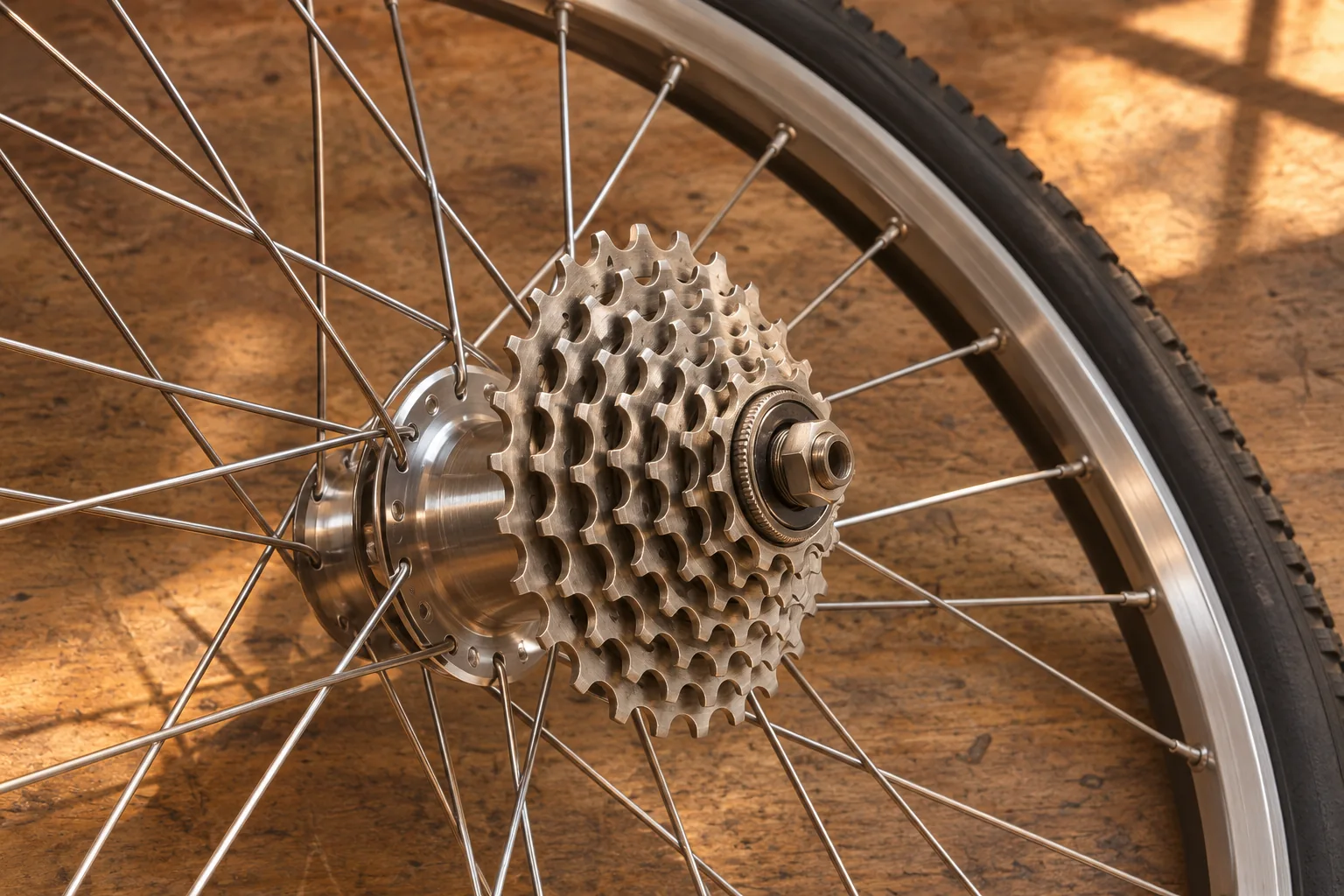
Watch a cyclist crest a hill. The cranks settle level, the chain stops moving and the rear wheel keeps turning. On many bikes a ticking sound begins just as the pedalling ends. The part responsible sits near the middle of the rear wheel. It is a one-way clutch that transmits a forward push from the sprockets to the wheel while letting the wheel run ahead of them.[1]
To follow the changeover, keep track of three things. The axle locates the wheel in the frame. The hub shell turns with the spokes and rim. The rear sprockets turn when the chain pulls them. The hub shell and the sprockets can turn at the same speed under power or at different speeds while coasting. The clutch determines when those two rotating assemblies have to travel together.[1, 2]
The instant you stop pedalling
While you are driving the bike forward, force travels from a pedal through the crank, front chainring and chain to the selected rear sprocket. The engaged clutch transmits torque to the hub shell. The spokes carry that torque to the rim and tyre. When the pedals stop, the bicycle still has forward speed. As the tyre rolls along the road, the hub shell keeps rotating with the wheel.
The sprockets would have to drag the chain around to keep pace. The clutch permits relative motion in precisely this situation. Now the spokes can blur past while the chain remains still. The same thing can happen with your feet still turning. If you pedal too slowly to catch the speed the rear wheel is already doing in that gear, the clutch can continue to overrun. Pedal motion alone does not guarantee drive.[1, 2]
That distinction is easy to feel at the bottom of a descent. In a low gear you might turn the cranks quite quickly with little resistance. Change to a taller ratio and the same cadence asks the sprocket assembly to turn faster. Once it catches the wheel and the clutch seats, pressure returns to the pedals. You have altered the relationship between wheel speed and cadence without changing anything inside the clutch.[2, 3]
Where the clicking comes from
A common hub uses small spring-loaded catches called pawls. A pawl bears against the steep face of a tooth in a toothed ring when the sprockets drive the wheel. That contact resists further movement between the parts in the driving direction. During coasting, the relative motion reverses. The sloping backs of successive teeth push the catches aside, and the springs bring them back toward the next spaces.[1]
Each little movement can produce a tick. Fast relative motion compresses a succession of ticks into the buzz familiar from a passing road bike. With the wheel rotating at the same speed, the pattern can sound slower if the rider gently turns the cranks and reduces the speed difference across the clutch. Where the sound comes from is easier to understand once you listen for the difference between wheel motion and sprocket motion.
Other designs use two toothed rings facing each other. The teeth around their faces can meet to drive the wheel. As one side overruns the other, the shapes of the teeth and the spring loading allow them to move apart and pass. DT Swiss illustrates this arrangement in its ratchet systems. It serves the same purpose as a set of pawls, so an audible freewheeling sound alone does not establish exactly which mechanism is inside.[4]
What happens in the first fraction of a pedal stroke?
Suppose a hub has 36 equally spaced points at which the two sides can engage. A complete turn spans 360 degrees, so the spacing is ten degrees at the hub. If the parts happen to be almost lined up when the rider starts to apply power, they meet after very little movement. If they have just passed a mating position, the parts can travel nearly the full ten degrees before they catch.[3]
This angle is measured between the freehub body and hub shell. It need not equal the angle your foot moves. Imagine a stationary wheel and an ideal taut chain running between a 32-tooth chainring and a 16-tooth sprocket. Turning the crank through five degrees turns the rear sprocket through ten degrees. Use a 32-tooth sprocket with the same chainring and the same ten-degree rear movement now takes ten degrees at the crank. The mechanical spacing inside the hub stayed exactly the same.[3]
The short interval is particularly easy to feel when restarting on a climb or advancing the pedals through small arcs. At steady speed under continuous power, the mating faces are already pressed together. They do not stop transmitting torque and wait for another tooth every few degrees. A count of engagement positions tells you about the transition from coasting to drive, not how many separate pushes you get during a loaded revolution.
Freewheel, freehub and cassette
Two bicycles that coast in the same way can package the parts differently. A traditional screw-on freewheel carries the ratcheting mechanism and rear cogs together in an assembly threaded onto the hub. On a common cassette system the sprockets fit onto a freehub body, often secured by a lockring. Remove that cassette and the ratcheting body remains with the hub. The distinction matters when identifying parts even though the experience of coasting can feel much the same.[2]
The bearings have another job. They support rotating parts and allow smooth relative movement. A bearing by itself does not decide when a forward push on the sprockets should drive the wheel. Conversely, teeth that lock together under load still need rotating parts that are supported and aligned. The ability to spin freely on the axle and the ability to coast with stationary pedals come from different features of the assembly.[1]
Why a track bike feels different
On a fixed-gear track bike the rear sprocket is fixed to the wheel’s rotation. The moving wheel therefore keeps the chain moving, and the chain keeps the cranks turning. A single-speed bike with a freewheel can have just as few gear choices while letting its rider hold both feet still. Counting sprockets tells you the available ratios. The coupling at the rear determines whether you can coast.[5]
Return to the rider cresting the hill. At the moment the pedals settle level, the tyre still follows the road, the spokes still follow the tyre and the chain stays with the pedals. All that changed was which side of a small hidden coupling was trying to get ahead. When the sprockets next catch up and push, the same parts will carry the rider’s effort all the way back to the road.
Keep exploring
Trace how gear ratios change pedalling effort and how bearings let rotating parts move past one another.
Sources and further reading
- Park Tool — Freehub Service
- Park Tool — Determining Cassette or Freewheel Type
- DT Swiss — Engagement Angle Technology
- DT Swiss — Ratchet DEG Technology
- Calgary Bicycle Track League — Track Info
Keep exploring.
One remarkable idea at a time—nature, science, history and beyond.
Last updated November 19, 2026.

Barnakle Editorial Team
Barnakle Editorial Team is the collective byline used for Barnakle’s editorial articles. The contributor profile explains the team identity and links to the publication’s editorial policies.
More from the editorial team →