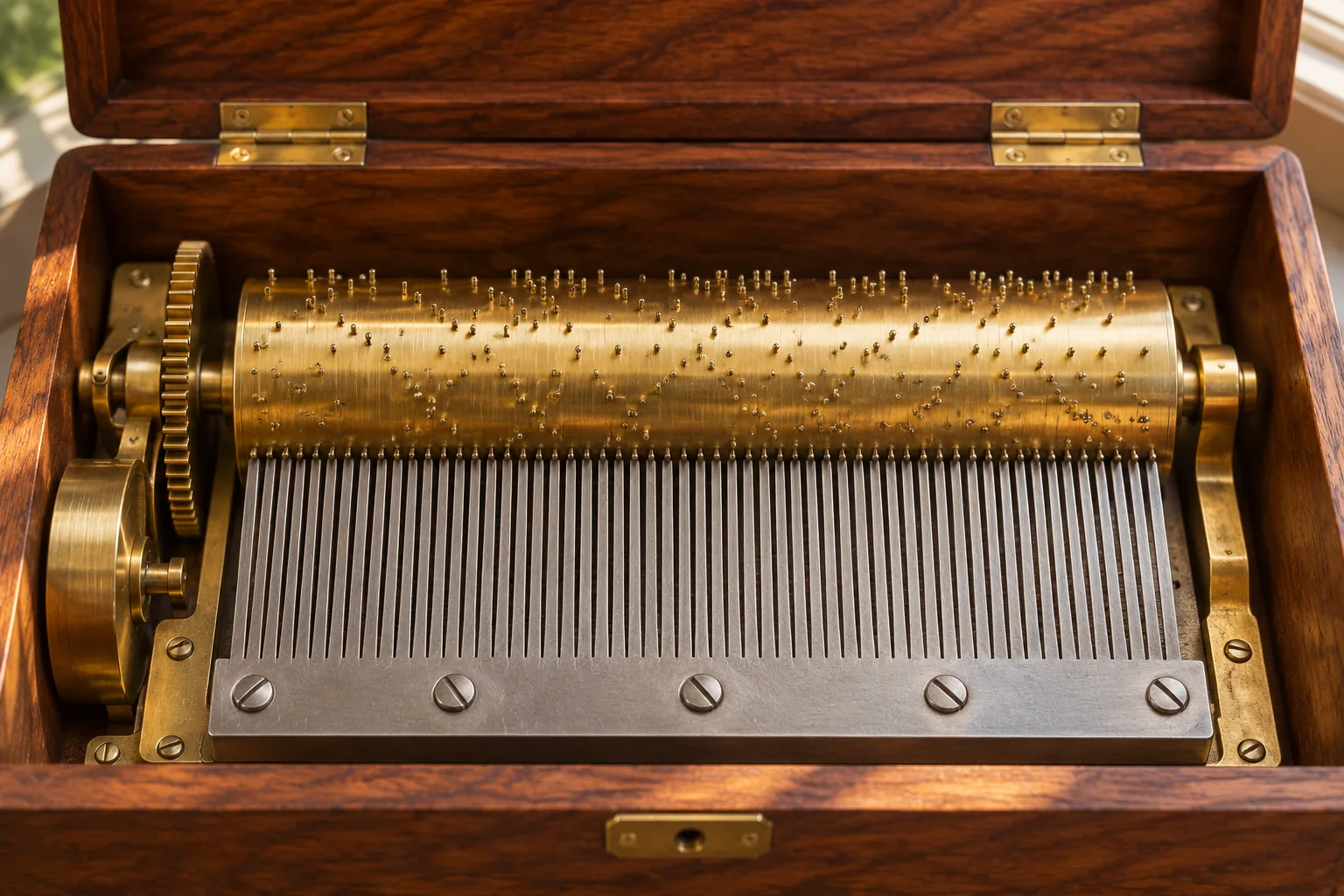
Inside a Swiss music box in the Smithsonian collection, one steel comb has 43 teeth and a single cylinder carries eight tunes. No musician has to select the notes as the box plays. A spring turns the mechanism, and a pattern of metal pins plucks the teeth in a fixed order. You can understand almost everything about the tune by asking where the next pin sits relative to the last one.[1, 3]
Look along the cylinder from end to end. A pin’s position in that direction determines which tooth it reaches. Look around the circumference instead. The distance between one row of pins and the next determines how far the cylinder must turn before another note sounds. These two directions give an arranger a way to write pitch and timing into a solid object.[1, 2]
The part you wind and the part you hear
Winding the mechanism stores energy in its mainspring. As the spring unwinds, gears transfer motion to the cylinder. A speed-regulating mechanism called a governor keeps the drive moving at a suitable pace. Nidec, a maker of music-box movements, describes a governor that uses a fast-spinning part and friction to control the spring-driven motion. The comparatively sedate movement of the pin cylinder is the result the listener hears as tempo.[2]
When one pin reaches its tooth, it pushes the free end aside. As the cylinder turns a little farther, the pin passes and the tooth springs free. The metal bends back and forth around its resting position many times before the sound dies away. The pin needs only one pass to start that vibration. The pitch comes from how fast the released tooth vibrates, a property set when the comb is made and tuned.[1, 2]
There are consequently two quite different rates at work. One might be a few note attacks per second, the pace at which pins release teeth in a lively passage. The other is the much faster vibration of a single tooth during each note. Slow the cylinder and the tune unfolds more slowly. A given tooth still has essentially the same natural pitch. A clockwork change of pace can stretch the tune without having to retune the comb.[1, 2]
Unroll the cylinder in your imagination
Picture a paper wrapper around the brass cylinder. Mark a dot wherever a pin pierces it and open the wrapper flat. A row running across its width represents a particular instant in the rotation. A column running around the original circumference belongs to one position along the row of teeth. Read down the page at a steady rate and the dots form a kind of score.
Place two dots side by side on the same row and they reach two teeth at the same moment. The notes can sound together. Place two dots in the same column on different rows and the same tooth is plucked twice. An empty row gives a moment when no new tooth is struck, although a note from a previous row may still be ringing. The difference between starting a sound and ending it matters to anyone arranging music for a plucked comb.
Take a simplified cylinder that turns once in twelve seconds. Two pins a quarter turn apart reach their respective teeth three seconds apart. Move the second pin to an eighth of a turn after the first and the interval becomes one and a half seconds. Moving that pin along the cylinder’s axis to a neighbouring tooth changes which pitch sounds while leaving the time gap alone. The real mechanism packs many more decisions into the same small surface.
How can one cylinder carry several tunes?
A glance at an antique movement can give the impression that virtually the entire surface is busy with pins. Yet the teeth of the comb occupy particular positions, with spaces between them. A maker can put several interleaved sets of pins on a cylinder and arrange for only one set to line up with the working tips at any given setting.[3, 4]
At a tune change, the cylinder shifts a short distance along its axis. Pins that passed harmlessly beside the teeth on the previous turn now line up with them. The pins for the old tune travel past unused. The American Watchmakers-Clockmakers Institute describes a change mechanism in which a stepped cam positions the cylinder. Each change selects a different set of instructions for the same comb.[4]
Think of drawing several versions of the paper score on transparent sheets and sliding them sideways by slightly different amounts. Only the dots directly opposite the teeth would count. The challenge for the maker is to leave enough clearance for every inactive pin while bringing each active pin close enough to pluck cleanly. This helps explain how the Smithsonian’s eight-tune box could play such a varied programme within a case less than forty centimetres wide.[3]
Why a small comb can fill a room with sound
One steel tooth moves a small amount of air on its own. The comb is fastened to a supporting structure, so some vibration travels into the frame and surrounding surfaces. These can move more air and affect which parts of the sound reach a listener strongly. The choice of case and mounting affects the character and audibility of a note even when the pattern of pins remains exactly the same.[2]
A quiet pause in the music gives the ear time to separate these effects. Listen to the start of the final note and then to its tail. The start marks the release of a tooth. The fading tail comes from energy already present in the vibrating metal and its support. The cylinder can move into a stretch with no more pins for a time, yet the box can still be audible.
What the box preserves of a performance
Museum Speelklok traces early cylinder movements into small objects such as clocks and snuffboxes. For an owner, lifting a lid could bring back a familiar arrangement with remarkably consistent timing. The pins stored the instructions and the comb supplied the sound afresh at every playing. The maker’s decisions included which pitches to provide, where to put the silences and which notes could ring together.[1]
That separation suggests a way to listen to a box whose mechanism you cannot see. Tap the rhythm at which the notes begin. Then hum one of the notes after it has started. The tapping follows the pins around the cylinder. The hum follows one vibrating tooth. Between those two observations you have identified the moving score and the instrument that reads it.
Keep exploring
Compare the vibrating strings in an acoustic piano and the physical instructions stored on a Jacquard loom’s punched cards.
Sources and further reading
- Museum Speelklok — Musical boxes
- Nidec Instruments — Structure of the cylinder music box
- Smithsonian National Museum of American History — Cylinder Music Box, 1982.0011.01
- American Watchmakers-Clockmakers Institute — Music Box Clocks
Keep exploring.
We’ll email you when the first edition is ready.
Last updated November 25, 2026.

Barnakle Editorial Team
Barnakle Editorial Team is the collective byline used for Barnakle’s editorial articles. The contributor profile explains the team identity and links to the publication’s editorial policies.
More from the editorial team →