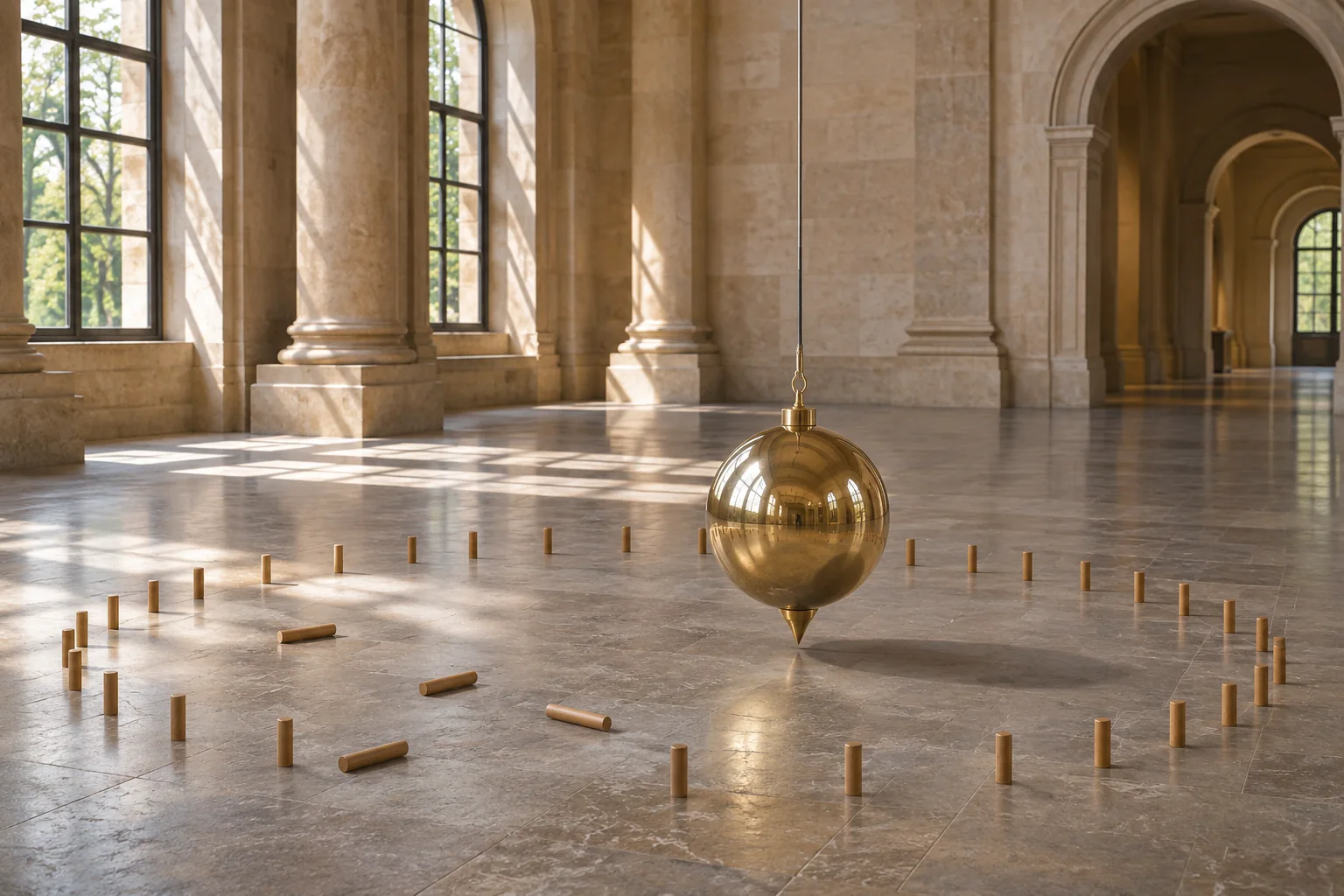
Stand beside a museum pendulum for half a minute and it seems to trace the same straight path again and again. Come back after lunch and the bob may have knocked down a peg that was well clear of it in the morning. The small change between successive swings has accumulated. A Foucault pendulum makes the rotation of Earth visible by comparing a freely swinging weight with a set of marks fastened to the floor.[1, 2]
The bob has two quite different motions worth timing. One is its familiar trip out and back, which takes seconds. The other is the slow change in the direction of that swing as judged from the room. That change takes hours to become conspicuous. Its rate depends on latitude, so copies of the same instrument in different cities need not knock down equally spaced pegs at the same intervals.[1, 2]
Begin with a museum at the North Pole
Imagine a pendulum suspended directly above the North Pole and a line painted on the floor beneath its starting path. The bob is free to swing in any horizontal direction. Gravity pulls it downward and the suspension keeps it travelling along an arc, but an ideal suspension has no preference for swinging toward the door or toward a particular wall. As time passes, the building and its painted line rotate with Earth.[2, 3]
Viewed from overhead, the north polar floor turns counterclockwise relative to the distant stars. Follow the floor around with your eyes and the pendulum’s line appears to turn clockwise relative to you. After about a quarter of a rotation of Earth, a floor mark that began along the swing lies across it. The polar example is especially simple because the local vertical and the planet’s spin axis line up.
An ordinary playground swing would make a poor replacement. Its two chains and crossbar favour one direction, and the frame turns with the ground. A museum pendulum uses a suspension that allows the direction to change freely relative to the building. The point of support travels with the ceiling. What matters is that the support avoids steering the bob around with the orientation of the surrounding walls.[1, 3]
Why the turn takes longer away from a pole
Put a pencil upright on a globe at the North Pole. The pencil points along the spin axis. Move it to the equator, keeping it perpendicular to the local surface, and it points sideways relative to that axis. Between those two places it makes an intermediate angle. For a Foucault pendulum, the part of Earth’s rotation about that local vertical sets the rate at which the swing direction changes against the floor.[2]
The size of that part is given by the sine of the latitude. At a pole it has its full value. At latitude 30 degrees the sine is one half, giving about half the polar turning rate. At the equator the value is zero. Earth still spins there, and the ground is moving rapidly through space. Its spin simply has no component about the local vertical at that location. Move into the Southern Hemisphere and the observed direction of turning reverses.[2]
For a numerical picture, Earth makes a turn relative to the stars in about 23 hours and 56 minutes. Using 24 hours for an estimate gives a polar rate close to 15 degrees per hour. A pendulum at 30 degrees latitude then turns at about 7.5 degrees per hour relative to the ground. A marked end of its swing direction would take roughly 48 hours to complete a 360-degree circuit there.[2]
At Toronto’s approximate latitude of 44 degrees north, the same calculation gives about 10.4 degrees per hour. Paris, near 49 degrees north, gives about 11.3. During a two-hour museum visit that difference amounts to less than two degrees, but after many hours it becomes easier to distinguish. The estimates refer to ideal instruments and rounded city latitudes. An exhibit’s own peg spacing is a separate choice.
What fallen pegs actually measure
A peg is a memory aid. After the bob moves on, the fallen peg marks a direction the swing reached earlier. Put pegs six degrees apart at a place where the swing line advances around twelve degrees per hour, and a newly reached peg on one end of the path would be expected about every half hour. The bob might have made hundreds of trips through the middle in that interval. The number of swings and the number of fallen pegs measure different things.
A straight swing also has two ends. If all you record is the undirected line, then a line at zero degrees looks identical to one at 180 degrees. To follow the customary full precession period, imagine marking one end of the direction arrow and following it continuously through a complete turn. When comparing photographs of an exhibit, use the same side of the display and a fixed feature of the floor as references. Otherwise it is easy to lose track of half a turn.
The Franklin Institute describes its exhibit starting along a north–south direction and progressing through a ring of pegs. Griffith Observatory in Los Angeles uses a long cable and a bronze bob, with a magnet near the suspension that supplies a small tug to sustain the swing. Without a means of replacing lost energy, air resistance and friction would gradually shorten the arc until the bob could miss a peg simply because it no longer reached it.[1, 4]
Why the magnet does not set the latitude
A well-adjusted drive restores the energy lost from the back-and-forth swing. A sideways push would introduce unwanted motion and complicate the measurement. This distinction matters when watching a working exhibit. A large arc makes the next peg easier to reach, but increasing the swing amplitude is a different operation from deliberately rotating the line along which the bob travels.[1, 2]
Léon Foucault demonstrated the effect in France in 1851. The enduring appeal of the experiment is that someone inside a building can see evidence of the planet’s motion without having to wait for a star to cross the sky. The floor carries a reference that rotates with the observer. The swing supplies a direction that can be compared with it. Even the unremarkable interval between two fallen pegs contains a little information about where on Earth the room was built.[2, 4]
Keep exploring
Compare the night sky’s record of Earth’s rotation with the motion of a spinning skater.
- Why Do Stars Leave Curved Trails in Photos?
- Why Do Figure Skaters Spin Faster When They Pull Their Arms In?
Sources and further reading
- Griffith Observatory — Foucault Pendulum
- Spanish National Geographic Institute — Royal Observatory of Madrid, Science, History and Heritage
- University of Wisconsin–Madison, Ingersoll Museum — Foucault Pendulum Model
- The Franklin Institute — Foucault’s Pendulum
Keep exploring.
One remarkable idea at a time—nature, science, history and beyond.
Last updated November 19, 2026.

Barnakle Editorial Team
Barnakle Editorial Team is the collective byline used for Barnakle’s editorial articles. The contributor profile explains the team identity and links to the publication’s editorial policies.
More from the editorial team →