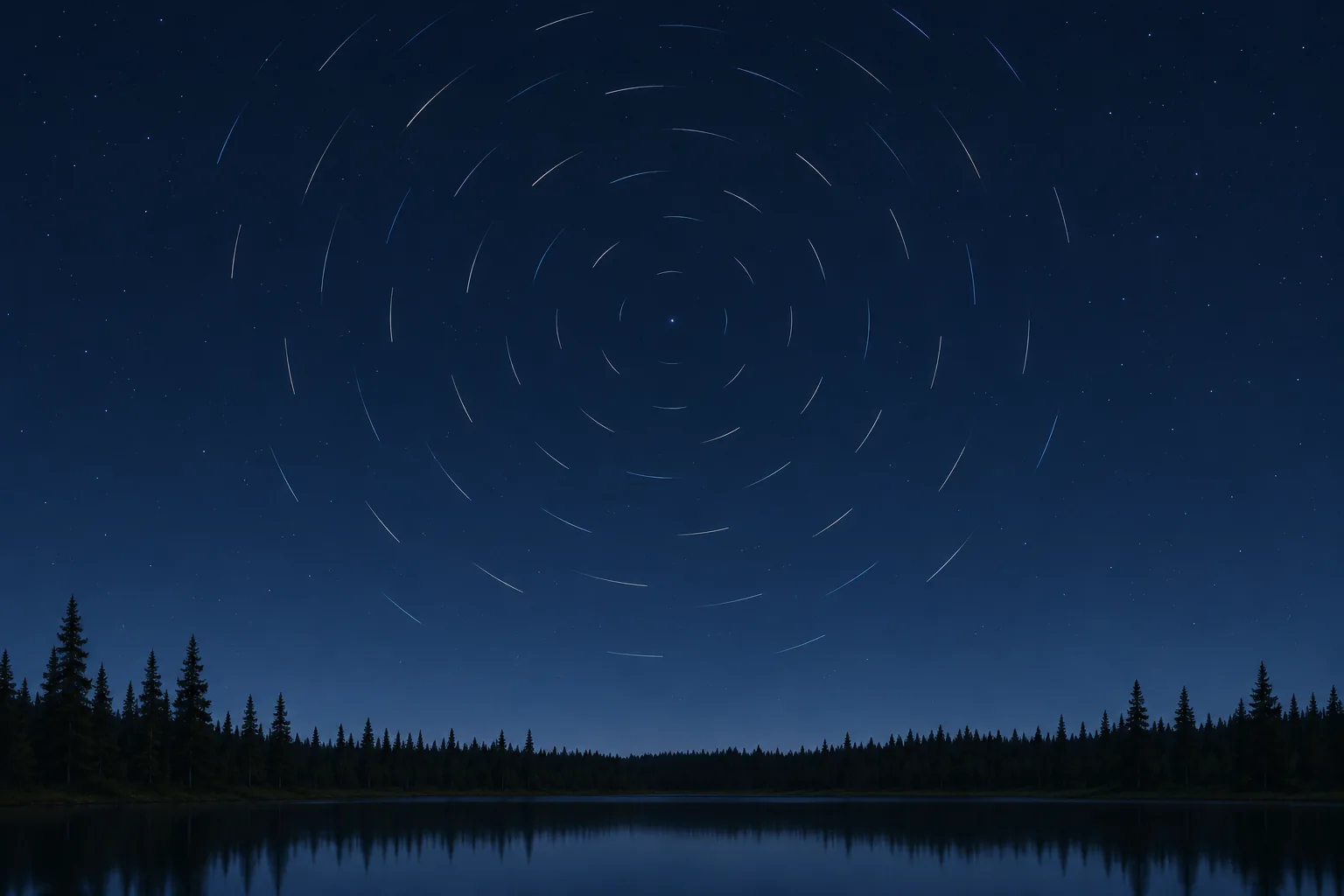
A star can draw a long arc across a photograph without appreciably changing its position relative to its neighbours. The camera is turning with Earth. Leave it pointed at the same patch of sky from a fixed tripod and a star’s light lands on a succession of different pixels. A short exposure records what looks like a point. A long exposure adds those positions together into a trail. Aim toward a celestial pole and a whole field of stars draws arcs around the same centre. [1, 2]
Find the axis that never appears in the picture
Picture an imaginary line running through Earth’s North and South poles. Extend both ends far into space. The two directions it picks out on the sky are the celestial poles. As Earth rotates, a camera attached to the ground turns around that axis. From behind the camera the landscape looks steady and the stars appear to swing around the pole instead. A star very close to that direction has only a tiny circle to trace. One farther from it follows a wider circle in the same time. [1, 2]
This gives you a clue that a single bright streak cannot provide. Imagine placing tracing paper over a photograph with many trails. On two clear arcs, mark their halfway points and draw lines through those points perpendicular to the local direction of the trails. In a view centred on the pole with little lens distortion, the lines should point toward the same centre. You could estimate where the axis meets the sky even if there were no conspicuous star at that precise spot.
In the north, Polaris lies near the north celestial pole and makes a convenient landmark. It is slightly off the axis, so a sufficiently detailed exposure can give Polaris itself a little trail. The southern sky offers a lovely test of the geometry. A photograph from the Anglo-Australian Telescope in New South Wales shows streams of light wrapped around a centre with no bright pole star to pick it out. The arcs locate the south celestial pole all by themselves. [3]
Why one trail can be longer than the next
Think of two marks on a clock face, one near the hub and one near the rim, both turning through the same angle. The outer mark travels farther. Stars around the pole behave similarly in an image. Two trails can have the same sweep around the centre but very different lengths in pixels. This makes measuring the angle around the pole much more informative than measuring the length of a line with a ruler. [1, 4]
Here is one way to read the clock. Earth turns once relative to the distant stars in about 23 hours and 56 minutes, giving a rotation rate close to 15 degrees per hour. A continuous two-hour recording therefore covers about 30 degrees around the pole. In a pole-centred photograph that is roughly one twelfth of a circle. A short arc near the centre and a long one out toward the edge can both represent those very same two hours. [4]
The distinction between that period and a 24-hour solar day has a physical cause. While Earth turns on its axis, it also advances in its orbit around the Sun. After one rotation relative to the stars, Earth has a little farther to turn before the Sun returns to the same local meridian. The difference amounts to roughly four minutes per day. It helps explain why a familiar star pattern appears a little earlier by the clock from one clear evening to the next. [2, 4]
What changes when you turn away from the pole
A set of tight concentric arcs is only one possible view. If a camera looks east or west, the relevant centre of rotation may lie well outside the picture. A short part of a large circle can look nearly straight. Changing the direction of the lens changes which segment you see. Changing the lens or cropping the image can also change the apparent curvature on the page. The underlying rotation stays the same. [1, 2]
Latitude changes your vantage point. At the equator the celestial poles lie on the horizon, while at the geographic North Pole the north celestial pole is overhead. At about 45 degrees north latitude, a level observer looking north sees it about 45 degrees above the ideal horizon. A local mountain or a steep roofline can hide part of that angle. If you try to infer latitude from a photograph, the chosen horizon line and the camera’s tilt matter just as much as locating the centre of the arcs. [1, 2]
How many exposures went into the trail?
One long exposure can record the whole path. A photographer can also combine a sequence of shorter frames made from the same fixed position, keeping the bright stellar marks from each one. With very small gaps in time, the pieces can join into nearly continuous lines. A longer pause between frames can leave a repeated gap in every trail. A tree, observatory dome or roofline provides a fixed foreground against which to read the result. [1, 3]
Suppose a camera makes a one-minute exposure and then waits a minute before recording the next. Over an hour it samples about half the available positions. The angle between the first and last recorded points still reflects almost an hour of rotation. The sum of the illuminated segments represents only the time the shutter was open. This matters if you want to use a sequence to measure Earth’s rotation. The elapsed time between the ends is the clock to compare with the whole sweep. [4]
You can also give the camera a different reference frame. A tracking mount turns the camera to follow the stars, allowing faint astronomical objects to stay on much the same pixels. In that arrangement a fixed object on the ground starts to drift across the picture instead. A star-trail photograph asks the opposite of the equipment. Keep the camera steady with respect to the landscape, give the sky time, and the common centre of the trails reveals which way the planet is turning its observer. [1, 2]
Keep exploring
Compare another change in the appearance of stars with a daytime way of telling time from Earth’s rotation.
Sources and further reading
The observatory activity explains how to measure a trail angle, and the southern-sky example shows a pole without a bright star at its centre.
- International Astronomical Union, Office of Astronomy for Education — Star trail
- British Astronomical Association — The turning sky
- NASA Astronomy Picture of the Day — Star Trails in Southern Skies
- Royal Observatory Greenwich — Using star trails to measure the sidereal day
Keep exploring.
One remarkable idea at a time—nature, science, history and beyond.
Last updated November 18, 2026.

Barnakle Editorial Team
Barnakle Editorial Team is the collective byline used for Barnakle’s editorial articles. The contributor profile explains the team identity and links to the publication’s editorial policies.
More from the editorial team →